Insurance Industry Growth Rate Projected at 2.3% Next Year... Down 5.1 Percentage Points from This Year
Total Earned Premiums Expected to Reach 265 Trillion Won in 2025
Life Insurers to Face Tougher Conditions Than Non-Life Insurers
There are projections that next year's insurance industry growth rate will shrink to about one-third of this year's level. Due to the effects of low growth, low interest rates, and increased uncertainty in the financial markets, a significant decline in profitability is expected to begin in earnest next year.
The Korea Insurance Research Institute held a seminar titled "2026 Insurance Industry Outlook and Challenges" at the Conrad Hotel in Yeouido, Seoul, on the 21st. The event was attended by Ahn Chulkyung, President of the Korea Insurance Research Institute, Kim Cheolju, Chairman of the Korea Life Insurance Association, Lee Byungrae, Chairman of the General Insurance Association of Korea, as well as more than 100 CEOs and executives from insurance companies.
The Korea Insurance Research Institute predicted that, based on premiums, the insurance industry growth rate for next year will be only 2.3%. This is a decrease of 5.1 percentage points compared to this year's projection of 7.4%. As a result, the total insurance premium volume for next year is expected to be about 265 trillion won.
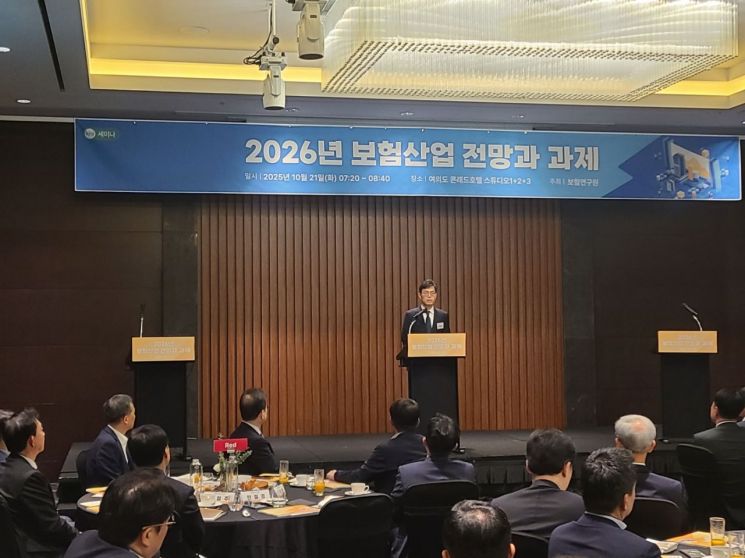 Ahn Chul-kyung, President of the Korea Insurance Research Institute, is speaking as a presenter at the seminar "2026 Insurance Industry Outlook and Challenges" held on the 21st at the Conrad Hotel in Yeouido, Seoul. Photo by Choi Donghyun
The outlook also varies by sector. Life insurance companies' premium income is expected to grow by only 1% compared to this year. While protection-type insurance is expected to continue growing, savings-type and variable insurance are projected to stagnate. For non-life insurance companies, premium income is expected to increase by 3.5% compared to this year. However, due to sluggish long-term and auto insurance, the growth rate is not expected to be significantly higher than this year.
Under the International Financial Reporting Standards (IFRS 17) regime, the Contractual Service Margin (CSM), a key performance indicator for insurers, is expected to see its growth rate slow starting next year. The CSM for life insurers next year is projected to be 64.3 trillion won, about 400 billion won less than this year's estimate of 64.7 trillion won. In contrast, the CSM for non-life insurers is expected to reach 71.8 trillion won next year, an increase of 1.5 trillion won compared to this year's estimate of 70.3 trillion won.
The capital adequacy ratio for insurers, known as the K-Insurance Capital Standard (K-ICS), is also expected to decline slightly next year compared to this year. Hwang Inchang, Head of the Financial Market Analysis Division at the Korea Insurance Research Institute, said, "Unfavorable conditions such as falling interest rates, rising lapse rates, and higher loss ratios will negatively impact insurers' K-ICS. The importance of managing required capital will grow, and there will be significant differences in K-ICS fluctuations among companies."
The Korea Insurance Research Institute anticipates that the decline in profitability for the insurance industry will begin in earnest next year. The impacts of low growth and low interest rates are expected to affect insurers' soundness, profitability, and growth in that order. There are concerns that if soundness and profitability deteriorate over the mid to long term, insurers' risk coverage capacity and ability to respond to future challenges will diminish, leading to slower growth.
In response, the Korea Insurance Research Institute recommended that insurers establish separate growth strategies (A·S·A·P) based on proactive liability management, advanced asset management, and cost efficiency, as well as new government policies. A·S·A·P stands for Artificial Intelligence, Sustainability, Aging Society, and Productive Finance. These are policy tasks that insurers must address immediately in line with the national agenda of the Lee Jaemyung administration.
No Geonyeop, Head of the Financial System Research Division at the Korea Insurance Research Institute, stated, "Insurers should expand the use of artificial intelligence (AI) in business operations such as customer service and actively engage in developing products like climate insurance. It is also necessary to participate actively in productive finance by building an integrated support ecosystem for the elderly and developing insurance products based on policy fund returns."
© The Asia Business Daily(www.asiae.co.kr). All rights reserved.
![Clutching a Stolen Dior Bag, Saying "I Hate Being Poor but Real"... The Grotesque Con of a "Human Knockoff" [Slate]](https://cwcontent.asiae.co.kr/asiaresize/183/2026021902243444107_1771435474.jpg)















