Meets Australian Prime Minister: "Good Relationship with President Xi... Will Meet in South Korea"
"Ended Eight Wars... Five Were Resolved Through Tariffs"
Draws Line on Possibility of War in the Taiwan Strait: "U.S. Military Is the Strongest in the
On October 20 (local time), US President Donald Trump announced that, following South Korea, Japan, and the European Union (EU), he would also establish a fair trade agreement with China. He also dismissed the possibility of Chinese President Xi Jinping invading Taiwan, emphasizing that the United States and China would maintain a smooth relationship not only in trade but also regarding the Taiwan issue.
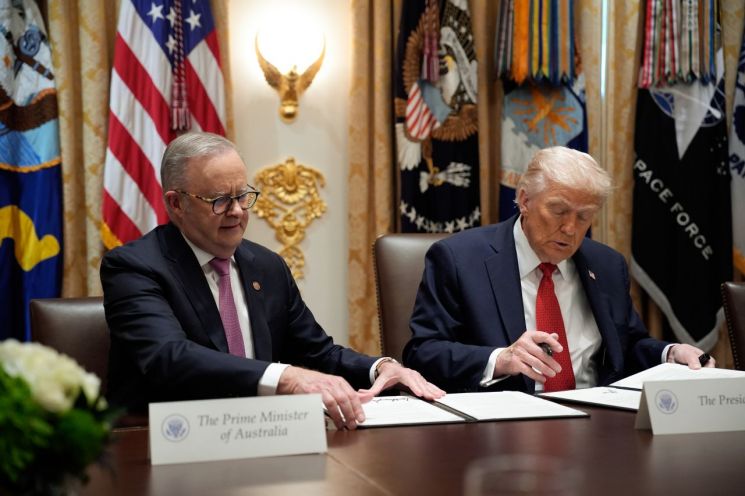 US President Donald Trump is signing a mineral agreement worth 8.5 billion dollars during a summit meeting with Australian Prime Minister Anthony Albanese at the White House on the 20th (local time). Photo by UPI
During a summit meeting with Australian Prime Minister Anthony Albanese at the White House that day, President Trump told reporters, "I have a very good relationship with President Xi, and we are scheduled to meet in South Korea in a few weeks."
This statement suggests that the US-China summit is expected to take place as planned on the sidelines of the Asia-Pacific Economic Cooperation (APEC) summit, which will be held in Gyeongju, South Korea, at the end of this month. Amid rising concerns over renewed trade tensions due to China's tightening of rare earth exports and the US announcement of an additional 100% tariff on Chinese goods, both leaders appear to be seeking a breakthrough. In this context, US Treasury Secretary Scott Besant held a video call with Chinese Vice Premier He Lifeng on the 17th, and is expected to meet again later this week in Malaysia to coordinate differences between the two countries.
President Trump explained that while China had previously tried to take advantage of the United States like other countries, this was no longer the case.
He said, "The EU also tried to take advantage of the United States, but we established a very fair trade agreement, and we also reached fair agreements with Japan and South Korea," emphasizing, "President Xi of China will also establish a very fair agreement with us." He added, "When I leave South Korea, we will have established a very strong trade agreement, and I do not expect any conflict to occur."
However, in the case of South Korea, despite reaching a broad trade agreement at the end of July, the reduction of automobile tariffs (from 25% to 15%) has not yet been implemented due to disagreements over the terms of a $350 billion investment in the United States. As a result, the two countries are continuing last-minute negotiations.
At the same time, President Trump warned, "China is paying us a huge amount in the form of tariffs," and added, "Currently, they are paying 55%, but if we do not reach an agreement, it could be raised to 155% on November 1."
He argued that tariffs have played a significant role in resolving global disputes. President Trump said, "I resolved eight wars in eight months, and five of them were thanks to tariffs," adding, "We have always been victims of tariffs, but now we have a president who uses tariffs for national security and various reasons. We have once again become a wealthy and safe country."
In addition, regarding the possibility of President Xi invading Taiwan, President Trump drew a clear line, saying, "China does not want such a thing to happen."
He stated, "The United States is the most powerful military nation in the world and cannot even be compared to other countries. We have the best equipment and are the best in every aspect, so no one can touch us," adding, "That is why I do not believe President Xi would do such a thing." He further emphasized, "Regarding the Taiwan issue, we will get along very well. Of course, Taiwan is a very important issue for him, but I do not believe anything will happen."
Meanwhile, at the summit that day, President Trump and Prime Minister Albanese signed an agreement on critical minerals. This move is seen as an effort to diversify supply channels for critical minerals and reduce dependence on China, as China has strengthened export controls on rare earth elements targeting the United States.
© The Asia Business Daily(www.asiae.co.kr). All rights reserved.
![Clutching a Stolen Dior Bag, Saying "I Hate Being Poor but Real"... The Grotesque Con of a "Human Knockoff" [Slate]](https://cwcontent.asiae.co.kr/asiaresize/183/2026021902243444107_1771435474.jpg)















