Ruling Party: "Lee and the Next President Will Appoint the Same Number of Supreme Court Justices"
Diversifying Recommendations for Justice Selection and Judicial Evaluation Committees
Jeong Cheongrae: "The Judiciary Is Entirely Responsible for the L
On October 20, the Special Committee on Judicial Reform of the Democratic Party of Korea announced a judicial reform plan to increase the number of Supreme Court justices from the current 14 to 26, with four additional justices appointed each year for three years. The party leadership also intends to push for the institutionalization of the "judicial appeal" system, which was not discussed within the special committee. The Democratic Party has intensified its criticism of the Supreme Court and Chief Justice Cho Hee-dae, claiming that the judiciary is reaping what it has sown. However, since both the legal community and opposition parties have criticized the increase in the number of justices and the judicial appeal system as potentially unconstitutional and as measures to shield President Lee Jaemyung, clashes are expected during the legislative process.
Jeong Cheongrae, leader of the Democratic Party, announced six key agendas for judicial reform at the National Assembly in the afternoon, stating, "The judiciary must be reborn as an institution that values political neutrality above all else." The six agendas include not only the increase in Supreme Court justices proposed by the special committee, but also diversification of the composition of the Supreme Court Justice Recommendation Committee, the introduction of a judge evaluation system, expanded public access to lower court rulings, the introduction of a pre-search warrant hearing system, and the implementation of "judicial appeal against Supreme Court rulings" as a party platform.
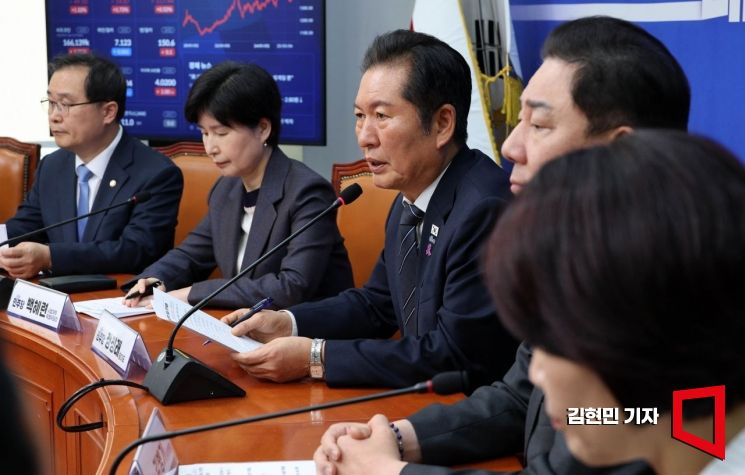 Jeong Cheongrae, leader of the Democratic Party of Korea, is speaking ahead of the announcement of the judicial reform plan by the Special Committee on Judicial Reform at the National Assembly on the 20th. 2025.10.20 Photo by Kim Hyunmin
Regarding the increase in the number of Supreme Court justices, Baek Hyeryeon, chairperson of the special committee, explained, "This bill will take effect one year after promulgation. The Supreme Court will be reorganized into six small panels and two joint panels, forming two effective en banc panels." She added, "This aims to enhance the expertise and diversity of cases and improve the quality of deliberations, thereby strengthening the protection of citizens' right to a fair trial."
The number of members on the Supreme Court Justice Recommendation Committee will be increased from 10 to 12, and the Chief Justice of the Court Administration (a Supreme Court justice) will be excluded from the committee. Instead, the Secretary-General of the Constitutional Court will be included. Previously, one non-Supreme Court judge served as a committee member, but now two judges recommended by the National Judges' Representatives Conference (one of whom must be a woman) will serve, along with one member recommended by a majority of local bar associations. Lee Geontae, Democratic Party lawmaker and secretary of the special committee, explained, "We have taken measures to ensure that the composition of the Supreme Court reflects diversity in gender, region, and experience."
The judge evaluation system will be divided into performance and competency assessments, and the composition of the Personnel Committee will change from three members recommended by the Chief Justice to one each recommended by the Chief Justice, the Judges' Conference, and the National Court Presidents' Conference. The two members previously recommended by the Korean Bar Association president will now be split: one recommended by the national bar association president and one by a local bar association. Lee emphasized, "There is a misconception that the National Assembly will have a role in recommending members, but that is not the case."
For the disclosure of lower court rulings, all cases except those that could significantly affect the outcome of a trial will be available for viewing and copying. The expanded disclosure will be retroactively applied to cases decided after August 1, 2000. Regarding the introduction of the search warrant hearing system, a provision will be added requiring the opinions of investigative agencies to be considered, as there are concerns about maintaining the speed and confidentiality of investigations.
Previously, as soon as Jeong Cheongrae became party leader, the Democratic Party established the special committee with Baek Hyeryeon as chairperson and prepared the judicial reform plan for over two months. The judicial appeal to the Constitutional Court against final Supreme Court rulings was excluded from the committee's proposal due to opposition that it would effectively create a four-tier court system, but the party leadership has declared its intention to pursue it as a party platform. Kim Gipyo, the Democratic Party lawmaker who will introduce the bill, explained that judicial appeals could be filed "when a court's ruling violates the intent of a Constitutional Court decision and infringes on fundamental rights, when fundamental rights are violated due to failure to follow constitutional and legal procedures, or when a clear violation of the Constitution or law results in an infringement of fundamental rights."
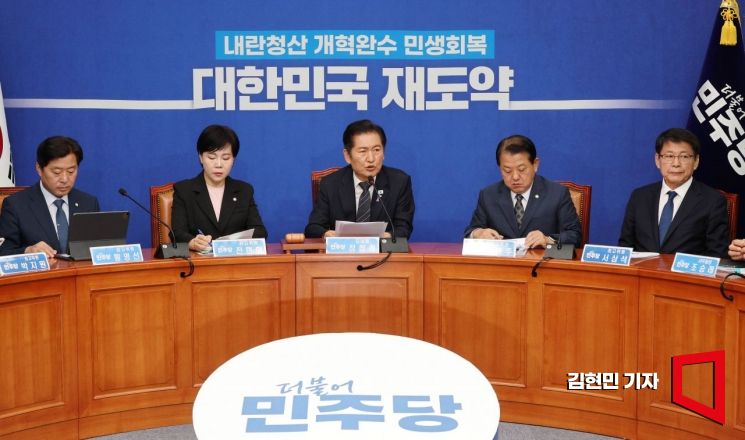 Jeong Cheong-rae, leader of the Democratic Party of Korea, is speaking at the Supreme Council meeting held at the National Assembly on October 20, 2025. Photo by Kim Hyun-min
The Democratic Party maintained its position that the responsibility for the strong judicial reform plan lies with the judiciary. Jeong Cheongrae reiterated, "The complete loss of public trust in the judiciary is entirely the judiciary's responsibility," and argued, "The judiciary, which should uphold due process and neutrality under any circumstances, has been found to have conducted hasty trials and interfered in the presidential election." He continued, "Nevertheless, Chief Justice Cho has completely refused to take the witness oath or answer questions during the National Assembly audit, and (Cheon Daeyeop) the Chief Judge of the Court Administration has been evasive and inconsistent in his statements. It is a serious hypocrisy and self-contradiction for them to judge others' legality while not abiding by the law themselves." This is interpreted as a counter to opposition claims that these moves are retaliation against the Supreme Court, which issued a full bench ruling on President Lee's violation of the Public Official Election Act in April, and against Chief Justice Cho, who was alleged to have met with former Prime Minister Han Ducksoo before the election.
They particularly emphasized that there is no political issue, as the number of Supreme Court justices that can be appointed by President Lee and the next president is the same. Chairperson Baek stated, "If you do the math, a total of 22 justices will be appointed during President Lee's term, and the next president will also appoint 22 justices," adding, "There is absolutely no room for the judiciary to be privatized or used for political purposes."
On the other hand, the People Power Party has consistently argued that the Democratic Party's push for judicial reform is an attempt by the Lee Jaemyung administration and the ruling party to seize control of the judiciary, and thus legislative passage is expected to be contentious. Choi Boyoon, chief spokesperson for the People Power Party, criticized the Democratic Party's announcement, stating, "As President Lee's judicial risks have become more pronounced, the administration's backlash is now directed at the judiciary. Although it is being called 'judicial reform,' in reality, it is a power grab to control the judiciary." He continued, "After the Chavez regime in Venezuela increased the number of Supreme Court justices from 20 to 32 and took control of the judiciary, democracy ultimately collapsed. In contrast, in the United States, the ruling party itself blocked President Theodore Roosevelt's attempt to increase the number of Supreme Court justices and protected the Constitution. The Democratic Party should reflect soberly on this difference."
© The Asia Business Daily(www.asiae.co.kr). All rights reserved.
![Clutching a Stolen Dior Bag, Saying "I Hate Being Poor but Real"... The Grotesque Con of a "Human Knockoff" [Slate]](https://cwcontent.asiae.co.kr/asiaresize/183/2026021902243444107_1771435474.jpg)
















