Prosecutors’ Revolt and Coercion Allegations Escalate to Questions of Ethics
Special Prosecutor Also Invested in Company Linked to Kim Gun-hee
Vague Explanations Only Deepen Suspicion
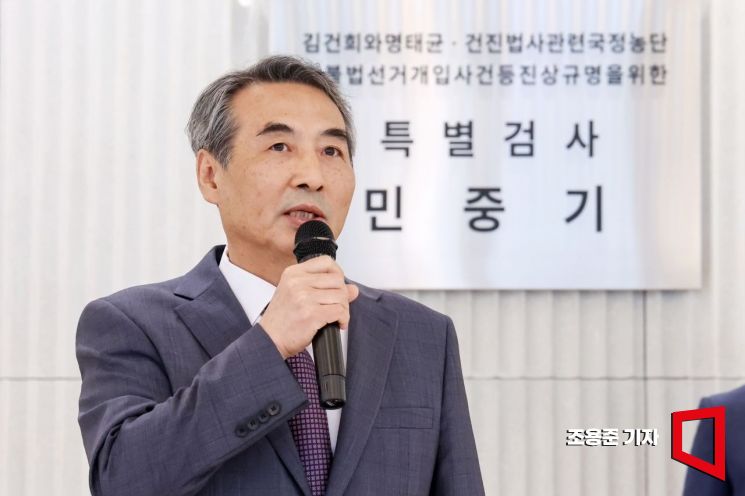 Min Joong-ki, the special prosecutor in charge of the case related to allegations against Kim Gun-hee, the wife of former President Yoon Seok-yeol, is giving a greeting speech at the plaque unveiling ceremony held on July 2 at the special prosecutor's office set up in the KT Gwanghwamun Building West in Jongno-gu, Seoul.
The special prosecutor team investigating Kim Gun-hee is facing a series of setbacks. Following incidents of protest from dispatched prosecutors and allegations of coercive investigations into Yangpyeong County officials, new suspicions have emerged that Special Prosecutor Min Joong-ki engaged in stock trading using undisclosed information, causing the team to appear increasingly unstable.
On October 20, legal circles pointed out that the legitimacy of the special prosecutor's investigation is being called into question, as it was revealed that Special Prosecutor Min also invested in a company in which Kim Gun-hee, the main subject of the investigation, had invested in the past, earning profits in excess of 100 million won. It is reported that while investigating Kim, the special prosecutor’s team also looked into matters related to the solar energy-themed stock "Neosemitech," in which Min had invested.
Records show that in 2010, Min held over 12,000 shares of Neosemitech and sold them all for approximately 130 million won. The issue lies in the timing of this sale. In August 2010, the company was delisted after accounting fraud was uncovered, resulting in losses exceeding 40 billion won for thousands of individual investors, yet Min reportedly made a profit of around 100 million won. This has led to suspicions that Min may have used undisclosed information. The controversy has intensified as it was revealed that Oh, the former CEO of Neosemitech who committed the accounting fraud, attended the same high school as Min.
Even if the process by which Min acquired unlisted shares and sold them after the company went public does not constitute a legal violation, the consensus in legal circles is that he cannot avoid questions of ethical propriety. A lawyer who formerly served as a deputy chief prosecutor stated, "If he received information about the delisting from the company’s CEO or an insider and sold his shares, that would constitute a punishable act of using undisclosed material information. However, if the information was relayed by a secondary source, it would not be subject to punishment, but merely acquiring unlisted shares in itself is enough to cast doubt on the special prosecutor's ethics."
In this context, the vague explanation provided by Special Prosecutor Min has only fueled further suspicion. The special prosecutor’s team explained, "In the early 2000s, Min invested approximately 30 to 40 million won in the company through an acquaintance who was not affiliated with the company, and sold the shares for about 130 million won around 2010 at the recommendation of a securities firm employee." However, they did not disclose who the acquaintance or the securities firm employee was, nor did they specify the exact timing of the sale.
© The Asia Business Daily(www.asiae.co.kr). All rights reserved.
![Clutching a Stolen Dior Bag, Saying "I Hate Being Poor but Real"... The Grotesque Con of a "Human Knockoff" [Slate]](https://cwcontent.asiae.co.kr/asiaresize/183/2026021902243444107_1771435474.jpg)















