Achievements of the Donghak Peasant Army Chief Training Officer in Goheung
Jeonnam Province to Consider Designating as Cultural Heritage
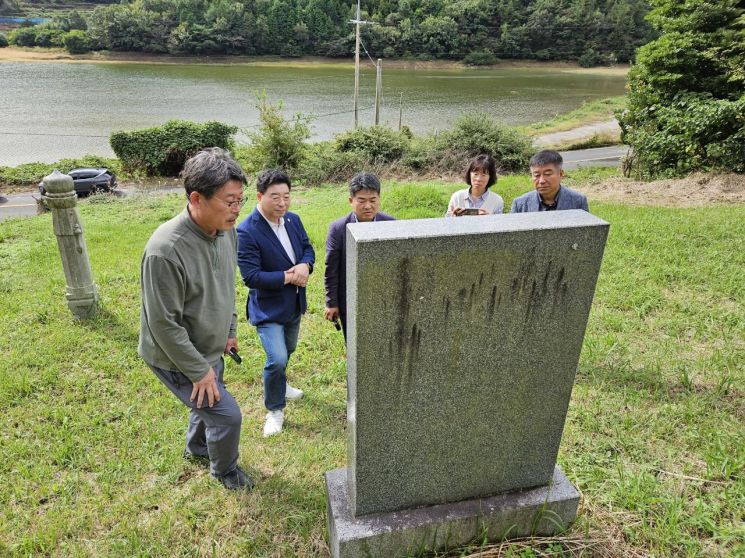
On October 17, Jeonnam Province announced that the tomb of Jeopju O Yunyoung, a leader of the Donghak Peasant Revolution, had been identified during the 'Survey on the Status of Donghak Peasant Revolution Historic Sites.'
Jeopju refers to a regional leader of Donghak who also led the Donghak Peasant Army.
Jeopju O Yunyoung served as the chief training officer at the Donghak Peasant Army training camp in Goheung during the Donghak Peasant War in 1894. With his tomb now confirmed in Bongnim-ri, Podu-myeon, Goheung-gun, it has drawn significant attention from both descendants and researchers.
The Donghak Peasant Revolution Memorial Foundation, the investigating body, conducted the final verification based on a tip from Shin Minho, a Jeonnam provincial assemblyman from Suncheon.
At the outbreak of the Donghak Peasant War, Goheung was a major stronghold for the Donghak Peasant Army, with two military training camps established at the Bongnim training ground in Podu-myeon and the Doyang training ground in Doyang-eup.
The Donghak Peasant Army in Goheung, together with the Yeongho Dohwaeso Donghak Peasant Army in Suncheon, crossed the Seomjin River and fought against the Japanese army. Donghak activities in Goheung were so active that the Japanese military even mobilized a fleet for operations in the area.
Professor Park Haehyun of Chodang University and local historian Song Hocheol emphasized that the strength of the Donghak movement in Goheung was largely due to the role of Jeopju O Yunyoung, who was the chief training officer at the Bongnim training ground in Podu-myeon.
Even today, legends about the operation of Donghak training institutions are passed down in Bongnim Village, and the achievements of Jeopju O Yunyoung are detailed in the military history of Goheung.
The tombstone of Jeopju O Yunyoung bears his other name, 'Myeongyeong.' The family registry also records 'Yunyoung' as 'Myeongyeong.' Experts have analyzed that, as repression of Donghak intensified, it was common for individuals to change their names. They believe it is highly likely that Jeopju O Yunyoung also changed his name to 'Myeongyeong.'
Recently, there have been arguments that the second Donghak Peasant Revolution should be interpreted as the origin of the Righteous Army and serve as the starting point of the independence movement. In this context, the discovery of the tomb of Jeopju O Yunyoung, a key figure in leading the Donghak movement in Goheung, is considered highly significant.
Based on the findings of the 'Survey on the Status of Donghak Peasant Revolution Historic Sites,' Jeonnam Province plans to consider designating important sites, including the tomb area of Jeopju O Yunyoung, as cultural heritage. The province also aims to ensure their permanent preservation and management, and to utilize them as cultural resources to enhance local pride.
© The Asia Business Daily(www.asiae.co.kr). All rights reserved.
![Clutching a Stolen Dior Bag, Saying "I Hate Being Poor but Real"... The Grotesque Con of a "Human Knockoff" [Slate]](https://cwcontent.asiae.co.kr/asiaresize/183/2026021902243444107_1771435474.jpg)















