3rd Innovation Forum for Realizing Pharmaceutical Bio Vision 2030
"Only by Becoming a Blockbuster Can Funds for Subsequent New Drug Development Be Secured"
"The Pharmaceutical and Bio Industry Should Be Fostered as a National Strategic Industry"
It has been assessed that the key strategies for the Korean pharmaceutical and bio industry to make a leap in the global market are the development of global blockbuster new drugs and global expansion through a nationwide strategic fostering system.
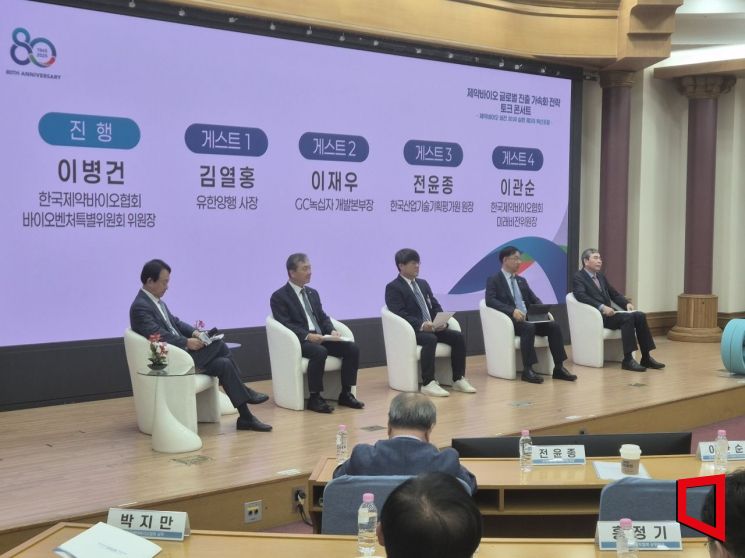 At the "Pharmaceutical Bio Vision 2030 Realization 3rd Innovation Forum: Talk Concert on Accelerating Global Expansion Strategies for the Pharmaceutical Bio Industry," held on the 17th at the National Assembly Members' Office Building, Meeting Room 1, Yeongdeungpo-gu, Seoul, panelists are discussing the future vision and concrete implementation plans for the domestic pharmaceutical and bio industry. Photo by Choi Taewon
The Korea Pharmaceutical and Bio-Pharma Manufacturers Association held the "Pharmaceutical Bio Vision 2030 Realization 3rd Innovation Forum: Talk Concert on Accelerating Global Expansion Strategies for the Pharmaceutical Bio Industry" on the 17th at the National Assembly Members' Office Building, Meeting Room 1, in Yeongdeungpo-gu, Seoul. At this event, participants discussed the future vision and concrete implementation plans for the domestic pharmaceutical and bio industry. Panelists included Kim Yeolhong, CEO of Yuhan Corporation; Lee Jaewoo, Head of Development at GC Green Cross; Jeon Yoonjong, President of the Korea Institute for Advancement of Technology; and Lee Gwansoon, Chair of the Future Vision Committee at the Korea Pharmaceutical and Bio-Pharma Manufacturers Association.
Kim Yeolhong, CEO of Yuhan Corporation, emphasized the unique characteristics of the pharmaceutical and bio industry and suggested that global expansion through open innovation is necessary. He stated, "Global diversification is essential for the sustainable growth of the pharmaceutical and bio industry," adding, "The pharmaceutical and bio industry is not only essential for ensuring public safety but is also a matter of national security."
He further highlighted the importance of developing global blockbuster drugs. Blockbuster drugs refer to those with annual sales of 1 billion dollars (approximately 1.4 trillion won) or more. Kim explained, "Only drugs that achieve global blockbuster status can recoup the investments made so far," and added, "If a new drug fails to become a blockbuster, it is a reality that it becomes impossible to secure the resources needed to develop subsequent new drugs."
He also explained that an open innovation strategy is necessary for this. Open innovation refers to the practice of acquiring needed technologies and ideas from outside the company while also sharing internal resources or technologies externally. He noted, "Many bio ventures are quite confident in their initial development stages, but they face difficulties in subsequent strategies, especially in clinical development." He then outlined a strategy where a company with expertise like Yuhan Corporation can take over promising candidate substances from bio ventures, proceed with clinical trials, and, through partnerships with global pharmaceutical companies, turn them into blockbuster drugs.
Lee Jaewoo, Head of Development at GC Green Cross, emphasized the importance of understanding the unique regulations and market characteristics of each country when entering overseas markets. He pointed out that the U.S. market, in particular, is highly complex due to the involvement of pharmacy benefit managers (PBMs) and large wholesalers. He said, "PBMs and private insurance companies have significant influence over drug pricing and prescriptions," and added, "Even after approval, securing insurance coverage and distribution networks each present their own hurdles."
He cited pharmaceutical manufacturing and quality management as the most urgently needed capabilities to be improved. Lee explained, "These days, the concept of GMP (Good Manufacturing Practice) extends not only to the production site but throughout the entire research and development cycle," and added, "It is necessary to examine whether manufacturers are applying the GMP concept throughout the entire cycle, from the initial research laboratory stage to sales."
Jeon Yoonjong, President of the Korea Institute for Advancement of Technology, stressed the need for a national-level strategy, noting that the size of the Korean pharmaceutical and bio industry is small compared to the global market. Jeon said, "The global bio market is three to four times larger than the semiconductor market," and added, "Considering that the research and development investment and sales volume of Samsung Biologics are only about one-hundredth that of Samsung Electronics, the potential of the bio industry is significant."
He also responded to a question about whether the pharmaceutical and bio industry should be fostered as a national strategic industry by saying, "Since the government determines the quality and price of pharmaceuticals, it is only natural that the government should also take the lead in fostering the industry," emphasizing the need for aggressive expansion of R&D budgets and ensuring research autonomy.
Lee Gwansoon, Chair of the Future Vision Committee at the Korea Pharmaceutical and Bio-Pharma Manufacturers Association, analyzed the opportunities and threats facing the Korean pharmaceutical and bio industry. Lee cited an abundant new drug pipeline and big data based on universal health insurance as the industry's greatest opportunities. As threats, he pointed to the small size of companies, a lack of recognition for innovation, and issues in talent development.
As measures to realize the vision, he proposed fostering innovative blockbuster new drugs, directly entering global markets and securing marketing capabilities, and nurturing first-in-class and new modalities to differentiate from China.
© The Asia Business Daily(www.asiae.co.kr). All rights reserved.

















