'1 Trillion Won Budget, 10 Million Tourists, 100,000 Residents'... Presents the '1·1·1 Vision'
"Few Children Have Tried Abalone Porridge"... Emphasizes Innovation in Food Culture
From KTX to Park Golf Courses... Strengthening Lifestyle-Oriented SOC and Living Conditions
Woo Hongseop, former deputy governor of Jindo County, officially announced on October 17 his intention to run for Wando County governor in next year’s election and presented a concrete vision to elevate Wando into the "capital of maritime and fisheries."
In an interview with Asia Economy that day, Woo stated, "Wando must move beyond merely implementing fisheries policies and transform into a central hub that leads policy and sets new models." He added, "I will create a healthy island where residents smile and children return."
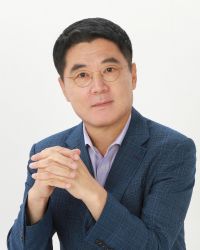 Woo Hongseop, former deputy governor of Jindo County.
He unveiled his plan to lead Wando under the "1·1·1 Vision," aiming for a budget of 1 trillion won, 10 million annual tourists, and a resident population of 100,000. Regarding abalone farming, the county’s core industry, Woo emphasized the need for structural change, stating, "Currently, the methods of the previous generation are still being used."
He argued, "Few children have ever tasted abalone porridge. We need to popularize abalone products so they can be easily prepared like instant noodles and consumed in daily life."
In fact, he mentioned new processed abalone products such as "abalone fish cake" and "abalone sweet and sour pork." Abalone fish cake, which is being sold on a trial basis at some highway rest stops, has received positive consumer feedback. At a promotional event held at the National Assembly in August, Woo personally cooked abalone sweet and sour pork and introduced it to key figures.
To stabilize the abalone industry, Woo proposed a cooperative structure among Sinan, Wando, and government agencies. He said, "Like OPEC, abalone should have a system where demand, production, and distribution are coordinated." He added, "If local governments, fisheries cooperatives, and processing companies each play their roles within a unified system, we can secure market dominance." He continued, "In this era of regional extinction, it is difficult for one area alone. It is necessary to organically connect with Haenam, Jindo, and Sinan for specific issues."
In the economic sector, he set forth more direct goals. "I will foster a company in Wando that is listed on the KOSDAQ," he said. "Although I have worked in public service for a long time, I have always approached the field with an entrepreneurial mindset." He stressed, "Wando should be redefined not as a mere administrative space, but as a place where dreams and opportunities coexist." He also stated, "We should not simply imitate other regions, but create success stories that are only possible in Wando."
Woo also introduced a strategy to link Wando’s identity with its future growth engines. This is embodied in his vision for a "Second Cheonghaejin Era." He plans to advance abalone and seaweed-centered industries while integrating marine bio and marine healing industries to develop Wando into a tourism city where visitors stay for extended periods.
In particular, he proposed a blue carbon business utilizing seaweed and a carbon credit acquisition model that combines clean energy sources such as offshore wind and solar power. He explained, "Profits generated from marine ecological assets can be returned to residents in the form of a basic income."
He also presented a roadmap to improve living conditions. "By strengthening support systems for each stage of life-such as childbirth, childcare, education, medical care, and culture-I will make Wando a place where residents want to stay," he said. He plans to enhance cultural and sports infrastructure by establishing park golf courses in each township, expanding all-day care centers, and operating Danuri Centers. Additionally, he aims to implement lifestyle-oriented SOC projects, including the construction of a new KTX Wando Station, development of a marine tourism road, and expansion of road networks connecting the 12 townships.
Born in Wando, Woo began his public service career at Wando County Office and worked in key departments such as the Maritime Affairs and Fisheries Bureau, Economic Bureau, and Welfare Bureau of South Jeolla Provincial Government. During his tenure as deputy governor of Jindo County, he achieved a record-high performance in attracting government-funded projects.
He emphasized, "I have experience in policy planning, securing budgets, and field operations in public service," adding, "I will create a successful model where all residents can be happy by fully utilizing Wando’s resources."
Woo expressed his strong determination to run for office, stating, "I will create a Wando where I can live with my family, overflowing with dreams, opportunities, and guaranteed success."
© The Asia Business Daily(www.asiae.co.kr). All rights reserved.
![Clutching a Stolen Dior Bag, Saying "I Hate Being Poor but Real"... The Grotesque Con of a "Human Knockoff" [Slate]](https://cwcontent.asiae.co.kr/asiaresize/183/2026021902243444107_1771435474.jpg)














