Jang Donghyuk, Leader of the People Power Party,
Proposes Domestic Production Tax Deduction
at Changwon Auto Parts Manufacturer Site
Expands Scope Beyond Ruling Party's Plan
Not Limited to National Strategic Technology Industries
Full Expan
Jang Donghyuk, leader of the People Power Party, has called for economic policies that are even more distinct than those of the government and the ruling party, such as a domestic production income tax deduction and the complete separation of taxation on stock dividend income. This move is aimed at solidifying the party’s image as a policy-driven organization by presenting alternatives, rather than merely criticizing the government and the ruling party.
On October 17, Kim Doeup, Chairman of the Policy Committee of the People Power Party, told Asia Economy in a phone interview, "We are currently discussing a domestic production income tax deduction plan to revitalize domestic manufacturing amid adverse internal and external conditions," adding, "It will not take long to introduce the bill."
On the previous day, Jang visited an auto parts manufacturer in Changwon, South Gyeongsang Province, and proposed the domestic production income tax deduction as a policy alternative. The plan is to provide tax benefits to manufacturers that produce and sell goods domestically, as a way to counteract the negative impact of tariffs and address the risk of industrial hollowing-out. The proposal also includes reflecting the proportion of domestic parts purchases to generate a ripple effect for small and medium-sized enterprises, and setting the sunset period until 2035 to encourage long-term domestic investment. Jang emphasized, "We will confront the national crisis of manufacturing hollowing-out head-on and strategically protect the crumbling domestic production base."
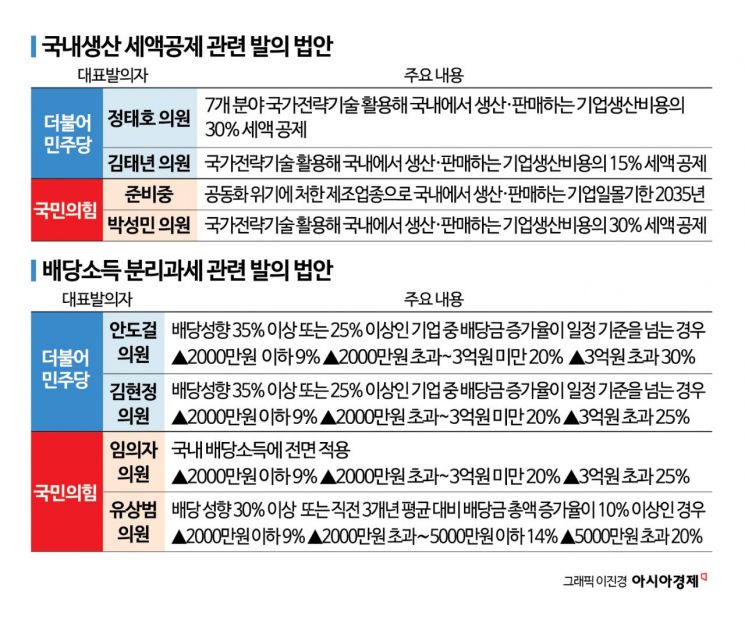
This proposal goes a step further than the Democratic Party’s plan, which only sought tax credits for national strategic technology industries. Previously, Democratic Party lawmakers Jung Taeho and Kim Taenyon, among others, introduced a bill to provide tax benefits for companies that produce and sell items such as semiconductors, secondary batteries, and clean hydrogen, or other items designated by presidential decree, within Korea.
The same applies to the separation of taxation on dividend income. The People Power Party’s proposal includes either lowering the tax rate further than the government’s plan or expanding the scope of separate taxation entirely. A representative example is the partial amendment to the Income Tax Act, introduced by People Power Party lawmaker Lim Ija on September 30. The core of the bill is to apply separate taxation to all domestic dividend income, with a 9% rate for amounts up to 20 million won and a 25% rate for amounts exceeding 300 million won, both lower than the government’s proposal. While the Democratic Party has also proposed bills to expand the range of applicable companies or further lower tax rates compared to the government’s plan, it has never proposed a full expansion.
This bill was introduced just one day after Jang declared at a capital market site meeting that "separate taxation will be applied to all dividend income." Jang and Song Eonseok, the People Power Party’s floor leader, also joined as co-sponsors, lending further support. It is reported that Jang himself demanded, "We need policies that are stronger than those of the Democratic Party."
The People Power Party’s introduction of more distinct policies than the Democratic Party is part of a strategy to strengthen its image as a policy-oriented party. Given the heightened sense of crisis among domestic companies due to initiatives such as the Yellow Envelope Act (amendments to Articles 2 and 3 of the Trade Union and Labor Relations Adjustment Act) and a tougher Commercial Act promoted by the Democratic Party, extraordinary measures are deemed necessary. The move is also intended to attract support from voters who have wavered in their support for the government and the ruling party since Chuseok by presenting concrete alternatives. A member of the People Power Party’s Strategy and Finance Committee said in a phone interview, "Ahead of the tax subcommittee meeting in November, it is necessary for our party to take the initiative in discussions by setting the agenda in advance."
© The Asia Business Daily(www.asiae.co.kr). All rights reserved.

















