2nd Core Regulation Rationalization Strategy Meeting Held
New Industry Innovation Plans in Bio and Renewable Energy
Measures to Promote Agrivoltaics Also Underway
Simplifying Waste Imports for Key Mineral Extraction
The government is pushing for regulatory innovation in sectors such as bio, renewable energy, and K-culture to foster the growth of new industries. In the bio sector, the government plans to shorten the approval period for innovative new drugs to within 240 days by improving the approval and review processes. Guidelines will be established within the year to promote stem cell therapy in Korea, and the government also announced plans to boost related clinical research.
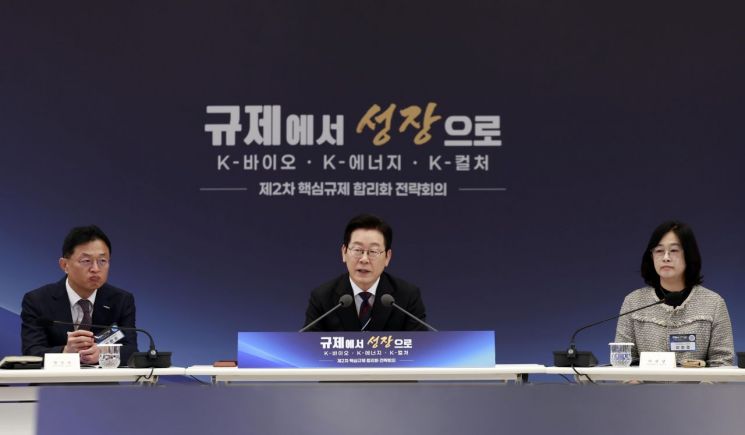 President Lee Jae-myung is speaking at the 2nd Core Regulation Rationalization Strategy Meeting held at the Yongsan Presidential Office on the 16th. Photo by Yonhap News Agency
On October 16, the government held the 2nd Core Regulation Rationalization Strategy Meeting at the Yongsan Presidential Office, presided over by President Lee Jaemyung, with more than 40 participants including ministers, business and field representatives, and private sector experts. This meeting followed the first strategy meeting held last month and aimed to rationalize regulations to promote the growth of new industries and secure industrial leadership in the global market.
The government will focus on transforming regulatory agencies into “support and fostering institutions,” recognizing that rationalizing regulations in new industries such as bio, renewable energy and circular economy, and K-culture can serve as new engines of national growth. In addition, the government will proactively improve key regulations by reflecting feedback from the field. President Lee emphasized, “We must avoid administrative convenience-based approaches and continue to shift toward a principle-based, negative regulatory system that allows everything except what is explicitly prohibited.”
Approval for Innovative New Drugs to Be Completed Within 240 Days
The government will push ahead with rationalizing key regulations in the K-bio sector. The approval and review process will be overhauled to allow for simultaneous and parallel reviews, and regulatory services will be provided throughout the entire cycle from development to approval. The plan is to approve safe and effective innovative new drugs quickly, aiming for a 240-day target, and to expand treatment opportunities for the public.
Access to advanced regenerative medical treatments will also be expanded domestically. Although the Advanced Regenerative Bio Act was amended in February to allow stem cell therapy, the scope of treatment remains limited, and the definition of intractable diseases is unclear, making it difficult to apply for treatment. Going forward, the government will establish guidelines within the year to allow for flexible case-by-case determination of intractable diseases, and will plan and implement government-led clinical research on diseases that are prerequisites for treatment next year to boost related clinical studies. If sufficient overseas clinical research is available, the government also plans to introduce a system within the year to immediately proceed with treatment reviews.
The government will also work to increase the use of deceased patient data. Medical data from deceased patients is considered a more important indicator than survival data for verifying the effects and limitations of new drugs. However, the use of this data has been difficult due to challenges in de-identification methods and criteria. The government will clarify detailed regulations on the use of deceased patient data in guidelines within the year.
In addition, the government will support online remote analysis to enable the use of big data from the Health Insurance Review and Assessment Service and the National Health Insurance Service for public interest research and industry. A “low-risk pseudonymized dataset” with enhanced personal identification protection will be developed, and pilot projects will be swiftly implemented to evaluate the effectiveness and safety of online remote analysis. The first pilot project will be conducted from January to June next year, and the second from July to December.
 Solar power facilities installed across the Yeonggwang area in Jeollanam-do. Photo by Asia Economy Database
Promoting Agrivoltaics... Expansion of Film Production Policy Funds
The government will also pursue rationalization of key regulations in response to the era of decarbonized green civilization. To promote agrivoltaics, the government will improve site regulations and expand the duration and eligibility of projects. If a renewable energy zone is designated within an agricultural promotion area, power generation projects will be permitted, and the use period for farmland will be extended from 8 years to 23 years. Village cooperative corporations will also be allowed as project operators, and agrivoltaics will be expanded with a focus on farmers by the first half of next year. The Renewable Energy Act will be amended to legally stipulate the setback distance for solar power facilities.
In the process of rationalizing waste import regulations, procedures for importing waste for the extraction of key minerals will be simplified in the first half of next year. In the first quarter of next year, tariffs on imported waste will also be eased. To expand the recycling of industrial by-products within industrial complexes, the government will amend relevant laws by the first half of next year to create regulatory special zones for the circular economy, exempting waste regulations for the recycling of process by-products in industrial complexes and workplaces.
The government will also push for the rationalization of key regulations in the K-culture sector. To expand support for film production, the government will increase policy funds such as the Mother Fund and Content Strategy Fund for film production companies. It is also considering expanding tax support for specialized cultural industry companies to encourage content investment. The regulatory system for broadcast advertising will be shifted to a “negative” regulatory framework to ease various advertising regulations, while a daily advertising quota system will be introduced to give broadcasters greater autonomy in ad management.
The Office for Government Policy Coordination stated, “The government will continue to pursue proactive and bold regulatory rationalization to discover future growth engines and new sources of national revenue.” It added, “Follow-up measures related to today’s discussions will be further detailed and swiftly implemented under the leadership of the Office for Government Policy Coordination through additional consultations if necessary.”
© The Asia Business Daily(www.asiae.co.kr). All rights reserved.
![Clutching a Stolen Dior Bag, Saying "I Hate Being Poor but Real"... The Grotesque Con of a "Human Knockoff" [Slate]](https://cwcontent.asiae.co.kr/asiaresize/183/2026021902243444107_1771435474.jpg)












