Possible Influx of Triad Factions Along the Belt and Road Initiative
Illegal Funds Flood into Gambling and Coin Laundering
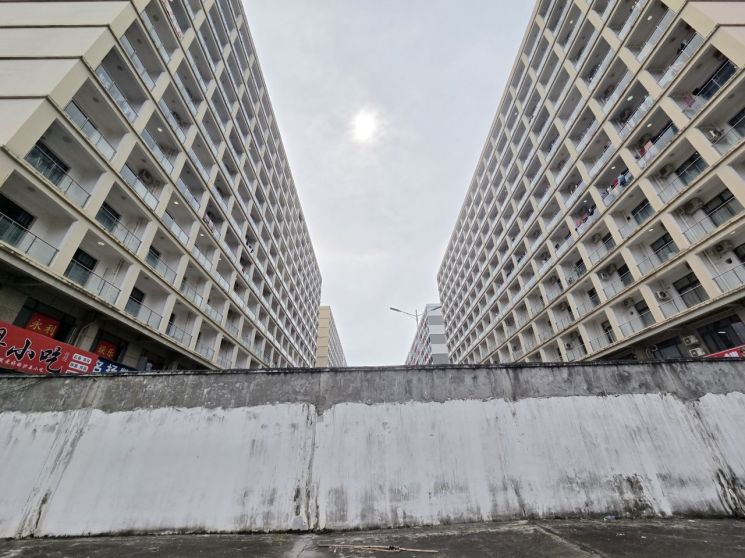 A building suspected to be a crime complex in Sihanoukville, Cambodia. It is enclosed by walls over 3 meters high. Yonhap News Agency
Most of the crime complexes in Cambodia, where a series of kidnappings and detentions of Korean nationals have occurred, are reported to have been built with Chinese capital that entered the country along the Belt and Road Initiative-a national-level foreign strategy that the Chinese government has been pursuing for over a decade. Crime organizations have established bases along the routes where Chinese capital has flowed in, such as casinos, high-rise hotels, and luxury resorts,and have generated massive profits through online gambling, drug sales, and illegal cryptocurrency money laundering. The funds amassed by these criminal organizations have grown so large that they now account for nearly a quarter of Cambodia's economy, and they are closely connected to political and business figures, raising concerns that eradicating them in a short period will be extremely difficult.
Chinese Capital Penetrates Cambodia Along the Belt and Road
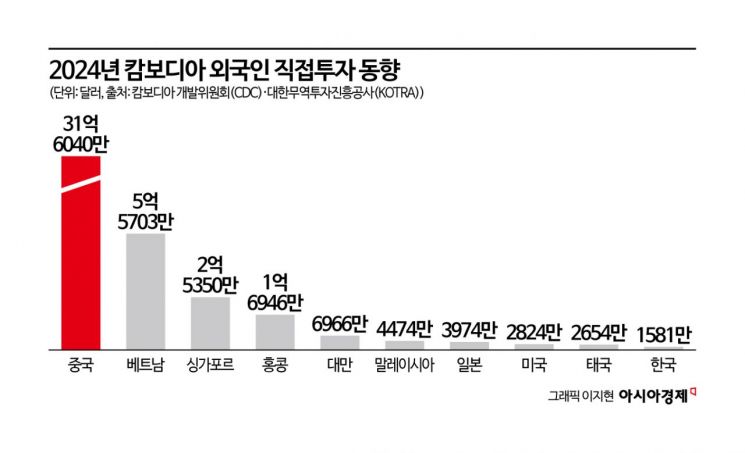
In connection with the Belt and Road Initiative, China has maintained a long-standing close relationship with Cambodia, continuing large-scale investments focused on infrastructure development. According to the Council for the Development of Cambodia (CDC), as of 2024, the share of foreign direct investment (FDI) in Cambodia is as follows: China (69.9%), Vietnam (12.3%), Singapore (5.6%), Hong Kong (3.8%), and Taiwan (1.5%). This means that the majority of foreign capital flowing into Cambodia is Chinese. The proportion of Chinese FDI in Cambodia, which was about 30% in 2020, has risen to around 70% in 2024 due to continued investment expansion.
As of last year, China's investment in Cambodia reached 3.1604 billion US dollars, an increase of about 39% compared to the previous year. This far exceeds the pre-pandemic figure of 1.321 billion US dollars in 2019. In a recent report, the Korea Trade-Investment Promotion Agency (KOTRA) noted, "There are concerns that the expansion of Chinese investment in Cambodia could lead to excessive dependence of the Cambodian economic environment on China," and added, "In particular, China provides investment funds based on loans, which could lead Cambodia into a debt trap in the future."
Belt and Road City Sihanoukville: Hotbed of International Crime...Triad Factions Thrive
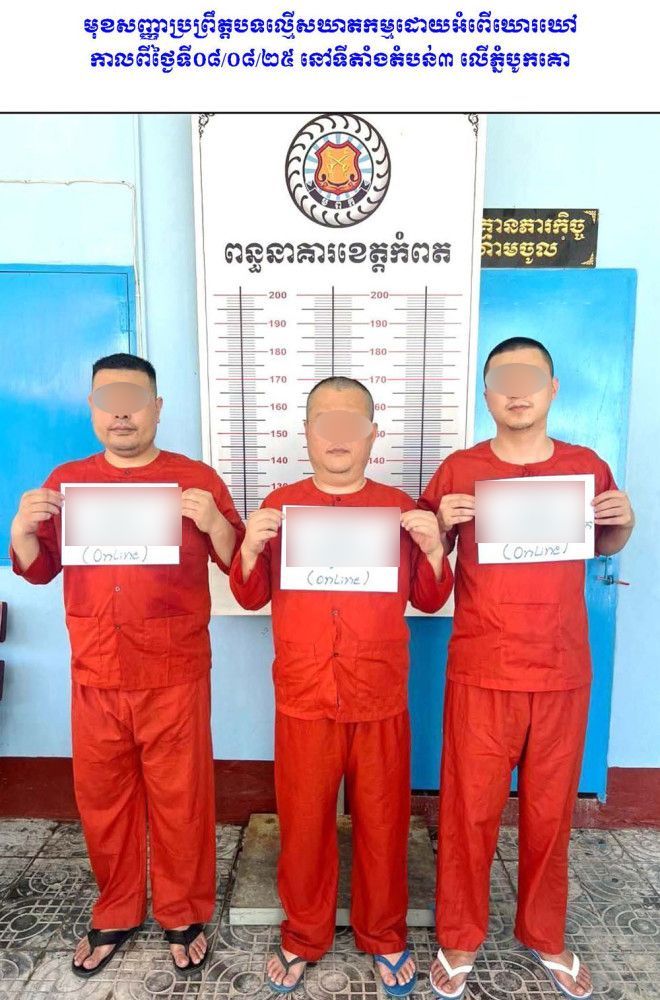 Suspects of Chinese nationality arrested by Cambodian authorities on charges of murdering a Korean university student in his 20s near Bokosan, Kampot Province, Cambodia, last August. Photo by Yonhap News
According to the United Nations Office on Drugs and Crime (UNODC), the major criminal organizations in the Sihanoukville Special Economic Zone-known as Cambodia's crime complex-are reported to be factions of the Chinese Triads, such as 14K and Sun Yee On. These organizations crossed into the Sihanoukville Special Economic Zone through the Belt and Road projects between China and Cambodia, which began in earnest in 2017, and have since engaged in various crimes including casinos, online fraud, and human trafficking.
With the start of the Sihanoukville Special Economic Zone development by the Chinese and Cambodian governments, Sihanoukville, once a small fishing village, has grown into a city with roads, railways, and large port facilities. Since 2017, as tourism development accelerated, more than 140 Chinese casinos have opened. At this time, Triad organizations that had been active in Macau's casino industry moved en masse from mainland China to Sihanoukville. When Chinese authorities launched a large-scale crackdown on crime organizations linked to Macau casinos, these groups relocated their bases overseas.
One particularly notorious figure is Wan Kuok-koi, the former boss of the Macau Triads. After his release from prison in 2012, he founded a security company called the Hongmen Group. Ostensibly, it was a business dispatching security personnel for Belt and Road projects in Southeast Asia, but the company is regarded as the core of various Southeast Asian crime organizations. According to the UNODC, the Hongmen Group has expanded not only in Cambodia but also into Myanmar, Laos, and even Pacific island nations such as Fiji and Palau.
Recently, Prince Holdings Group, a Chinese-Cambodian online financial company sanctioned by the United States and the United Kingdom, has also been identified as one of these organizations. According to the US Treasury Department, Prince Holdings Group has operated as a financial and real estate company in Southeast Asia and has run 10 crime complexes within Cambodia. The group is accused of forcing trafficked foreigners into labor through online scams and laundering cryptocurrencies illegally obtained by North Korean hackers. The US Treasury Department has sanctioned Prince Holdings Group's chairman, Chen Zhi, as well as related companies and executives, and has seized Bitcoin worth 15 billion US dollars (about 21.3 trillion won) obtained from criminal proceeds.
Black Money Floods into Online Gambling and Coin Laundering...Approaching 25% of Cambodia's Economy
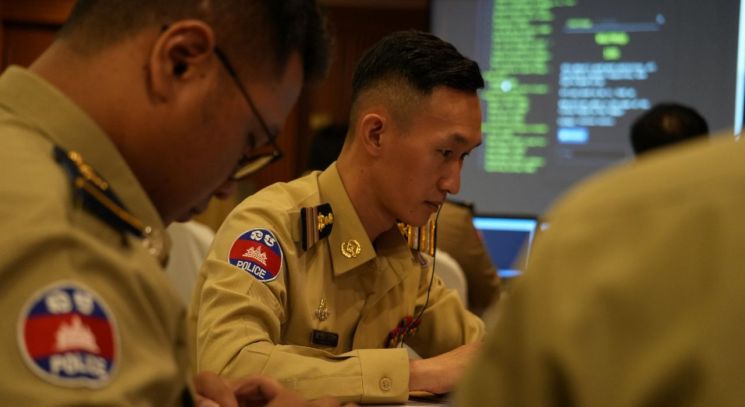 Cambodian police monitoring cybercrimes such as online gambling and illegal cryptocurrency money laundering in collaboration with the United Nations Office on Drugs and Crime (UNODC). UNODC Southeast Asia Regional Office website
The scale of funds controlled by these criminal organizations has grown so large that it now accounts for more than 20% of Cambodia's economy, and their close ties with Cambodia's political and business circles make eradication extremely difficult.
Deutsche Welle, the German public broadcaster, estimates that international crime organizations in Cambodia earn more than 12 billion US dollars (about 17 trillion won) annually through online gambling, scam fraud, and cryptocurrency laundering. This is equivalent to 26% of Cambodia's gross domestic product (GDP) last year. Their funds are reportedly laundered through Huione, one of Cambodia's major financial companies.
Huione Group, Cambodia's largest private financial company, which was sanctioned by the US Treasury Department last May, is suspected of laundering at least 4 billion US dollars (about 5.7 trillion won) in illegal funds from August 2011 to January this year. Among these laundered funds is 37 million US dollars (about 5.24 billion won) in cryptocurrency illegally obtained by North Korea.
Deutsche Welle, citing local sources in Cambodia, pointed out, "Huione Group is identified as being behind the crime organizations in Cambodia, but only superficial investigations are repeated and punishment is avoided," and added, "One of the company's board members, Director Hun To, is reportedly a cousin of Cambodian Prime Minister Hun Manet and is deeply connected to Cambodian political figures."
© The Asia Business Daily(www.asiae.co.kr). All rights reserved.
![Clutching a Stolen Dior Bag, Saying "I Hate Being Poor but Real"... The Grotesque Con of a "Human Knockoff" [Slate]](https://cwcontent.asiae.co.kr/asiaresize/183/2026021902243444107_1771435474.jpg)


















