Keynote Speech at the 7th Sustainable Business Innovation Forum
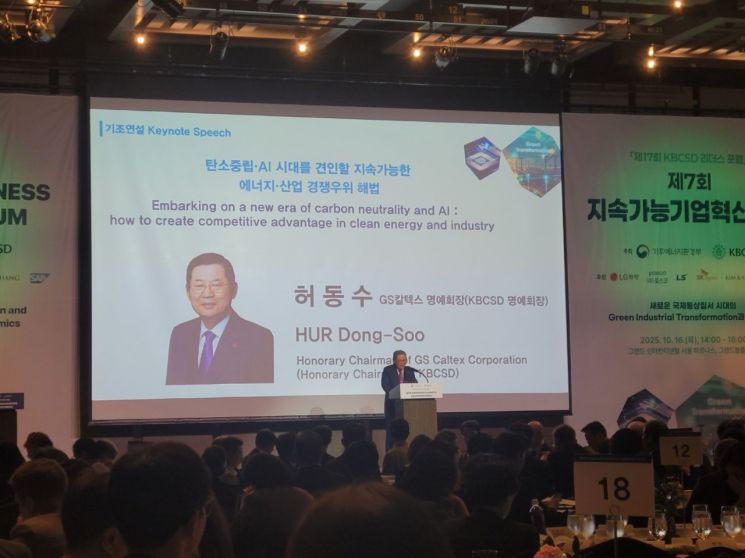 Huh Dongsoo, Honorary Chairman of GS Caltex and Honorary Chairman of the Korea Business Council for Sustainable Development (KBCSD), is delivering the keynote speech at the 7th Sustainable Business Innovation Forum held on the 16th at the Grand InterContinental Seoul Parnas.
With the Lee Jaemyung administration planning to rapidly expand renewable energy, the industrial sector has emphasized the need for a gradual energy transition.
Huh Dongsoo, Honorary Chairman of GS Caltex, stated in his keynote speech at the 7th Sustainable Business Innovation Forum held on the 16th at the Grand InterContinental Seoul Parnas, "A gradual energy transition minimizes the costs associated with policy changes," adding, "The profits generated from this process will drive a virtuous cycle, leading to further investment in the future energy industry."
Honorary Chairman Huh led the establishment of the Korea Business Council for Sustainable Development (KBCSD), which co-hosted the event with the Ministry of Climate, Environment and Energy, and served as its first chairman.
In his keynote speech titled "Sustainable Energy and Industrial Competitive Advantage Solutions to Lead the Carbon Neutrality and AI Era," Honorary Chairman Huh stated, "How to design a Korean-style energy transition system that simultaneously achieves carbon neutrality, leadership in future industries, and energy self-sufficiency has become a generational responsibility for our industry and government," and presented three solutions.
First, Honorary Chairman Huh explained, "As energy sovereignty emerges as a top priority amid recent geopolitical conflicts and supply chain crises, major countries such as the United States and the European Union are expanding the scope of clean industries to include so-called 'bridge energy' sources such as natural gas, liquefied natural gas (LNG), and blue hydrogen."
He emphasized, "Given the characteristics of Korea's industrial structure, which is centered on advanced manufacturing, we possess a competitive natural gas supply system, including blue hydrogen produced as a by-product in refining and steelmaking processes, as well as LNG carriers. If these are linked with carbon capture technologies, they will not only serve as a bridge to carbon neutrality but also become a valuable foundation for creating the next-generation energy industry ecosystem."
Honorary Chairman Huh further explained, "Within our industrial structure, which is well-equipped with refining and petrochemical infrastructure, eco-friendly biofuels utilizing existing resources, next-generation battery materials, and small modular reactors (SMRs) can serve as effective solutions for carbon neutrality in the era of future energy transition."
He also stressed the need to establish industrial sovereignty in AI and clean energy by developing intelligent power grids as a strategic industry, leveraging Korea's world-class manufacturing capabilities and robust industrial base in the power equipment sector, including energy storage systems (ESS) and ultra-high-voltage transformers.
As the final solution, Honorary Chairman Huh proposed nurturing convergent professionals in the fields of energy and artificial intelligence (AI). He emphasized, "It is essential to have comprehensive software capabilities that can understand the technological gap in next-generation energy industries, analyze business benefits using engineering methodologies such as data analysis, and design leading business models."
The industrial sector has called for government policy support, noting that massive corporate investments are required to achieve carbon neutrality.
On this day, Lee Kyungho, Chairman of KBCSD and CEO of Younglim Timber, stated, "Due to the internalization of clean industry supply chains by major countries and astronomical facility conversion costs, companies find it difficult to make decisions on next-generation technology investments." He added, "Effective government policy measures to support corporate investment needs for industrial transition-such as expanding energy infrastructure and green finance-should be the main focus of discussions."
The event was attended by more than 400 participants, including Keum Hanseung, Vice Minister of the Ministry of Climate, Environment and Energy; Lee Kyungho, Chairman of KBCSD; Huh Dongsoo, Honorary Chairman of KBCSD; Ugo Astuto, Ambassador of the European Union to Korea; James Kim, Chairman of the American Chamber of Commerce in Korea; as well as representatives of domestic and international companies, officials from international organizations, and ambassadors from foreign embassies in Korea.
Keum Hanseung, Vice Minister of the Ministry of Climate, Environment and Energy, stated, "The green transformation of the industrial and energy sectors and the strengthening of AI capabilities are key factors in determining national and corporate competitiveness." He added, "Going forward, the Ministry will clearly present a roadmap for decarbonization that creates synergy between climate and energy policies, and will strengthen institutional, financial, and technological support to foster carbon-neutral industries."
© The Asia Business Daily(www.asiae.co.kr). All rights reserved.

![User Who Sold Erroneously Deposited Bitcoins to Repay Debt and Fund Entertainment... What Did the Supreme Court Decide in 2021? [Legal Issue Check]](https://cwcontent.asiae.co.kr/asiaresize/183/2026020910431234020_1770601391.png)