Bank of Korea Releases Q2 Flow of Funds Statistics
Household Net Fund Operation Decreases by 41.6 Trillion Won
In the second quarter of this year, the surplus funds (excess funds) of South Korean households nearly halved compared to the previous quarter. This was due to a decrease in household income as seasonal effects such as bonus payments disappeared, while investments in real assets such as apartments increased.
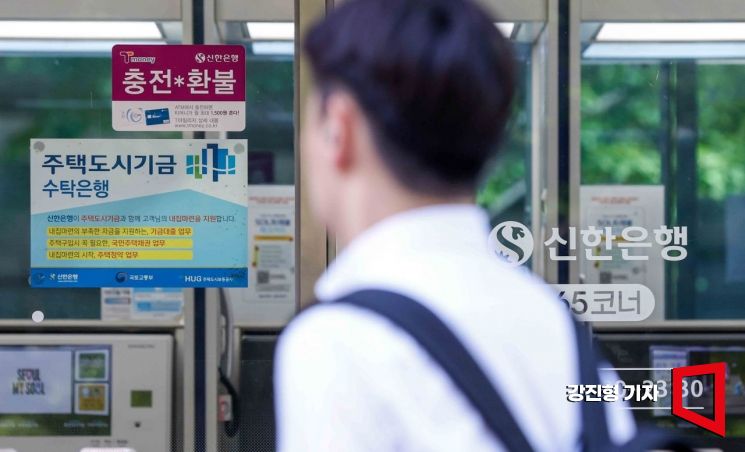 The photo shows a promotional notice for the Housing and Urban Fund trustee bank posted at the entrance of a Shinhan Bank branch in Seoul. Photo by Kang Jinhyung aymsdream@
According to the "2025 Second Quarter Money Flow (Preliminary)" statistics released by the Bank of Korea on October 16, the net fund operations of households and nonprofit organizations in the second quarter of this year amounted to 51.3 trillion won. This is 41.6 trillion won less than the previous quarter (92.9 trillion won). This figure had increased each quarter since the third quarter of last year (37.7 trillion won), but the growth slowed after four quarters.
Net fund operations are calculated by subtracting the amount of financial liabilities (fund procurement) from the amount of financial asset transactions (fund operations) for each economic entity, and are interpreted as the surplus funds of the economic entity. Typically, households supply surplus funds to companies and the government through deposits or investments. As a result, households are generally in a net operating position, while companies and the government are in a net borrowing position.
Kim Yonghyun, head of the Money Flow Team at the Bank of Korea's Economic Statistics Department 1, explained that the reduced growth in household surplus funds was "due to the disappearance of the bonus effect in the second quarter and the increased purchase of apartments." He added, "While households saved a lot in the first quarter, in the second quarter, bonuses decreased and spending increased, resulting in a smaller scale of net fund operations compared to the previous quarter."
According to the National Data Office, household income in the second quarter of this year decreased by 5.4% compared to the previous quarter. In contrast, according to the Korea Real Estate Board, the net acquisition of apartments by individuals increased from 7,800 units in the first quarter to 9,200 units in the second quarter.
Excluding fund procurement, the scale of fund operations by households and nonprofit organizations in the second quarter was 76.9 trillion won, down from 101.2 trillion won in the previous quarter. Deposits at financial institutions, as well as investments in equity securities, investment funds, and bonds, all decreased.
On the other hand, during the same period, fund procurement increased significantly to 25.6 trillion won, up from 8.2 trillion won in the previous quarter, as borrowings from financial institutions such as mortgage loans and credit loans rose.
As a result, the household debt-to-nominal GDP ratio rose to 89.7%, up 0.3 percentage points from the previous quarter (89.4%). This is the first increase in eight quarters since the second quarter of 2023.
However, Kim noted, "In the third quarter, household loans are expected to be about half the level of the second quarter due to the June 27 measures, the implementation of the third stage of the Debt Service Ratio (DSR), and voluntary household loan management measures by financial institutions." He added, "Since GDP growth is also expected to be higher in the third quarter, the upward trend may be temporary."
The net fund procurement by non-financial corporations (general companies) was 3.5 trillion won, down 15.2 trillion won from the previous quarter (18.7 trillion won), as demand for fund procurement such as investments decreased due to increased domestic and international uncertainties.
Excluding fund procurement, the scale of fund operations by companies in the second quarter was 25.5 trillion won, a slight increase from 25.3 trillion won in the previous quarter. This was due to a shift to increased deposits at financial institutions and bond investments. While fund procurement through direct financing such as stock issuance increased, trade credit declined, resulting in a reduction in total fund procurement to 29.1 trillion won from 44.1 trillion won in the previous quarter.
The net fund procurement by the government was 2.7 trillion won, a significant decrease from the previous quarter (40.2 trillion won). While government revenue remained at a similar level to the previous quarter, expenditures decreased significantly.
The net fund procurement by the overseas sector was 41.5 trillion won, an increase from the previous quarter (18.5 trillion won) due to a larger current account surplus. The scale of fund operations was 33.9 trillion won, and fund procurement was 75.4 trillion won, both up from the previous quarter. The increase in fund operations by the overseas sector indicates a rise in South Korea's external debt, while the increase in fund procurement reflects a rise in South Korea's external assets.

Meanwhile, as of the end of the second quarter of this year, the financial assets of households and nonprofit organizations stood at 5,797.4 trillion won, an increase of 222.3 trillion won from the end of the previous quarter. During the same period, financial liabilities rose by 27 trillion won to 2,404.9 trillion won. As a result, net financial assets, calculated by subtracting financial liabilities from financial assets, amounted to 3,392.4 trillion won. The debt-to-asset ratio was 2.41 times, up from 2.34 times at the end of the previous quarter.
© The Asia Business Daily(www.asiae.co.kr). All rights reserved.
![Clutching a Stolen Dior Bag, Saying "I Hate Being Poor but Real"... The Grotesque Con of a "Human Knockoff" [Slate]](https://cwcontent.asiae.co.kr/asiaresize/183/2026021902243444107_1771435474.jpg)
















