Heavy Fiscal Spending Amid High Interest Rates
Biggest Concern: "Financial Market Turmoil"
Evokes Memories of the 2010 European 'Doom Loop'
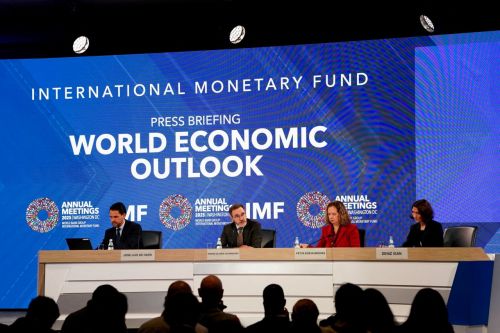 On the 14th (local time), participants spoke at the International Monetary Fund (IMF) and World Bank (WB) Annual Meetings held in Washington D.C., USA. Photo by Reuters Yonhap News
The International Monetary Fund (IMF) warned on October 15 (local time) that if governments around the world continue to increase fiscal spending amid high interest rates, the global government debt-to-GDP ratio will exceed 100% within four years. The IMF assessed that fiscal soundness in many countries will deteriorate to levels comparable to those seen during wartime.
According to Reuters, Victor Gaspar, Director of the IMF’s Fiscal Affairs Department, stated, "Global public sector debt could reach 123% of GDP by 2029," adding, "This is close to the all-time high of 132% recorded right after World War II."
The most concerning scenario is if financial turmoil occurs in the markets. Citing the IMF’s Fiscal Monitor report released on October 14, Gaspar pointed out, "Such turmoil could trigger a 'fiscal-financial doom loop,' where fiscal and financial sectors feed off each other in a vicious cycle, as seen during the European debt crisis in 2010."
The IMF slightly raised its global economic growth forecast this week, but warned that the recently escalating US-China trade war could severely impact output.
Gaspar emphasized, "In a situation of very high uncertainty, the importance of fiscal reform has become greater than ever," and urged both advanced and developing countries to reduce debt, narrow fiscal deficits, and secure adequate buffers.
There are two main fundamental reasons for the continued rise in public debt ratios. First, government spending has increased more rapidly than expected since the COVID-19 pandemic in 2020, leading to faster debt accumulation. Second, rising interest rates are increasing the repayment burden for all sectors.
Gaspar noted, "Current borrowing costs are much higher than during the 2008-2009 financial crisis and the period before the 2020 pandemic," and pointed out that "interest rate hikes are putting pressure on budgets, while demand for fiscal spending is surging due to geopolitical tensions, more frequent natural disasters, disruptive technological changes, and aging populations."
Among these, emerging economies with relatively lower incomes are assessed to be at greater risk than advanced economies such as the United States, Canada, China, and France. Although their debt ratios are relatively low, higher funding costs and limited policy capacity make them more vulnerable.
By country, the US debt-to-GDP ratio is projected to rise from 125% in 2025 to 140.1% in 2029. The fiscal deficit is expected to remain around 8% of GDP. Accordingly, the IMF plans to urge the US government to reduce its fiscal deficit and stabilize debt during its annual review of the US economy next month.
The IMF also expects China’s public debt to surge from 88.3% of GDP in 2024 to 113% in 2029. South Korea’s debt ratio is projected to increase from 53.4% in 2025 to 62.7% in 2029, but its fiscal deficit is expected to remain around -1%.
© The Asia Business Daily(www.asiae.co.kr). All rights reserved.
![Clutching a Stolen Dior Bag, Saying "I Hate Being Poor but Real"... The Grotesque Con of a "Human Knockoff" [Slate]](https://cwcontent.asiae.co.kr/asiaresize/183/2026021902243444107_1771435474.jpg)















