First Comprehensive Plan for Organ and Tissue Donation and Transplantation Finalized
Legalization of Donation after Circulatory Death
Reorganization of Human Tissue Supply System
The government is pushing for a legal amendment to allow organ donation from patients who have died of cardiac arrest after discontinuation of life-sustaining treatment. While the number of people waiting for organ transplants continues to rise each year, the only method of organ transplantation other than living donor transplants from family members or acquaintances-namely, donation from brain-dead patients-has stagnated, prompting this move to address the issue.
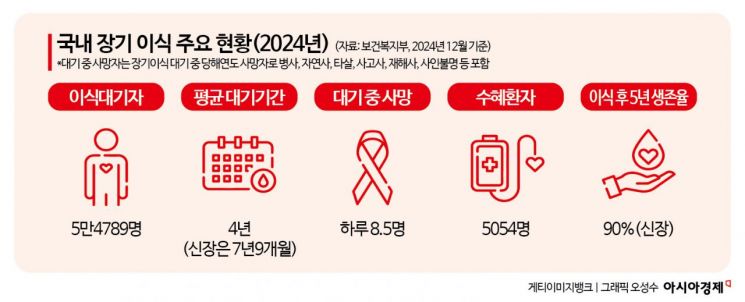
On October 16, the Ministry of Health and Welfare finalized and announced the "First Comprehensive Plan for Organ and Tissue Donation and Transplantation (2026-2030)." This is the first government-level comprehensive policy on donation and transplantation since the amendment of the "Act on Organ Transplantation" in 2023 provided the legal basis for such a plan.
Currently, organ transplantation in Korea relies primarily on donations from brain-dead patients. When a potential brain-dead donor is identified, the Korea Organ and Tissue Donation Agency visits the hospital to obtain family consent, after which brain death is confirmed and a recipient is selected before the organ is procured and transplanted.
Due to population aging and advances in medical technology, the number of people waiting for organ transplants increased by 26.9% from 43,182 in 2020 to 54,789 in 2024. In contrast, the number of brain-dead donors decreased by 16.9% from 478 to 397 over the same period. As a result, the imbalance between the rapidly growing number of patients on the waiting list and the declining number of donors is becoming increasingly severe. The average waiting period for a transplant is four years, and for kidney transplants, it is seven years and nine months. Every day, an average of 8.5 patients die while waiting for an organ transplant.
In response, the Ministry of Health and Welfare has decided to introduce not only traditional brain-dead donor transplants but also "Donation after Circulatory Death (DCD)"-organ donation from patients whose hearts have stopped after discontinuation of life-sustaining treatment. In this method, organs are donated with family consent after the patient is declared dead due to complete cessation of cardiac function and blood circulation. Major countries such as the United States and the United Kingdom already implement this system, and DCD accounts for about half of all organ donations there. Experts explain that expanding the criteria for organ donation from brain-dead donors to include cardiac arrest patients will increase the number of donations, thereby benefiting more patients.
DCD targets patients who wish to discontinue life-sustaining treatment and also donate their organs. To implement this, amendments to both the "Organ Transplantation Act" and the "Act on Decisions on Life-Sustaining Treatment" are required. Detailed guidelines must be established regarding the timing of donor and recipient selection, criteria for cardiac death, coordination between palliative care and operating rooms, and family visitation at the end of life. In addition, the surgical system immediately after death and the introduction of medical devices such as ex vivo perfusion machines must be considered.
The government also aims to address imbalances in the supply of human tissues such as skin, fascia, cartilage, and nerves, which are not organs. Currently, only about 150 people donate human tissues annually in Korea, resulting in over 90% reliance on imports. The Ministry of Health and Welfare stated, "It appears that the closure of major hospital tissue banks due to operational difficulties has led to a decrease in domestic tissue supply," and added, "We will strengthen support for hospital tissue banks by increasing awareness of tissue donation and considering measures such as raising the differential reimbursement rate."
To lower the barriers to participation for organ donors, the number of donor registration centers nationwide-currently only 462 (two per city, county, or district)-will be expanded to 904 by 2030. Registration channels will be broadened to include public institutions such as the National Health Insurance Service, community centers, and local branches of the Korea Road Traffic Authority to improve accessibility. Recognition for donors and their families will also be enhanced by installing "walls of remembrance" (donor plaques) at major hospitals and local governments, and by expanding memorial events. In addition, the system will be improved so that the occurrence of potential brain-dead donors can be immediately reported to the Korea Organ and Tissue Donation Agency through hospital electronic medical records (EMR), and the number of coordinators responsible for donor counseling and funeral support will be increased.
© The Asia Business Daily(www.asiae.co.kr). All rights reserved.
![Clutching a Stolen Dior Bag, Saying "I Hate Being Poor but Real"... The Grotesque Con of a "Human Knockoff" [Slate]](https://cwcontent.asiae.co.kr/asiaresize/183/2026021902243444107_1771435474.jpg)
















