60th Anniversary Forum of Korea-Japan Diplomatic Normalization
Environment and Energy, Low Birth Rates and Aging Populations
Proposal to Establish a Private-Sector Partnership to Address the Demographic Crisis
To mark the 60th anniversary of the normalization of diplomatic relations between Korea and Japan, business leaders from both countries gathered to discuss ways to move "from 60 years of cooperation to 60 years of advancement," exploring strategies for future joint prosperity in areas such as environment and energy, as well as low birth rates and aging populations.
The Korea Economic Association and the Japan Business Federation held the "60th Anniversary of Korea-Japan Diplomatic Normalization Forum" and a "Reception" consecutively at the Keidanren Kaikan in Tokyo on the afternoon of October 16. The reception was attended by key government and business figures from both countries, including Japanese Prime Minister Shigeru Ishiba and Korean Ambassador to Japan Lee Hyuk.
The forum, which took place first, was co-hosted by the two organizations along with the Korea-Japan Future Partnership Fund and the Keidanren Comprehensive Policy Research Institute. During the event, measures to strengthen bilateral cooperation in three areas-environment and energy, low birth rates and aging populations, and culture and startups-were proposed.
In his opening remarks, Ryu Jin, chairman of the Korea Economic Association, praised the recent decision by both governments to establish a consultative body to jointly address common social issues. He emphasized that now is the time for the business community to also seek opportunities for future joint prosperity. Ryu stated, "The cooperation measures discussed at today's forum will serve as the blueprint for a new relationship between our two countries," adding, "I hope Korea and Japan will create a new success story for the next 60 years as partners in future joint prosperity."
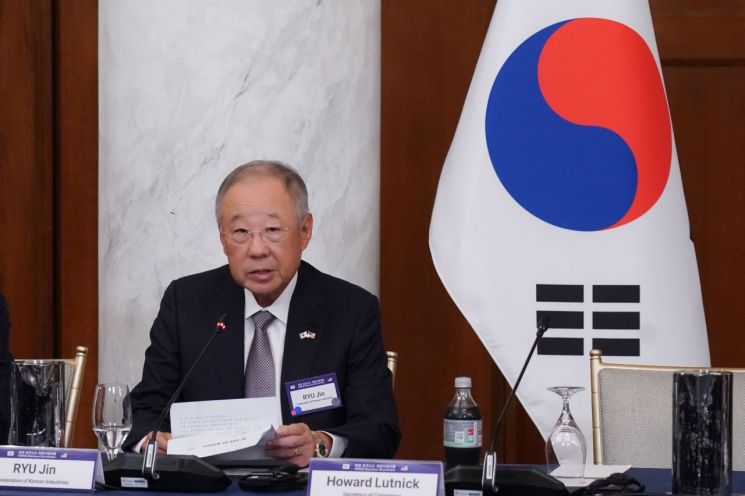 Ryu Jin, chairman of the Korea Economic Association, is delivering a greeting at the "Korea-US Business Roundtable: Manufacturing Renaissance Partnership" held at the Willard Hotel in Washington DC, USA, on August 25 (local time). Photo by Yonhap News.
In his opening address, Tsutsui Yoshinobu, chairman of the Japan Business Federation, noted, "Both countries face several common challenges, such as low birth rates and aging populations," and added, "Now that our bilateral relationship has matured over the past 60 years, it is time to pool our wisdom for the future and continue sustainable growth."
The forum was attended by experts and business leaders from both countries, including Kang Sungjin, Korean advisory chairman of the Future Partnership Fund and professor at Korea University, and Fukagawa Yukiko, Japanese advisory chairman of the Future Partnership Fund and professor at Waseda University.
During the "Environment and Energy" session, Ahn Jiyeong, research fellow at the Korea Energy Economics Institute, presented a "Korea-Japan Hydrogen Economy Cooperation Strategy." Ahn pointed out that while both countries recognize hydrogen as a key to energy transition, their production bases remain weak. As a joint response, he proposed the construction of large-scale hydrogen and ammonia hub terminals. He explained that by building shared infrastructure, the geographically close Korea and Japan can achieve economies of scale and respond flexibly to supply and demand fluctuations. He also highlighted the need for joint development of overseas clean hydrogen supply chains and cooperation on clean hydrogen certification and standardization.
On the Japanese side, Yamaji Kenji, president of the Research Institute of Innovative Technology for the Earth, gave a presentation on "A New Era of Energy and Environment Opened by Innovation."
In the second session on "Low Birth Rates and Aging Populations," Hong Seokcheol, professor at Seoul National University, stressed the need to approach the population crisis from an economic rather than a welfare perspective. He added that, as companies in both countries are experiencing similar demographic changes, there is a need to establish a private-sector partnership led by the business communities of both countries to address the population crisis. This partnership is expected to create synergy with the consultative body recently agreed upon by both governments to discuss low birth rates and aging population issues, by promoting cooperation among government, business, and academia.
Additionally, Professor Hong suggested directions for cooperation between companies in both countries, including sharing successful case studies, jointly proposing policies, and promoting the standardization of related technologies and services.
From Japan, Fujinami Takumi, senior researcher at the Japan Research Institute, presented on "Measures for Low Birth Rates and Aging Populations and Regional Revitalization Challenges." In this context, the Korea Economic Association announced that the Future Partnership Fund would continue to play a central role in working with the Japanese business community to develop measures to address low birth rates and aging populations in both countries.
In the "Culture and Startups" session, Lim Hyemin, CEO of Creatrip, noted, "Generation Z is experiencing K-lifestyle through social networking services (SNS), creating interactive cultural exchanges." She proposed the establishment of a "Korea-Japan Culture-Tech Innovation Fund" (tentative name) to support this. The fund aims to support digital technology-based cultural exchange projects by startups, with joint investment from business communities and institutions in both countries. Lim identified promising investment areas such as AI-based tourism technology, content commerce platforms, and immersive media content production.
On the Japanese side, Sasai Yuko, president of the Pia Research Institute, presented on ways to build a sustainable Korea-Japan relationship through audience-participatory art exchanges.
Following the forum, a reception was co-hosted by the Korea Economic Association, the Japan Business Federation, and the Future Partnership Fund, attended by Ryu Jin, Tsutsui Yoshinobu, and other business leaders from both countries. Government officials from both sides also participated, reaffirming their commitment to developing future-oriented Korea-Japan relations.
On the Korean side, major group leaders such as Shin Dongbin, chairman of Lotte Group; Kim Yoon, chairman of Samyang Holdings; Cho Hyunjoon, chairman of Hyosung Group; and Koo Ja-eun, chairman of LS Group, were present. On the Japanese side, attendees included Tokura Masakazu, advisor to Sumitomo Chemical; Koji Akiyoshi, chairman of Asahi Group Holdings; Endo Nobuhiro, special advisor to NEC; and Sawada Jun, chairman of NTT.
Ryu Jin remarked, "Thanks to the efforts of business leaders, the relationship between our two countries has made great strides over the past 60 years," adding, "The next 60 years are also full of hope." He continued, "Just as our countries are geographically closest, I hope we will become the closest of neighbors in spirit as well. Let us open a future of joint prosperity through trust and cooperation."
Tsutsui Yoshinobu also stated, "As we reach this turning point of the 60th anniversary of diplomatic normalization, it is time to elevate dialogue and exchanges between our two countries to a new level," and urged, "Let us work together to restore a rules-based, free, and open international economic order."
The Korea Economic Association and the Japan Business Federation plan to hold the "32nd Korea-Japan Business Conference" at the Keidanren Kaikan in Tokyo on October 17, with key business leaders from both countries in attendance, to discuss future directions for economic cooperation.
© The Asia Business Daily(www.asiae.co.kr). All rights reserved.

















