Discovered in a British Field in 2019
Pendant Made of 24-Carat Gold
Believed to Be an Artifact from the Era of Henry VIII, 500 Years Ago
A gold necklace from the era of Henry VIII, discovered on a British farm, has been confirmed as authentic, prompting a nationwide fundraising campaign to acquire the artifact for the country.
On October 14 (local time), the Daily Mail reported that the British Museum has launched a fundraising campaign to raise 3.5 million pounds (approximately 6.6 billion won) to secure the 24-carat pure gold heart pendant, known as the 'Tudor Heart', as a national treasure. The pendant symbolizes the love between Henry VIII and his first wife, Catherine of Aragon.
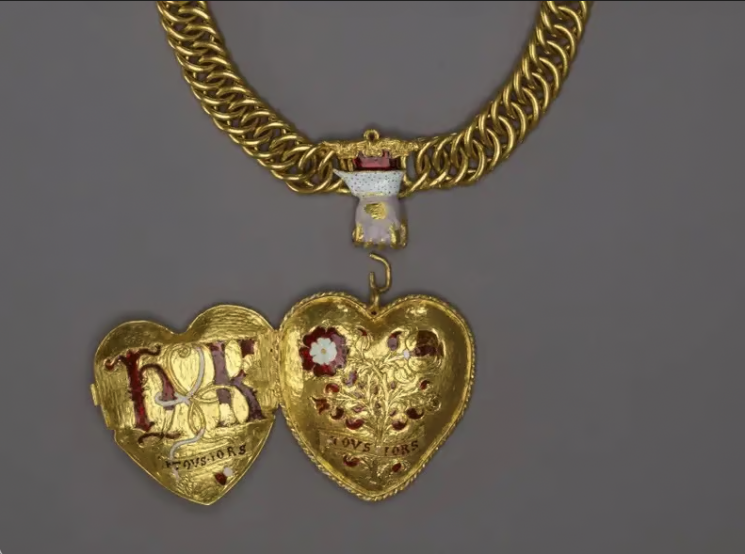
This pendant was accidentally discovered in 2019 by Charlie Clarke, a caf? owner, in a field in Warwickshire, England. Clarke found the 'Tudor Heart' just six months after taking up metal detecting as a hobby. When the necklace was first found, museum curators and artifact experts were skeptical about its authenticity, as its condition was considered too pristine for a genuine piece over 500 years old. However, after analysis, it was confirmed to be authentic, and it is now regarded as one of the best-preserved and rarest Renaissance artifacts discovered in Britain in recent years.
The artifact discovered by Clarke is a necklace made of 24-carat gold, consisting of 75 interlinked chain links and a heart-shaped pendant. The pendant is engraved with the letters H and K, which experts believe stand for Henry VIII (1491-1547) and his first wife, Catherine of Aragon. The pendant is also decorated with the Tudor rose, a symbol of the Tudor dynasty, and a pomegranate bush, the emblem of the queen, along with the word 'tousiors'-meaning 'always' in Old French. Experts speculate that the 'Tudor Heart' was created for a tournament held in October 1518 to commemorate the engagement of Princess Mary, the daughter of Henry VIII and Catherine, to the French heir to the throne.
Meanwhile, it is estimated that there are around 40,000 people in the UK who search for treasures with metal detectors. According to the Treasure Act enacted in 1996, anyone who discovers an object that could be classified as treasure is required to report it. Treasure is defined as a metallic object, other than coins, that is at least 300 years old and contains at least 10% precious metal. Once classified as treasure, it undergoes an independent valuation, and museums may purchase it. The proceeds are usually split between the finder and the landowner.Accordingly, Clarke, as the original finder, is expected to receive a reward of 1.75 million pounds (approximately 3.3 billion won). In an interview with The Guardian, Clarke shared his feelings about the discovery, saying, "I screamed like a schoolgirl at a find that you might only experience once in thirty lifetimes."
Currently, the 'Tudor Heart' is on display at the British Museum as part of the fundraising campaign, which will run until April 2026. If the target amount is not reached, the artifact may be sold to a private collector. Nicholas Cullinan, director of the British Museum, appealed to the public for support, stating, "The Tudor Heart is one of the most astonishing artifacts in British history," and "Securing this piece as a national treasure will allow future generations to see and marvel at it."
© The Asia Business Daily(www.asiae.co.kr). All rights reserved.
![Clutching a Stolen Dior Bag, Saying "I Hate Being Poor but Real"... The Grotesque Con of a "Human Knockoff" [Slate]](https://cwcontent.asiae.co.kr/asiaresize/183/2026021902243444107_1771435474.jpg)















