"Guaranteeing Rest as Much as Possible, but with Flexibility"
President Lee: "Will Review to Ensure No Harm to Workers"
Leaders of major domestic game companies who met with President Lee Jae-myung voiced a unified call for more flexible application of the 52-hour workweek system. They emphasized that the unique characteristics of the gaming industry-such as the need for short-term, intensive work periods (crunch mode) ahead of new releases or major updates-must be taken into account.
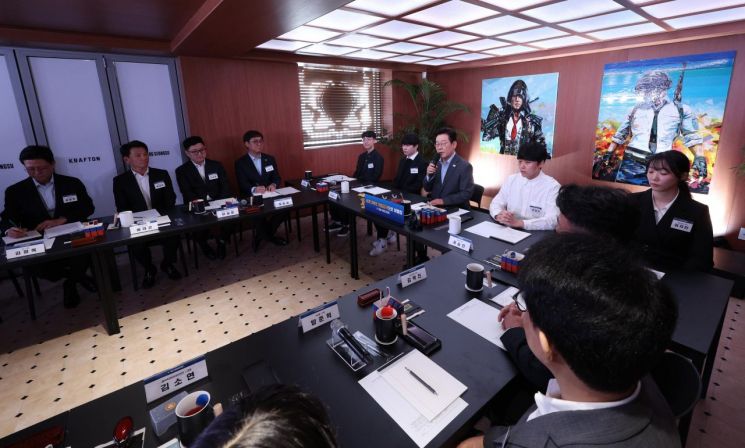 President Lee Jae-myung is holding an on-site meeting for K-Games at PUBG Seongsu, a game and culture platform of the domestic game company Krafton, located in Seongdong-gu, Seoul, on the 15th. Photo by the Presidential Office Press Photographers Group
According to the Presidential Office and industry sources on October 16, Kim Jungwook, CEO of Nexon Korea; Kim Changhan, CEO of Krafton; Kim Taekjin, CEO of NCSoft; Bang Junhyuk, Chairman of Netmarble; and Bae Taekeun, CEO of Neowiz, all attended the meeting the previous day. They recommended that the rigid labor environment be improved to strengthen global competitiveness. This issue was also raised during a meeting with Minister Choi Hwi-young of the Ministry of Culture, Sports and Tourism last month.
According to the Korea Creative Content Agency, unofficial work hours outside the office for game industry workers have steadily increased-from 2.4 hours in 2020, to 3.1 hours in 2022, and 5.7 hours last year. Although the proportion of workers who experienced crunch mode decreased by 3.9 percentage points year-on-year to 34.3% last year, the number of unrecognized work hours by companies actually increased. Official industry working hours averaged 44.7 hours per week, about 15% longer than the average for all industries (38.7 hours).
Industry insiders say that when including hours not captured in official statistics, actual working hours far exceed the 52-hour workweek. One game company official stated, "We operate a system that complies with the 52-hour workweek, such as offering substitute days off for overtime, but it is difficult to keep within the limit right before a game launch or during special events like G-Star. What we are asking for is flexibility according to necessity."
Currently, companies such as Netmarble and Nexon have adopted flexible work hour systems to help employees maintain a work-life balance. However, small and medium-sized developers are known to face harsher working conditions, often relying on short-term contract workers due to limited financial resources. Another industry official commented, "Even after a game is released, there are often urgent tasks that must be addressed. Alternatives such as adjusting work hours in three- to six-month increments are not realistic."
President Lee reportedly said, "There should be no cases where workers are harmed. We will have in-depth discussions and look into what can realistically be done before making any legal or institutional changes." Since his time as party leader, President Lee has advocated for adjustments to the 52-hour workweek system within the existing labor laws.
© The Asia Business Daily(www.asiae.co.kr). All rights reserved.
![Clutching a Stolen Dior Bag, Saying "I Hate Being Poor but Real"... The Grotesque Con of a "Human Knockoff" [Slate]](https://cwcontent.asiae.co.kr/asiaresize/183/2026021902243444107_1771435474.jpg)















