Full-scale Legislative Discussions on Unilateral Binding Force to Begin Next Year
Comprehensive Measures to Eradicate Illegal Private Lending to Be Established This Year
Accelerating the "Three Major Financial Transformations": Productive, Consu
The Financial Services Commission will begin operating the Financial Consumer Policy and Evaluation Committee, as well as a Private Evaluation Subcommittee, starting early next year. The commission plans to establish a national policy task regarding the unilateral binding force system for small-scale financial dispute cases by the end of this year, and to initiate full-scale legislative discussions next year.
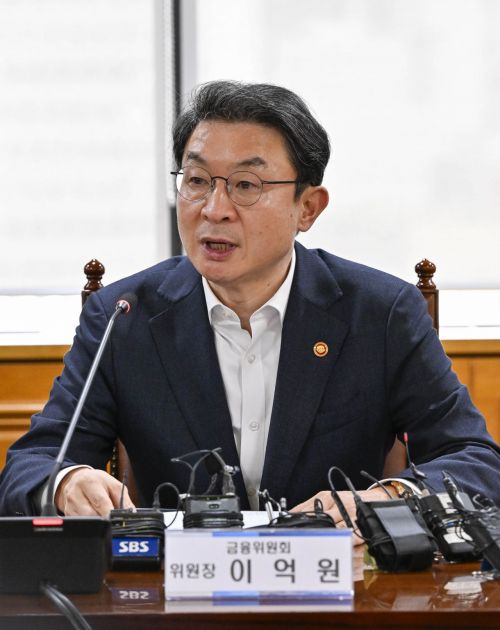 Lee Eokwon, Chairman of the Financial Services Commission, is attending the Bank Presidents' Meeting held at the Bankers' Hall in Jung-gu, Seoul on September 29, delivering opening remarks. 2025.09.29 Photo by Yoon Dongjoo
On October 15, Lee Eogwon, Chairman of the Financial Services Commission, announced these plans at the "Financial Consumer and Ordinary Citizens' Meeting" held at the Korea Inclusive Finance Agency in Jung-gu, Seoul. The meeting was attended by Chairman Lee, four representatives from consumer organizations including the Citizens' Coalition for Economic Justice, eight experts such as Je Yoonkyung, Special Advisor to the National Assembly Speaker on Livelihood Affairs, and six representatives from associations including the Korea Federation of Banks, Korea Financial Investment Association, Korea Life Insurance Association, General Insurance Association of Korea, Credit Finance Association, and Korea Federation of Savings Banks.
This was Chairman Lee's first time holding a meeting to hear directly from consumers since taking office on September 15. Upon his inauguration, he presented three major policy goals for a "Triple Transformation in Finance": productive finance, consumer-centered finance, and trustworthy finance. At the meeting, he particularly emphasized the need to shift toward consumer-centered finance.
Chairman Lee stated, "Policy changes that policy recipients can truly feel are still lacking," and stressed, "We must re-examine existing policies from the perspectives of consumers and financially vulnerable groups, and push for a major shift toward consumer-centered finance."
He outlined four policy directions: establishing the Financial Consumer Policy and Evaluation Committee, improving financial company governance, significantly strengthening financial support for ordinary and vulnerable groups, and eradicating financial crimes.
First, the Financial Consumer Policy and Evaluation Committee and the Evaluation Subcommittee will begin full-scale operations early next year. The policy committee will consist of around 15 members and will be chaired by Chairman Lee. Both private sector members and officials from relevant ministries will participate, with regular meetings held semiannually and ad hoc meetings convened as needed. The Evaluation Subcommittee will be an independent body composed solely of private sector members, which will evaluate policies annually and publicly release the results.
Concrete plans for national policy tasks such as the unilateral binding force system and the Korean-style fair fund will be established by the end of this year, with full-scale legislative discussions to begin next year. The unilateral binding force system requires financial companies to comply with the financial authorities' dispute resolution outcomes in small-scale financial disputes. Additionally, the commission plans to announce measures by the end of this year to improve the process for closing bank branches and to promote the operation of regionally customized branches such as digital lounges and mobile branches.
Support for ordinary citizens and financially vulnerable groups will also be strengthened. A Financial Stability Fund for Ordinary Citizens, jointly funded by the government and the private sector, will be established as soon as possible. Furthermore, by advancing alternative credit evaluation systems that utilize non-financial information such as telecommunications data and by developing specialized credit scoring models for ordinary citizens, the commission aims to expand private lending to ordinary citizens and lower lending rates. Comprehensive measures to improve the management of individual delinquent loans will also be prepared.
Chairman Lee also expressed a strong commitment to eradicating financial crimes such as voice phishing. Comprehensive measures to eliminate illegal debt collection and illegal private lending will be established by the end of this year. A system of strict liability for financial companies in cases of voice phishing victimization will also be introduced. Through these measures, the commission intends to ensure that the financial sector takes a more proactive and systematic approach to preventing financial crime victimization.
Participants at the meeting suggested measures such as protecting long-term delinquent borrowers through financial companies' voluntary debt restructuring, strengthening prompt punitive damages, and encouraging voluntary participation by financial companies in the design of the unilateral binding force system.
Chairman Lee stated, "We will actively identify and implement policy and follow-up tasks such as establishing the policy and evaluation committee, introducing the unilateral binding force system, and creating the Financial Stability Fund for Ordinary Citizens, to realize a major shift toward consumer-centered finance," adding, "We will promptly announce and implement the most concrete tasks first."
© The Asia Business Daily(www.asiae.co.kr). All rights reserved.
![Clutching a Stolen Dior Bag, Saying "I Hate Being Poor but Real"... The Grotesque Con of a "Human Knockoff" [Slate]](https://cwcontent.asiae.co.kr/asiaresize/183/2026021902243444107_1771435474.jpg)
















