At Hyundai Gallery from October 15 to November 23
Featuring Around 20 Works from the 1980s and 1990s
On a large canvas measuring 1.4 meters in height and 0.7 meters in width, birds and humans are intertwined, depicted with simple lines and vibrant colors. The technique of applying generous amounts of paint to both large and small brushes and rendering the beings of nature in sweeping, unrestrained strokes is characteristic of artist No Eun (1946-2022). The powerful traces of the brush evoke an atmosphere reminiscent of a lively song, which is why his paintings are often described as "improvised poems of life." The title of the artwork and the current exhibition, "With the Red Bird," conveys a warm sense of embrace to viewers.
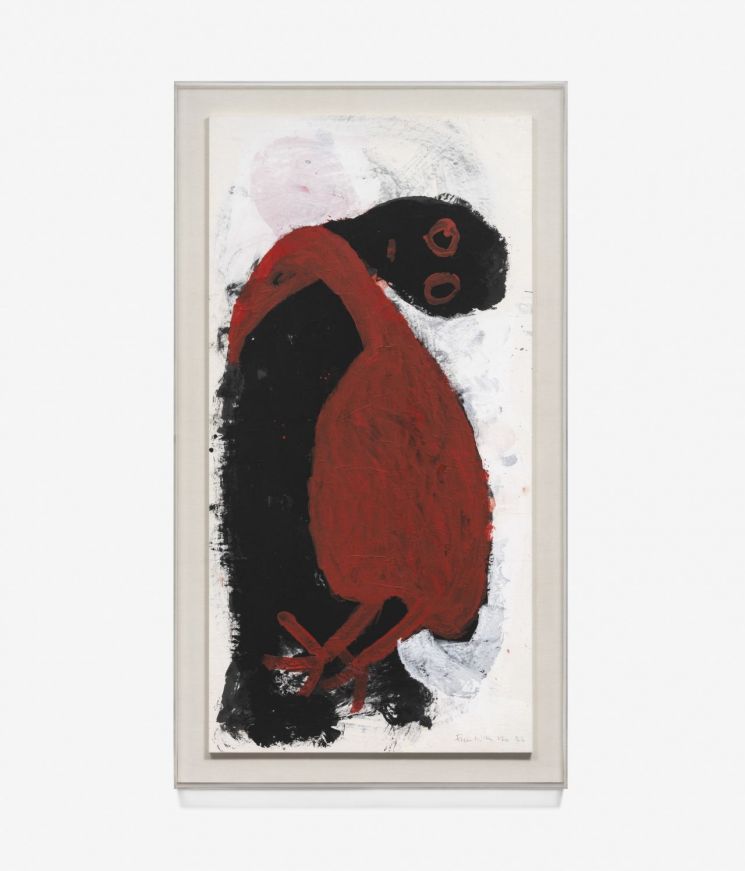
Marking the third anniversary of No Eun's passing, the retrospective exhibition "With the Red Bird" opens at Hyundai Gallery on October 15, featuring around 20 works from the artist's prolific years in the 1980s and 1990s. The exhibition explores No Eun's artistic world, capturing subjects such as birds, cats, fish, tigers, and ducks with concise dots and lines and bold, colorful strokes, artistically expressing nature and life.
The artist was born in 1946 in Jeonju, North Jeolla Province, and moved to Germany in 1970, where he worked at a port hospital in Hamburg. Although he arrived in Germany without a nursing license, he worked as a nursing assistant while dedicating himself to painting. With the support of a colleague who recognized his talent, he entered the Hamburg University of Fine Arts in 1973 and began his full-fledged artistic career in 1979. He later became an internationally renowned artist, primarily based in Europe, and served as a tenured professor at the Hamburg University of Fine Arts from 1990 to 2010. His works have been included in French middle school literature textbooks, and in November 2019, a permanent exhibition room was established for him at the Odenwald Museum of Art in Michelstadt, Hesse, Germany.
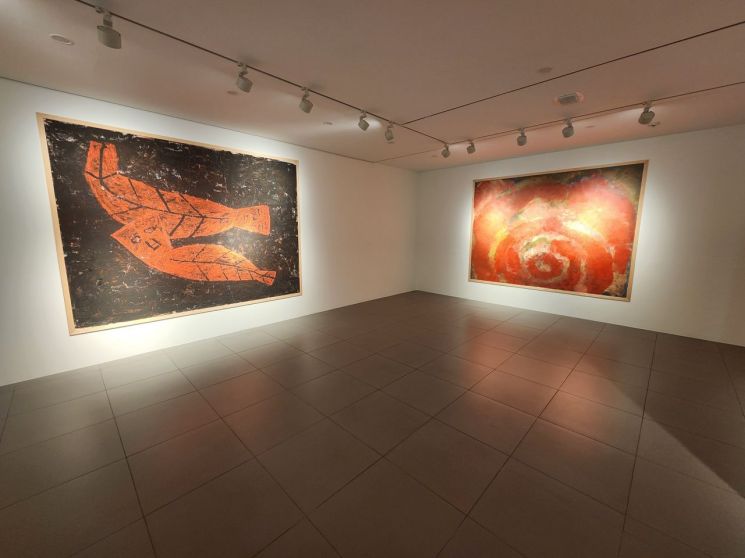 Interior view of Hyundai Gallery where the retrospective exhibition of No Eun is held. Photo by Seo Mideum
No Eun's paintings are rooted in German Expressionism while also connecting with Eastern ontology. Unusual forms fill his canvases, such as fish swimming in the sky, birds flapping their wings underwater, and caterpillars running on wheels. Particularly striking are images of people embracing giant red birds or floating through the sky in crescent-shaped boats.
His work also resonates with the Eastern philosophy of "emptiness" (kong). He freely transforms subjects-turning people into birds, birds into fish, and fish into leaves-and the frequent inversion of top and bottom in his paintings recalls the Eastern idea that "nothing in the universe is immutable." German art critic Anneli Plen once described No Eun's work as "a bridge between Eastern meditation and Western Expressionism."
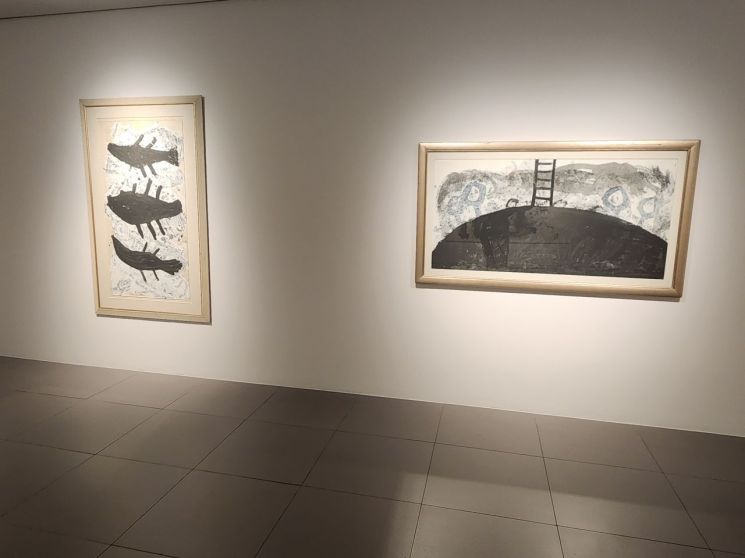 Interior view of Hyundai Gallery where the retrospective exhibition of No Eun is held. Photo by Seo Mideum
The exhibition also features a screening area for Barbara Kuzenberg's 1989 documentary film "My Luggage Is My Wings," which chronicles No Eun's artistic journey in search of his creative world within nature.
Kwon Junseong, director of the No Eun Archive and the exhibition's curator, explained, "This exhibition presents the artist's major works and is composed of pieces from the collection of Hyundai Gallery Chairwoman Park Myeongja."
A representative from Hyundai Gallery stated, "This is a meaningful occasion that showcases the free and dynamic artistic world of an artist who has been a central figure in the history of modern Korean art for over half a century." The exhibition runs until November 23.
© The Asia Business Daily(www.asiae.co.kr). All rights reserved.
![Clutching a Stolen Dior Bag, Saying "I Hate Being Poor but Real"... The Grotesque Con of a "Human Knockoff" [Slate]](https://cwcontent.asiae.co.kr/asiaresize/183/2026021902243444107_1771435474.jpg)

















