Warning of Russian Threat
"We Are Already Under Attack"
The head of Germany's intelligence agency has warned that Russia could invade the North Atlantic Treaty Organization (NATO) before 2029. As the war in Ukraine drags on and Russia's threat spreads across Europe, Germany is ramping up its defense spending and even considering reinstating conscription, signaling a shift toward a wartime readiness posture.
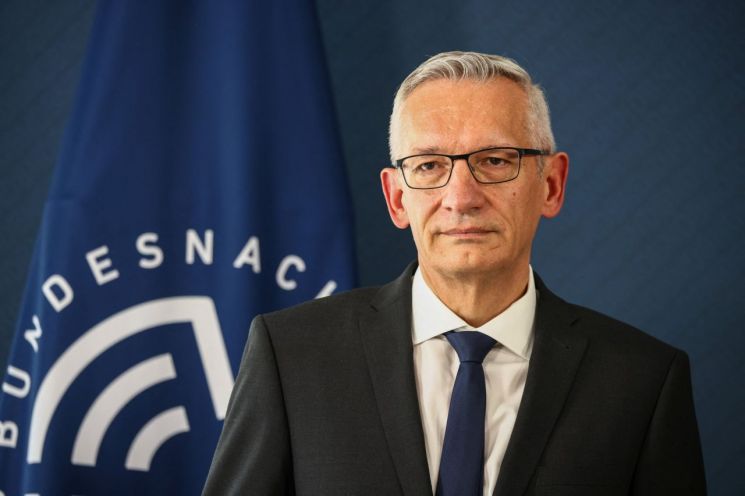 Martin Jaeger, Director of the German Federal Intelligence Service (BND). Photo by Reuters Yonhap News
Martin Jaeger, Director of the German Federal Intelligence Service (BND), appeared before parliament on the 13th (local time) and stated, "We must not become complacent with the assumption that a Russian invasion could only be possible as early as 2029." He added, "We are already under attack." Jaeger asserted that Russia's objective is to weaken NATO and divide European society, saying, "Russia will not hesitate to engage in direct military conflict with NATO if necessary to achieve these goals."
Jaeger also noted that Russia is testing the limits of the West, remarking, "The line between war and peace is becoming increasingly blurred. There is a frozen peace in Europe that could erupt into conflict at any moment in certain areas." He emphasized, "We must prepare for the possibility that the situation could deteriorate further in the future."
Recently, Russia has faced criticism for actions against European countries, including Germany, such as airspace violations, cyberattacks on airports and logistics centers, and malicious campaigns to influence elections. In response, Ursula von der Leyen, President of the European Commission, has defined this strategy of combining non-military attacks with actual military operations to weaken adversaries as 'hybrid warfare.' She announced plans to soon present a roadmap to strengthen capabilities in nine key areas, including air defense, artillery, and electronic warfare, by 2030.
European security officials have proposed various hypotheses regarding the timing of a potential Russian invasion of NATO member states since the outbreak of the war in Ukraine in February 2022. Early in the war, many believed that Russia would not be able to recover its military strength enough to wage war against other countries within the next ten years. However, more recently, claims have increased that Russia could invade a NATO member state within three to five years, that is, around 2029.
In response to these assessments, the German government is rearming, aiming to achieve wartime operational capability by 2029. This includes significantly increasing defense spending and revising the conscription system. The amendment to the Military Service Act, prepared by the German government in August, maintains voluntary enlistment but allows for compulsory conscription with parliamentary approval if there are not enough volunteers or if national security is threatened. As a result, every year, men and women turning 18 receive a questionnaire about their willingness and ability to serve in the military, and men are required to respond. Starting in 2027, all men turning 18 will be subject to a physical examination in preparation for military service. Additionally, the German Ministry of Defense has introduced incentives to increase enlistment, such as a guaranteed minimum monthly salary of 2,000 euros, free accommodation, train travel, and medical services, vocational training, and subsidies for obtaining a driver's license.
Within German politics, there are claims that reinstating conscription is inevitable if the country is to increase its current force of 182,000 to the target of 260,000 by 2035. Although Germany abolished conscription in 2011, the constitution still contains a provision requiring military service for men over 18, so conscription is currently suspended rather than abolished. For this reason, the federal government continues to accept applications for conscientious objection on religious or ethical grounds. According to the daily Berliner Zeitung, 3,257 applications for conscientious objection were filed with the Bundeswehr between January and August this year, already surpassing last year's total of 2,998. In 2023, there were only 1,609 such applications. The number of new recruits joining the Bundeswehr each year is around 20,000.
© The Asia Business Daily(www.asiae.co.kr). All rights reserved.

















