"A Modest Celebration with a Glass of Cheap Wine"
Recognition for Potential to Address Climate and Energy Challenges
Richard Robson, 88, an honorary professor at the University of Melbourne and one of this year's joint Nobel Prize in Chemistry laureates, broke his long-standing habit of abstaining from alcohol and celebrated the meaningful night with a rare glass of wine after hearing the news of his Nobel Prize win.
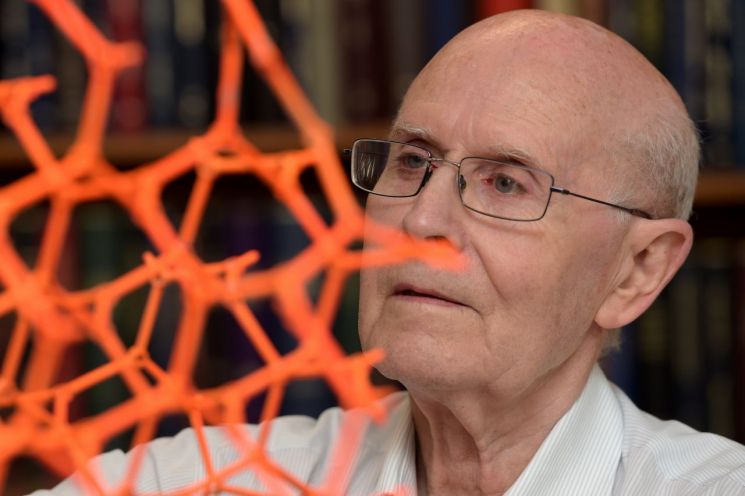 Richard Robson, one of the three scientists who jointly won the Nobel Prize in Chemistry. Photo by AP News Agency
According to Yonhap News, citing foreign media such as Reuters, Professor Robson broke his rule of abstinence upon receiving the news. On October 8 (local time), he received a call from the Royal Swedish Academy of Sciences informing him that he had been selected as a Nobel Prize in Chemistry laureate. The call came about 30 minutes before the official announcement. He quietly received the news at his home on the outskirts of Melbourne with his wife.
In an interview, Professor Robson said, "I cooked fish for dinner, and after the meal, I did the dishes," adding, "I celebrated modestly with a glass of cheap wine for the first time in a long while." He explained that he had stopped drinking several years ago due to health reasons, but made an exception for this occasion. He continued, "I can't believe something like this has happened at the final stage of my life," expressing that he felt "deeply honored, but also somewhat bewildered."
Professor Robson is regarded as a pioneer who first conceived the unique structures formed by the combination of metal ions and organic molecules, known as Metal-Organic Frameworks (MOFs). MOFs are noted for their ability to adsorb or store other substances through molecular-level micropores, making them a key material in climate change mitigation technologies.
Born in Yorkshire, United Kingdom, in 1937, Professor Robson completed his undergraduate and doctoral studies at the University of Oxford, then worked as a postdoctoral researcher at the California Institute of Technology and Stanford University in the United States. Since 1966, he has continued his research and teaching at the University of Melbourne.
An Idea from the 1970s Bears Fruit Half a Century Later
He first conceived the concept of MOFs in 1974 while serving as a lecturer in inorganic chemistry at the University of Melbourne. While making crystal structure models from wood balls and sticks for a first-year lecture textbook, he came up with the idea of forming geometric frameworks by combining metal ions and organic molecules. After refining his concept for more than a decade, he succeeded in experimentally realizing a copper cation-based MOF structure in the laboratory around 1989.
The initial MOFs had the limitation of structural instability and collapsed easily, but the concept proposed by Professor Robson inspired further research by successors such as Susumu Kitagawa of Kyoto University in Japan and Omar Yaghi of the University of California, Berkeley in the United States. Both were also selected as joint Nobel Prize in Chemistry laureates this year.
The Nobel Committee stated, "Although the early MOFs created by Professor Robson were structurally weak, they inspired countless scientists and laid the foundation for MOF research." Professor Kitagawa demonstrated the gas permeability and flexibility of MOFs, while Professor Yaghi succeeded in developing highly stable MOFs.
To date, tens of thousands of MOFs have been developed worldwide, and some are being used to address real-world challenges such as carbon dioxide capture, water scarcity, and high-density energy storage.
Heiner Linke of the Nobel Committee for Chemistry stated, "MOFs are materials that can change the world in ways we could not have predicted," calling them "an innovation that has enabled the development of customized functional materials."
Mark Cassidy, Deputy Vice-Chancellor (Research) at the University of Melbourne, said, "Professor Robson is a scholar who has devoted his life to chemistry, working with students in the laboratory," adding, "Today is the day his dedication has been recognized around the world."
© The Asia Business Daily(www.asiae.co.kr). All rights reserved.
![Clutching a Stolen Dior Bag, Saying "I Hate Being Poor but Real"... The Grotesque Con of a "Human Knockoff" [Slate]](https://cwcontent.asiae.co.kr/asiaresize/183/2026021902243444107_1771435474.jpg)















