September Exports Up 12.7% With Four More Working Days...
Average Daily Exports Down 6.1%
October Working Days to Decrease by Two Due to Chuseok Holiday
In September of this year, the number of working days-meaning the days employees went to work-increased, which led to a nearly 13% rise in exports. This set a new all-time monthly export record for the first time in three and a half years, with export growth continuing for the fourth consecutive month. The concern now is October. In October, a shortage of working days is likely to result in an overall decrease in exports, prompting the government to make every effort to minimize the impact of fewer working days.
According to the Ministry of Trade, Industry and Energy on October 9, exports in September reached 65.95 billion dollars, a 12.7% increase compared to the same month last year.
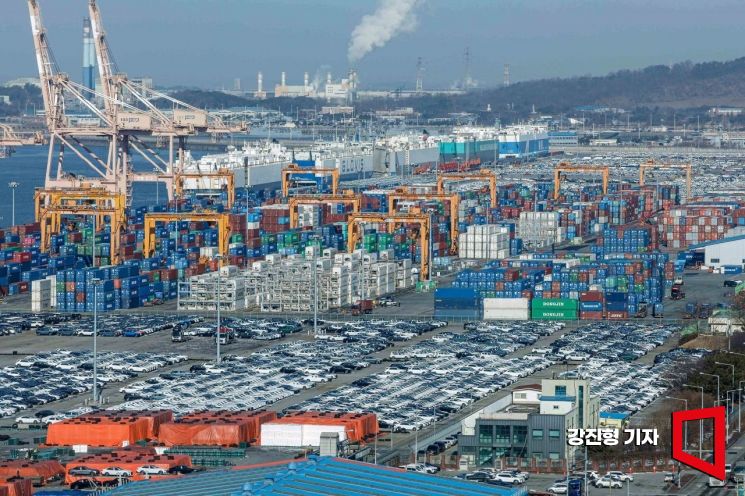 Export vehicles are waiting to be loaded at Pyeongtaek Port, Gyeonggi Province. Photo by Kang Jin-hyung
Exports last month rose by more than 12%, breaking the all-time record for the first time in three and a half years since March 2022. Third-quarter (January to September) exports also surpassed 180 billion dollars (an average of 60 billion dollars per month), reaching 185.03 billion dollars, the highest quarterly figure ever recorded.
The increase in exports in September this year was mainly due to the greater number of working days. Unlike last year, the Chuseok holiday fell in October this year. As a result, there were 24 working days in September, four more than the 20 days in the same month last year. Taking this into account, the average daily export value was 2.75 billion dollars, a decrease of 6.1%.
A Ministry official explained, "The increase in September exports was largely due to the expanded number of working days." However, he added, "The average daily export value in July was 2.43 billion dollars, in August 2.59 billion dollars, and the average for January to September was 2.57 billion dollars, so the September figure is not particularly low by comparison."
By product category, the increase in working days led to growth in 10 out of the 15 major export items. Semiconductor exports rose 22.0% to a record 16.61 billion dollars, driven by strong demand for high-value memory such as high-bandwidth memory (HBM) and double data rate (DDR) 5, especially for artificial intelligence (AI) servers, and continued stable memory fixed prices. September set a new all-time monthly record, following August's record performance.
Automobile exports increased by 16.8% to 6.4 billion dollars, the highest ever for any September, marking four consecutive months of growth. This was due to increases in both eco-friendly vehicles such as electric vehicles (EVs) and hybrid cars, as well as internal combustion engine vehicles, with used car exports also performing well at 1.04 billion dollars. Auto parts exports turned positive, reaching 1.92 billion dollars (up 6.0%).
Ship exports grew by 21.9% to 2.89 billion dollars, marking a seventh consecutive month of increase. General machinery exports (4.2 billion dollars, up 10.3%) turned positive for the first time this year, thanks to strong performance in emerging markets such as ASEAN, the Middle East, and Central and South America. Petroleum product exports (4.15 billion dollars, up 3.7%) also saw a slight increase due to higher product prices.
Biohealth exports reached a record 1.68 billion dollars in September (up 35.8%), turning positive. Display exports also posted the highest performance so far this year at 1.75 billion dollars (up 0.9%). Textiles (up 7.1%) and home appliances (up 12.3%) recorded positive export growth for the first time this year.
Outside the 15 major export items, agricultural, fisheries, and food products (1.17 billion dollars, up 21.4%) and cosmetics (1.17 billion dollars, up 28.5%) set new all-time records for the period. Electrical equipment (1.46 billion dollars, up 14.5%) set a new September record, further driving export growth.
By region, exports to China increased by 0.5% to 11.68 billion dollars, ending four consecutive months of decline and turning positive. Exports to the United States fell by 1.4% to 10.27 billion dollars, amid challenging conditions such as tariff policies. Exports to ASEAN reached a record 11.06 billion dollars in September (up 17.8%), with increases in major items such as semiconductors, general machinery, and ships, marking four consecutive months of growth. Exports to the European Union also hit a record high of 7.16 billion dollars (up 19.3%), driven by strong performance in the three major export items: automobiles, ships, and general machinery.
Imports in September rose by 8.2% to 56.4 billion dollars. While energy imports (9.4 billion dollars) fell by 8.8%, non-energy imports (47.0 billion dollars) increased by 12.5%. The trade balance last month posted a surplus of 9.56 billion dollars, up 3.12 billion dollars, marking the largest surplus in seven years since September 2018 (9.62 billion dollars). The cumulative surplus from January to September also increased by 13.85 billion dollars to 50.47 billion dollars.
A Ministry official stated, "This month, with the Chuseok holiday, there will be two fewer working days, so unlike September, total exports are likely to decrease, while average daily exports may increase. We will strengthen policy support to minimize the impact of fewer working days and help our companies maintain export competitiveness."
© The Asia Business Daily(www.asiae.co.kr). All rights reserved.
![Clutching a Stolen Dior Bag, Saying "I Hate Being Poor but Real"... The Grotesque Con of a "Human Knockoff" [Slate]](https://cwcontent.asiae.co.kr/asiaresize/183/2026021902243444107_1771435474.jpg)















