Mary Bruncko and Fred Ramsdell of the US, and Shimon Sakaguchi of Japan, awarded jointly
This year's Nobel Prize in Physiology or Medicine has been awarded to scientists who elucidated the "brake" mechanism of the human immune system.
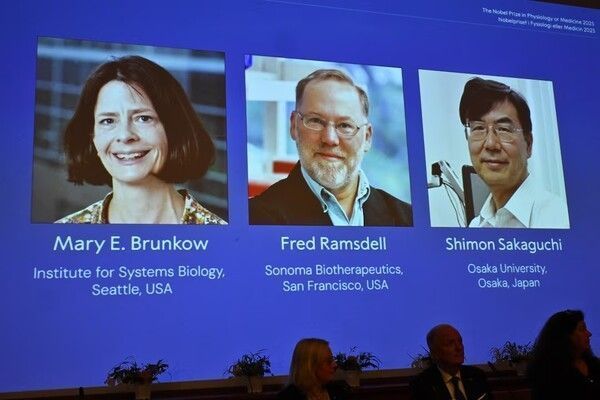 American biologists Mary Bruncko (left) and Fred Ramsdell (center), and Japanese biologist Shimon Sakaguchi, winners of the 2025 Nobel Prize in Physiology or Medicine. Photo by Yonhap News
On October 6 (local time), the Nobel Committee at Sweden's Karolinska Institute announced that American scientists Mary Bruncko and Fred Ramsdell, along with Japanese scientist Shimon Sakaguchi, were selected as joint recipients for their work in uncovering the principles of "peripheral immune tolerance."
The committee stated, "Their discoveries identified the core mechanism by which the human body prevents attacks on its own tissues," and praised their achievements as "a redefinition of the fundamental principles of immunology."
Shimon Sakaguchi, a distinguished professor at Osaka University in Japan, was the first to propose the existence of regulatory T cells that suppress autoimmune responses within the immune system in the early 1990s. Through experiments, he demonstrated that specific T cells control excessive immune reactions, thereby maintaining immune balance.
Subsequently, the two American researchers completed the study. Dr. Mary Bruncko, a biochemist, led genetic-level research on immune diseases at the University of Washington and the biotechnology company Immuo at the time. In 2001, she identified the "Forkhead box P3 (Foxp3)" gene mutation, which causes autoimmune diseases in mouse models. Foxp3 is a key transcription factor that determines the formation and function of regulatory T cells and plays a crucial role in maintaining immune tolerance. Currently, she is participating in immune-related gene-based drug development projects at the research headquarters of the Seattle-based biotech company Insight.
Co-recipient Dr. Fred Ramsdell is an immunologist and biotech innovator. At Immuo, he worked jointly with Bruncko to identify the immune regulatory function of Foxp3. He demonstrated that defects in Foxp3 cause IPEX syndrome, an autoimmune disease, and established Foxp3 as the "master gene" of regulatory T cells. Ramsdell is currently collaborating with Cytolic Therapeutics, a San Francisco-based company, focusing on the development of new drugs to suppress autoimmunity and restore immune balance platforms.
According to research on the regulation of immune system self-recognition, T cell receptors can also be generated from self-derived receptors, allowing self-recognition. To eliminate these, self-reactive T cells are removed in the thymus, thereby preventing diseases caused by autoantibodies, such as rheumatoid arthritis and lupus.
Professor Jegal Dongwook of the Department of Laboratory Medicine at Seoul St. Mary's Hospital explained, "Professor Sakaguchi discovered that self-reactive T cells express CD25 and identified the presence of these CD25 cells. He found that administering these CD25 T cells to experimental groups suppresses autoimmune diseases."
He continued, "Professors Bruncko and Ramsdell discovered the FOXP3 gene on the X chromosome and validated this in patients with IPEX syndrome. In conclusion, they found that the FOXP3 gene is critical for the maturation of CD25 T cells, and proved that CD25 T cells (Treg) suppress T cells that recognize self-proteins."
The research of these three scientists developed along separate paths since the early 1990s, but in 2001, when Bruncko and Ramsdell identified the molecular nature of the Foxp3 gene and Sakaguchi linked it to regulatory T cells, it was established as a complete theory of immune tolerance.
Committee chair Ole K?mpe evaluated, "Their discoveries played a decisive role in understanding how the immune system works and why we do not all suffer from severe autoimmune diseases."
The Korean immunology community also welcomed the Nobel Committee's decision. Kim Seongsu, professor emeritus at Kyung Hee University School of Medicine, who has devoted his career to studying the microenvironment of tumors, muscles, and immunity and revealed that metabolic regulation can act as a switch for tolerance and immune activation, commented, "This research demonstrates the essence of basic science," and added, "Research that has fundamentally changed humanity's understanding of immunity for decades has finally received its rightful recognition."
Professor Kim stated, "Recently, applied medical research such as obesity treatments like Wegovy or new diabetes drugs has attracted attention, so it is both surprising and welcome that the Nobel Committee has returned to basic science."
He added, "The relationship between regulatory T cells and Foxp3 is not just simple cell biology, but shows the 'philosophical system of the body that prevents self-attack,' and is a decision that reminds us of the true nature of immunology as a discipline."
There is also an evaluation that the discovery of regulatory T cells and FOXP3 is a classic example of how basic immunology can shift the paradigm of clinical medicine. The 1995 discovery began as pure basic research, but by cloning the FOXP3 gene and elucidating the molecular pathology of IPEX syndrome, it exemplified the classic "bench to bedside" pathway. Furthermore, the molecular biological discovery that FOXP3 comprehensively regulates the development and function of regulatory T cells demonstrated a mechanism that plays a key role in the onset of autoimmune diseases.
Of particular note is that research into rare diseases has become a breakthrough for understanding common diseases. Although IPEX syndrome is an ultra-rare disease affecting less than one in a million people, molecular genetic research on these patients provided the key to explaining the pathogenesis of common autoimmune diseases such as rheumatoid arthritis, multiple sclerosis, and type 1 diabetes. This underscores the importance of "model systems" in basic medical research and highlights the significant medical science value of uncovering not only treatments for specific diseases but also the fundamental principles of immunology.
The true value of this discovery lies in its facilitation of bidirectional translational research. In autoimmune diseases, treatment strategies can now be developed to enhance FOXP3+ regulatory T cells, while in cancer, the opposite approach of suppressing regulatory T cells within the tumor microenvironment can be pursued.
Professor Lee Juha of the Department of Rheumatology at Seoul St. Mary's Hospital commented, "The discovery of regulatory T cells and FOXP3 redefined autoimmune diseases from 'malfunctions of the immune system' to 'a shortage or dysfunction of peacekeepers.' Through research on rare diseases such as IPEX syndrome, the common mechanisms of various autoimmune diseases have been uncovered, which is an outstanding example of the power of basic science. In the past, the entire immune system was suppressed with immunosuppressants, but now it is possible to enhance or transplant regulatory T cells to target the root cause of disease, opening up the possibility of treating various diseases in a more precise and less side-effect-prone manner."
Meanwhile, the laureates will equally share the prize money of 11 million Swedish kronor (approximately 1.64 billion won). Starting with the announcement of the Physiology or Medicine Prize on this day, the Nobel Committee will continue to announce the recipients of the Physics Prize on October 7, the Chemistry Prize on October 8, the Literature Prize on October 9, the Peace Prize on October 10, and the Economics Prize on October 13.
© The Asia Business Daily(www.asiae.co.kr). All rights reserved.
![Clutching a Stolen Dior Bag, Saying "I Hate Being Poor but Real"... The Grotesque Con of a "Human Knockoff" [Slate]](https://cwcontent.asiae.co.kr/asiaresize/183/2026021902243444107_1771435474.jpg)
















