Flu Season Begins a Month Earlier Than Last Year in Japan
46 Schools in Tokyo Closed Due to Cluster Infections
Early outbreaks of influenza (flu) have begun in Japan and Taiwan, two popular destinations for Korean travelers, prompting caution among those planning to visit.

According to Kyodo News and other sources, on October 3, Japan's Ministry of Health, Labour and Welfare announced that the flu season had started a month earlier than last year. The ministry explained that this marks the second earliest entry into the epidemic phase in the past 20 years.
According to the Ministry of Health, Labour and Welfare, from September 22 to 28, a total of 4,030 flu cases were reported by 3,000 designated medical institutions nationwide, averaging 1.04 cases per institution. This exceeds the threshold for entering the epidemic phase, which is set at one case per institution. By region, Okinawa reported the highest incidence at 8.98 cases per institution, followed by Tokyo (1.96 cases) and Kagoshima (1.68 cases), which also showed high infection rates.
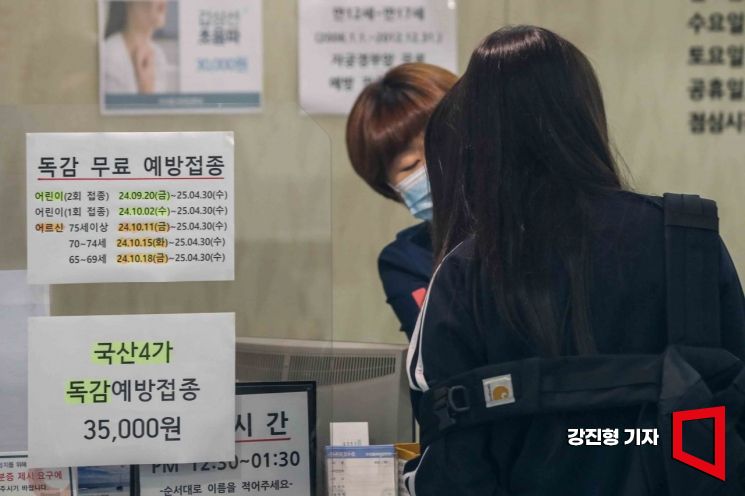 A notice for free flu vaccinations is posted at an otolaryngology clinic in Seoul. Photo by Kang Jin-hyung
Typically, influenza spreads from December through March of the following year, but last year, the outbreak began in early November, peaked at the end of December, and continued until April of this year. The Ministry of Health, Labour and Welfare cited several factors for this year’s early flu season: the hot and humid summer weather, prolonged stays in enclosed indoor spaces, and an increase in tourists due to large-scale events such as the Osaka-Kansai Expo.
In Tokyo, a total of 61 group infection cases have been reported, leading to the closure of 46 schools. This is three times higher than the same period last year. Under Japan’s School Health Act, students infected with influenza are recommended to stay home for at least six days after symptoms appear.
In Taiwan, the flu season has also already begun, and the government is ramping up vaccination efforts. On September 16, the Taiwan Centers for Disease Control announced that the number of patients with flu-like symptoms was increasing and that the epidemic threshold could soon be surpassed.
In Taiwan, the flu season typically runs from late autumn through winter (late November to March), with the peak occurring around the Lunar New Year. Since October 1, Taiwan has launched a free flu vaccination program, and to prepare for a possible 'twindemic' of influenza and COVID-19, both vaccines are being administered simultaneously.
© The Asia Business Daily(www.asiae.co.kr). All rights reserved.
![Clutching a Stolen Dior Bag, Saying "I Hate Being Poor but Real"... The Grotesque Con of a "Human Knockoff" [Slate]](https://cwcontent.asiae.co.kr/asiaresize/183/2026021902243444107_1771435474.jpg)
















