"Kazakh Government's Aggressive Push for AI Education"
100,000 Students to Be Trained Annually for Six Years Under AI-Sana
Program Expansion Planned for Africa, Including South Africa
"It is unfortunate that Korea seems to be focusing on hardware. What is more important is building an ecosystem."
Paul Kim, a professor at Stanford University, made this remark in an interview with a reporter at the "Digital Bridge Forum 2025" held on the 2nd (local time) in Astana, Kazakhstan. He said, "As part of Kazakhstan's AI-Sana project, which aims to educate 100,000 students each year for the next six years, we plan to launch an experimental AI education program starting early next year."
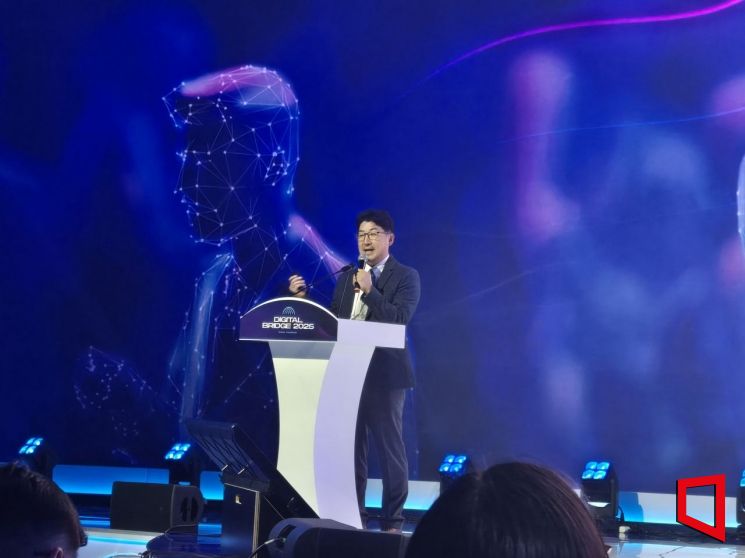 Paul Kim, a professor at Stanford University, is giving a presentation titled "Quest to Establish an AI Nation" at the "Digital Bridge Forum 2025" held on the 2nd (local time) in Astana, Kazakhstan. Photo by Kyungjo Noh
This project, led by the Kazakh government, originated from the recognition that the country needs a professional scientific institution capable of systematically covering the entire field of AI applications. The goal is to enable students to receive world-class education within their own country, rather than abroad.
President Kassym-Jomart Tokayev of Kazakhstan also emphasized at the inaugural meeting of the AI Development Committee, held the day before the forum, that "it is necessary to foster highly skilled experts who can apply AI technology across all sectors of the economy" and that "the country must attract leading global universities as partners."
Kazakhstan launched the AI-Sana project earlier this year. AI-Sana aims to introduce advanced AI technology into education, with objectives including the creation of deep-tech startups, the development of IT capabilities, and the stimulation of entrepreneurship.
Professor Kim explained that, in line with this, he has developed an educational program to help students understand how AI works. He noted that, unlike AI model training or coding education, this program takes an exploratory approach using animation and simulation, and encouraged people to sign up and experience it firsthand once it is released.
He drew attention to the Kazakh government's aggressive initiatives. Professor Kim said, "We have signed agreements with 60 universities in Kazakhstan to make this program available as both elective and required courses. We are starting by training the professors who will teach the students." He added, "Furthermore, elementary, middle, and high schools are also introducing an AI-linked, inquiry-based learning method using 'SMILE' (Stanford Mobile Inquiry-based Learning Environment), a mobile learning platform developed at Stanford University."
He continued, "We are also developing AI-based coaching and assessment systems," emphasizing, "Whenever a new version of hardware is released, it quickly becomes outdated. We need to focus on software."
He also added, "We are planning to expand this program to Africa as well, and are working in cooperation with Nelson Mandela Metropolitan University in South Africa to align the modules and facilitate easy adoption."
© The Asia Business Daily(www.asiae.co.kr). All rights reserved.
![Clutching a Stolen Dior Bag, Saying "I Hate Being Poor but Real"... The Grotesque Con of a "Human Knockoff" [Slate]](https://cwcontent.asiae.co.kr/asiaresize/183/2026021902243444107_1771435474.jpg)















