Interview with Hong Kong's Asia Weekly
"Strengthening cooperation with the U.S. ... Will maintain economic ties with China"
"South Korea-U.S. military alliance primarily focused on peace and stability on the Korean Peninsula"
Prime Minister Kim Minseok stated on October 2 that regarding Chinese President Xi Jinping's planned visit to Korea at the end of this month for the Asia-Pacific Economic Cooperation (APEC) summit, "We always hope that China will make a positive contribution to inter-Korean relations."
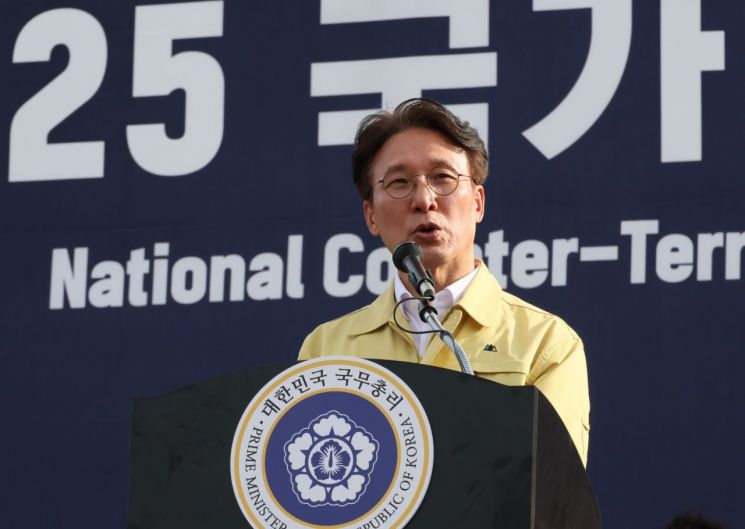
In an interview with the Hong Kong weekly magazine "Asia Weekly" published on the same day, Prime Minister Kim was asked whether Korea would request China's support for inter-Korean exchanges during President Xi's visit. He replied, "This includes both facilitating peaceful dialogue between the two Koreas and contributing to the denuclearization of the Korean Peninsula." He added, "I believe the Chinese government still maintains its established position of promoting peace, dialogue, and denuclearization on the Korean Peninsula."
Regarding the possibility of inter-Korean dialogue itself, he commented, "Currently, Chairman Kim Jong Un of North Korea is maintaining a cautious stance, so I think it is a difficult time for any meaningful progress between the two Koreas."
On the relationship between South Korea, the United States, and China, he said, "In terms of the economy, both now and in the future, cooperation with the United States will inevitably be further strengthened." However, he also noted, "China remains our largest trading partner, so we will continue to maintain economic cooperation with China as well."
He emphasized, "If Korea refrains from taking a hostile stance and strives to strengthen mutual relations, I believe China will understand."
When asked which is more worth learning from, the 'Washington model' or the 'Beijing model,' Prime Minister Kim answered, "President Lee Jaemyung's declared pragmatism seems to be about utilizing only the necessary elements from both the Washington and Beijing models."
Regarding the relevance of the Taiwan Strait issue to security on the Korean Peninsula, he stated, "Although there is a South Korea-U.S. military alliance, as a matter of principle, Korea does not participate in conflicts outside the Korean Peninsula without the consent of the Korean people." He added, "The South Korea-U.S. alliance is also primarily focused on peace and stability on the Korean Peninsula."
When asked about the U.S. request for increased South Korean defense spending, Prime Minister Kim replied, "From the perspective of self-reliant defense, we are continuously strengthening our security posture and plan to keep increasing our defense budget. This is based on our own needs."
Regarding the possibility of South Korea developing nuclear weapons, he asserted, "The Republic of Korea does not consider developing its own nuclear weapons under the Nuclear Non-Proliferation Treaty (NPT) regime," adding, "There has been no progress in such discussions between South Korea and the United States either."
On the possibility of South Korea joining the North Atlantic Treaty Organization (NATO), he said, "Militarily, we are not considering any special alternatives outside the South Korea-U.S. alliance system," and added, "The possibility of our military joining the NATO system is virtually nonexistent."
Regarding the APEC summit to be held in Gyeongju, Prime Minister Kim explained, "Preparations have been made on the premise that both President Trump and President Xi will attend, and we are doing our utmost to ensure everything is perfect."
He also emphasized, "Through this APEC summit, Korea will demonstrate on the international stage that it has fully recovered after the military coup."
When asked about the possibility of North Korean Chairman Kim attending the APEC summit and meeting with President Trump, he predicted, "Given the current situation, the likelihood that Chairman Kim will be invited to and attend APEC is low."
© The Asia Business Daily(www.asiae.co.kr). All rights reserved.

















