Plenary Session During Audit Season Essential for Passing Non-Contentious Bills
Abolition of Breach of Trust and Third Commercial Act Amendment Expected to Gain Momentum
Last month, during the regular session of the National Assembly, four contentious bills, including the amendment to the Government Organization Act that calls for the abolition of the Prosecutors’ Office, were passed under the leadership of the Democratic Party of Korea. The Democratic Party still faces pending tasks to be addressed within the current session, such as the third amendment to the Commercial Act and the abolition of the crime of breach of trust, but strong opposition from the People Power Party is anticipated. The regular session began on September 1 and is set to continue for 100 days.
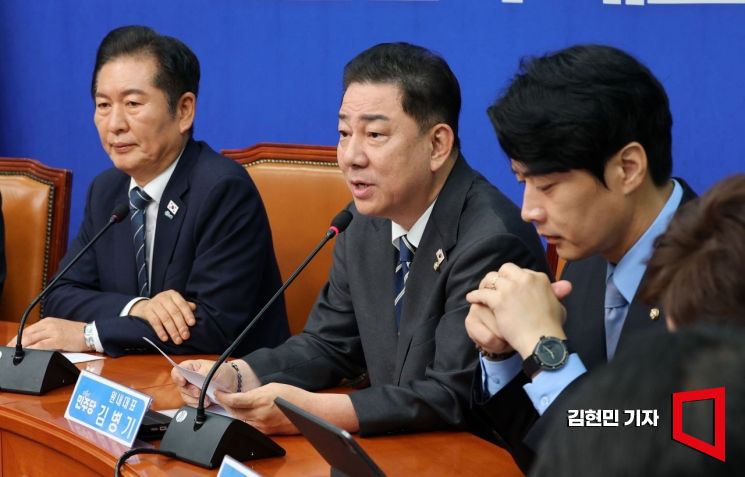 Kim Byunggi, floor leader of the Democratic Party of Korea, is speaking at the Supreme Council meeting held at the National Assembly on October 2, 2025. Photo by Kim Hyunmin
The Democratic Party’s plan is to prioritize the passage of about 70 non-contentious bills that were not addressed last month due to responding to the People Power Party’s filibuster. The party initially intended to hold a plenary session on October 2 to process at least some of these bills, but the plan fell through due to unsuccessful negotiations between the two parties. With the National Assembly audit scheduled to take place throughout October following the Chuseok holiday, the Democratic Party maintains that further delays are not feasible.
A key official from the Democratic Party stated, “There seems to be a discussion about setting a plenary session date during the audit period.” Chief Spokesperson Park Soo-hyun also commented, “I hope that, through swift agreement between the ruling and opposition parties, a separate plenary session can be held to process the bills, even if it is during the audit period, without being bound by precedent.” The audit period is scheduled from October 13 to 30.
However, cooperation from the People Power Party is crucial for the rapid processing of a large number of bills. On October 2, People Power Party leader Song Eon-seok stated at a press briefing, “For the passage of livelihood-related legislation, I hope the ruling and opposition parties can come together, reach an agreement, and then hold a plenary session to process the bills.” He emphasized the need for bipartisan cooperation, saying, “If the ruling and opposition parties agree on the agenda and schedule, there is no reason to conduct a filibuster (unlimited debate).”
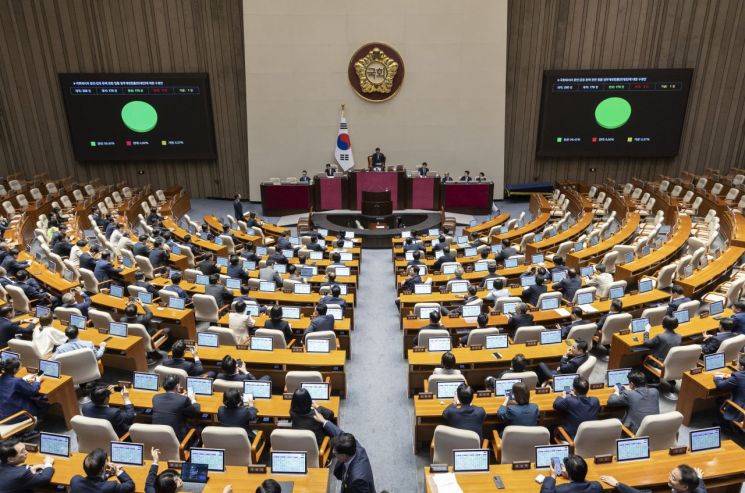
After the audit season, the Democratic Party is expected to accelerate efforts to abolish the crime of breach of trust. The party and government have agreed to move toward abolishing the crime of breach of trust under the Criminal Act to reduce the burden of economic criminal penalties on companies. However, the People Power Party is criticizing this move, framing it as an attempt to “save Lee Jaemyung.” In response, the Democratic Party argued that this issue has also been discussed under the Yoon Suk-yeol administration, citing figures such as Lee Bokhyeon, Governor of the Financial Supervisory Service. Oh Gi-hyeong, Chairman of the KOSPI 5000 Special Committee, stated, “Even if we discuss abolishing the crime of breach of trust, we must categorize and thoroughly discuss how to prevent any legislative vacuum.”
The third amendment to the Commercial Act is also expected to undergo full-scale discussion next month. The Democratic Party is pushing for the third amendment, which would require companies to cancel treasury shares they hold. Bills proposed by Democratic Party lawmakers are already on the table, including the “Kim Hyunjung bill,” which requires immediate cancellation upon acquisition of treasury shares, and the “Kim Namgeun bill,” which mandates cancellation within one year of acquisition, except for cases such as employee compensation. A key Democratic Party official said, “Since discussions on the Commercial Act and other remaining bills have not yet begun, it will likely be November before progress is made.”
Meanwhile, due to the People Power Party’s four-night, five-day filibuster (unlimited debate), the Democratic Party processed one contentious bill per day from September 25 to 29, including the amendment to the Government Organization Act, the bill to establish the Broadcasting and Media Communications Committee, the amendment to the National Assembly Act, and the amendment to the Act on Testimony and Appraisal before the National Assembly.
© The Asia Business Daily(www.asiae.co.kr). All rights reserved.
![Clutching a Stolen Dior Bag, Saying "I Hate Being Poor but Real"... The Grotesque Con of a "Human Knockoff" [Slate]](https://cwcontent.asiae.co.kr/asiaresize/183/2026021902243444107_1771435474.jpg)
















