Prescriptions Sent After Phone or Video Consultations
Medication Delivery Available for Vulnerable Groups
During the Chuseok holiday, more than 260 clinic-level medical institutions across the country will provide telemedicine services through remote consultation platforms.
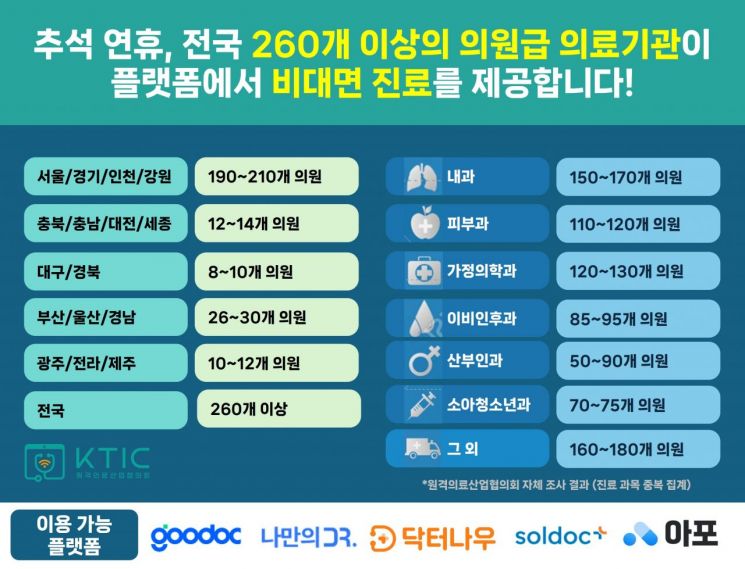
According to the Remote Healthcare Industry Council on October 3, over the Chuseok holiday period, which continues until October 9, clinic-level medical institutions offering telemedicine services include approximately 170 internal medicine clinics, 130 family medicine clinics, 120 dermatology clinics, 95 otolaryngology clinics, 90 obstetrics and gynecology clinics, and 75 pediatrics clinics. These figures include overlapping counts for clinics offering multiple specialties, and the actual number of participating institutions is expected to be higher when including member institutions not registered with the council.
Notably, among these are internal medicine clinics that treat mild conditions such as colds, flu, rhinitis, and allergies, as well as pediatric clinics, enabling a swift response to sudden fevers or gastrointestinal illnesses in young children.
By region, the largest number of telemedicine clinics are located in Seoul and the greater metropolitan area with about 210 institutions, followed by approximately 30 in the Gyeongnam region including Busan and Ulsan, 14 in the Chungnam region including Daejeon and Sejong, and 10 in the Daegu and Gyeongbuk region.
Telemedicine allows patients to select and receive care from any medical institution nationwide, regardless of their actual place of residence. To use telemedicine services, users need to download applications such as 'Goodoc,' 'My Doctor,' 'Doctor Now,' 'Soldoc,' or 'Apo' from the Play Store or App Store, then complete membership registration and identity verification.
Consultations are conducted via phone or video call, and after a one-on-one consultation with medical staff, a prescription can be issued if necessary. These platforms also provide information about pharmacies open during the holiday, allowing users to send prescriptions to operating pharmacies and pick up their medication in person. For vulnerable groups such as those aged 65 or older with long-term care certification and persons with disabilities, medication delivery is also available under current regulations.
Lee Seul, co-chair of the Remote Healthcare Industry Council, stated, "During holidays, emergency rooms are often overwhelmed with patients with mild illnesses, causing repeated overload of medical resources. Expanding telemedicine will allow for the rapid management of mild cases, enabling emergency rooms to focus on emergency and severe patients, which will contribute to public convenience and the stability of public healthcare."
© The Asia Business Daily(www.asiae.co.kr). All rights reserved.
![Clutching a Stolen Dior Bag, Saying "I Hate Being Poor but Real"... The Grotesque Con of a "Human Knockoff" [Slate]](https://cwcontent.asiae.co.kr/asiaresize/183/2026021902243444107_1771435474.jpg)















