Controversy Over the Expertise of the New High-Level Radioactive Waste Management Committee Chairperson
Nuclear Safety and Security Commission Delays Review of Continued Operation for Kori Unit 2
Site Selection Process for New Nuclear Power Plants Effectively Halted
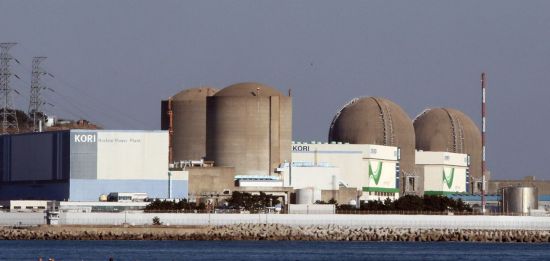 View of Gori Nuclear Power Plant Units 1 to 4 in Gijang County, Busan. Photo by Yonhap News Agency
Since the launch of the new administration, planned nuclear power policies have been repeatedly delayed. As nuclear power has been pushed down the list of government policy priorities, dissatisfaction and concern within the industry are growing.
Although the Special Act on the Management of High-Level Radioactive Waste (High-Level Waste Special Act) went into effect on September 26, the appointment of the chairperson to lead the management committee did not take place until October 2. The chairperson is appointed by the president upon the recommendation of the prime minister.
On that day, the presidential office announced the appointment of former National Assembly member Kim Hyunkwon as vice-ministerial-level chairperson of the High-Level Radioactive Waste Management Committee. The presidential office stated that Kim was highly regarded for his expertise and experience gained through years of work in institutions and committees related to the environment and energy, as well as for his demonstrated political acumen and ability to manage communication and conflict. The office added, "Since this is a national task that could spark social conflict, we expect the inaugural chairperson to successfully foster social dialogue and build consensus through sufficient communication and deliberation."
However, doubts have already been raised regarding Kim's expertise. Born in 1964, Kim graduated from Chungam High School and Seoul National University. After being imprisoned for student and labor activism, he returned to his hometown of Uiseong, North Gyeongsang Province, where he spent 25 years as a farmer, growing garlic and raising Korean cattle. He has served as head of the Uiseong Garlic Branding Project Group and president of the Uiseong Korean Cattle Association.
In 2016, Kim entered the 20th National Assembly as a proportional representative of the Democratic Party and leveraged his expertise in agriculture through long-term service on the Agriculture, Food, Rural Affairs, Oceans and Fisheries Committee. While nuclear power is a field requiring advanced expertise, Kim's only significant energy-related experience is as the inaugural president of the Gyeonggi Environment and Energy Promotion Agency, established in 2021. His spouse is Democratic Party lawmaker Lim Mi-ae.
The High-Level Waste Special Act was enacted in response to the urgent need to establish interim storage facilities and permanent disposal sites, as spent nuclear fuel (high-level radioactive waste) currently stored in temporary facilities at nuclear power plants is expected to reach capacity starting in 2030. The management committee now faces a mountain of tasks, including establishing a master plan, site selection, gathering resident opinions, and resolving social conflicts.
The management committee must also coordinate work and establish new relationships with the Ministry of Climate, Energy and Environment, which has been expanded from the Ministry of Environment to oversee nuclear power policy, as well as with the Korea Radioactive Waste Agency, which currently operates the low- and intermediate-level waste disposal facility in Gyeongju.
The nuclear industry has already presented its demands to the management committee. On September 25, the Korean Nuclear Society, ahead of the committee's launch, issued a statement calling for the prompt establishment of a national spent nuclear fuel policy that includes recycling, the immediate revision of harmful clauses in the special act that hinder the stable operation of nuclear power plants, and transparent resolution of technical controversies surrounding the Taebaek Underground Research Laboratory (URL) site.
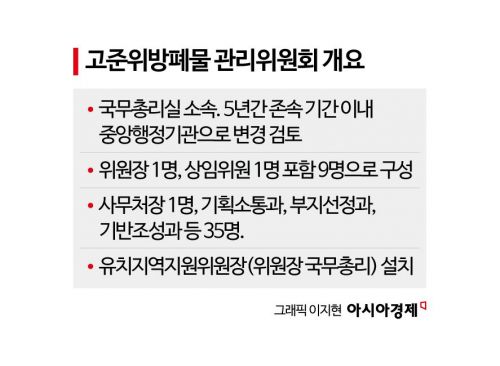
The High-Level Radioactive Waste Management Committee consists of one chairperson and nine members, including standing members. Of the eight other members, four are nominated by the chairperson and appointed by the president, while the remaining four are recommended by the National Assembly and appointed by the president. The committee's secretariat is composed of one secretary general and three subordinate divisions-planning and communication, site selection, and infrastructure development-totaling 35 staff members. The government is proceeding with appointments for the secretariat, including designating Kim Daeil, director of nuclear power industry policy at the Ministry of Trade, Industry and Energy, as secretary general.
The continued operation of nuclear power plants was expected to proceed without major obstacles under the new administration, as President Lee Jaemyung also acknowledged its necessity.
However, on September 25, the Nuclear Safety and Security Commission, which was reviewing the continued operation of Kori Unit 2, failed to reach a conclusion and decided to revisit the issue at the next meeting. On that day, both the approval of the Kori Unit 2 accident management plan and the permit for continued operation were on the agenda. Although these are separate matters, both were presented simultaneously to ensure consistency in the radiological environmental impact assessment between the accident management plan and the periodic safety review (PSR) for continued operation.
Some commission members spent the entire day reviewing only the accident management plan, so the continued operation issue was not properly addressed and the meeting ended. The accident management plan will also be resubmitted after supplementing the materials.
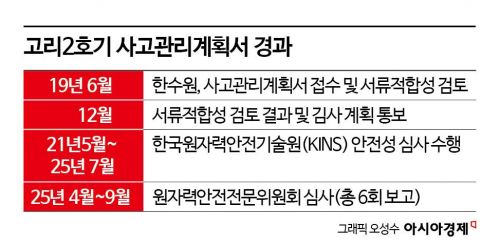
The accident management plan, submitted by Korea Hydro & Nuclear Power to the commission in June 2019, has undergone six years of safety reviews by the Korea Institute of Nuclear Safety (KINS) and a total of six preliminary reviews by the Nuclear Safety Expert Committee. Nevertheless, some members recommended by the Democratic Party raised issues by delving into detailed matters.
It is highly unusual for commission members to point out issues one by one regarding matters that dozens of experts have reviewed over several years. One fellow commission member even remarked, "Is it really necessary to go this far when both KINS and the expert committee have already completed their reviews?" Jung Bumjin, professor of nuclear engineering at Kyung Hee University, commented, "It does not align with the nature of the commission as an organization to revisit matters that have already been reviewed by experts in each subcommittee during the commission's meeting."
Even if the agenda is presented at the next meeting, its passage is far from guaranteed. Many predict that meaningful discussion will be difficult, as the terms of three commission members will expire this month. On October 12, Kim Gyuntae, a doctor at the Korea Institute of Nuclear Safety recommended by the People Power Party, and Hanyang University professor Je Mu-seong will see their terms end, followed by Park Chunhong, former president of the Korea Institute of Machinery and Materials and a Democratic Party nominee, on October 24. An official from the commission's secretariat said, "Judging by the atmosphere of the last meeting, even if the accident management plan is resubmitted, it does not seem likely to pass."
The outlook for new nuclear power plant construction is even bleaker. After Minister of Climate, Energy and Environment Kim Seonghwan raised the need for public debate at a press briefing, President Lee Jaemyung also stated, "We should greatly expand renewable energy rather than nuclear power plants, which take 15 years to build." Korea Hydro & Nuclear Power had planned to begin soliciting applications from local governments for new nuclear power plant sites in the second half of this year, but the process is currently on hold.
© The Asia Business Daily(www.asiae.co.kr). All rights reserved.


















