Amid the NCC Price War, No "Bold Moves" in Sight
Core Restructuring Delayed as Only Non-Core Assets Are Sold
Burden of Investing in Commodity Facilities Deters Market Interest
As LG Chem secures 2 trillion won in cash by selling its stake in its subsidiary LG Energy Solution, there is growing speculation that the domestic petrochemical industry is shifting into a 'holding pattern' rather than undertaking restructuring. This is because, amid a prolonged global oversupply and declining profitability, the reorganization of core facilities such as naphtha cracking centers (NCCs) has stalled, with companies mainly selling off non-core assets and partially reducing production to secure liquidity.
According to a disclosure by LG Chem on October 1, the company secured approximately 2 trillion won in cash by selling common shares of LG Energy Solution. Previously, in June, LG Chem sold its water solutions (water treatment filter) business, the second largest globally, for 1.4 trillion won, and in August, it disposed of its life science aesthetics (filler and skin booster) division for 200 billion won. While these two businesses accounted for less than 1% of the company's total sales, the cash secured over the past three months has approached 4 trillion won.
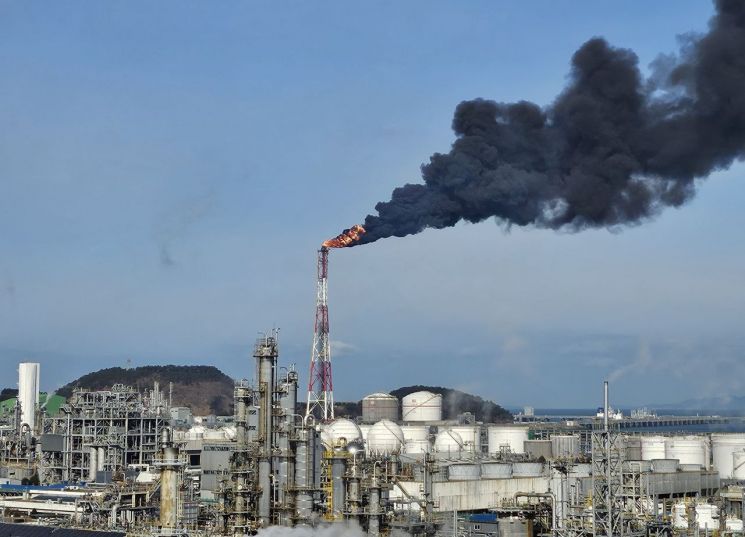 On the morning of February 25, power supply was cut off to LG Chem and Lotte Chemical within the Daesan Petrochemical Complex in Seosan, Chungnam, causing factory operations to halt. During this time, raw materials used in the production process were being burned, resulting in black smoke billowing from the chimneys. [Provided by reader] Photo by Yonhap News
In contrast, the core petrochemical segment has seen only operational efficiency measures rather than restructuring. LG Chem halted operations at the Yeosu styrene monomer line and the Naju alcohol production facility. Although there have been ongoing discussions about integrating its NCC operations with GS Caltex, no conclusion had been reached as of the end of September.
Since 2023, LG Chem has been seeking to sell its second NCC plant in Yeosu, holding talks with Kuwait's PIC and domestic oil and chemical companies, but failed to reach an agreement on price expectations. Subsequently, PIC acquired a stake in a Chinese NCC company, further highlighting the gap between market valuations.
This holding pattern is also related to an increase in borrowing during this period. LG Chem's net debt has increased by about 8 trillion won over the past year. The net debt ratio has surged from 35.6% to 52.5%. Analysts say that the funds secured through this latest stake sale are largely aimed at improving the company's financial structure, such as repaying debt. NH Investment & Securities commented, "The petrochemical segment continues to post operating losses, and any short-term improvement depends on the performance of LG Energy Solution."
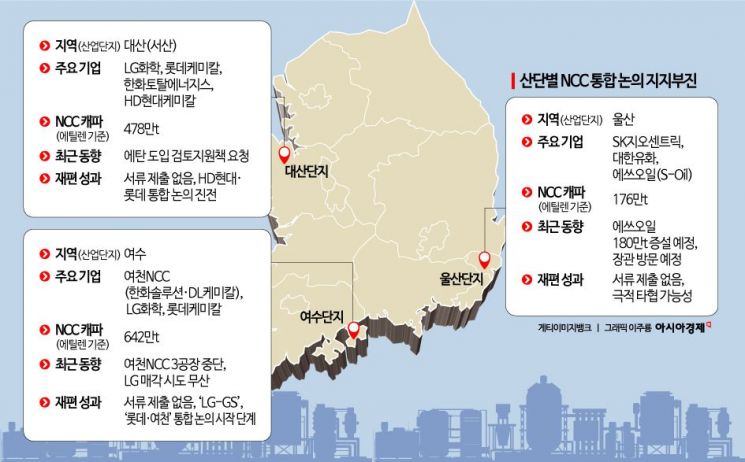
This trend is not much different for other major companies. Lotte Chemical, for example, has pursued an 'asset-light' strategy by selling its water treatment filter business last year and is moving to monetize non-core assets. At the same time, it is discussing integrating its Daesan NCC business with HD Hyundai Oilbank, but the scale is limited and progress is slow.
Hanwha Solutions faces a similar situation. By participating in a capital increase for Yeocheon NCC, it has chosen to maintain production capacity for now. Yeocheon NCC recently suspended operations at its third plant due to lower operating rates, but the continued investment even as profitability declines is largely aimed at defending market share. Yeocheon NCC has stated that it is leaving the door open to restarting the third plant if demand recovers in the future.
The government has set a target to reduce NCC capacity by 25% as part of its petrochemical industry restructuring plan, but the industry has been reluctant to pursue large-scale mergers or facility sales. An industry insider commented, "The industry as a whole is buying time by selling non-core assets rather than reorganizing core ones," adding, "As long as the oversupply from China persists, this wait-and-see attitude is likely to continue."
© The Asia Business Daily(www.asiae.co.kr). All rights reserved.
![Clutching a Stolen Dior Bag, Saying "I Hate Being Poor but Real"... The Grotesque Con of a "Human Knockoff" [Slate]](https://cwcontent.asiae.co.kr/asiaresize/183/2026021902243444107_1771435474.jpg)
















