Revealed in Data from the Office of Yoon Kunyoung of the Democratic Party of Korea
Of the 96 Systems Destroyed, None Had Disaster Recovery in Place
Discrepancy Between Claims of "Daily Backup for Over 60% of Systems" and Reality
It has been revealed that the Daejeon headquarters of the National Information Resources Service (NIRS), which manages the nation’s major administrative computer systems, was effectively left in a "disaster recovery blind spot." There are growing concerns that the recent fire, which completely destroyed a significant number of systems, led to the paralysis of the administrative network because many of these systems were operating without a server disaster recovery (DR) system in place.
According to data submitted by the office of Assemblyman Yoon Kunyoung of the Democratic Party of Korea on October 1, only 28 out of 647 systems (4.3%) operated at the Daejeon headquarters had server DR, and only 19 systems (2.9%) had storage DR. Notably, among the 96 systems destroyed in the fire in the 7-1 computer room, not a single one had server DR implemented.
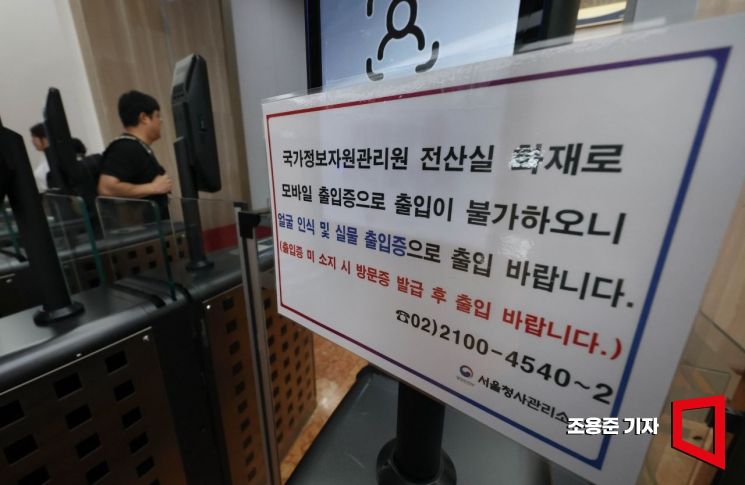 Amid the near paralysis of the government network due to a fire at the National Information Resources Service, a notice stating "Access not allowed with mobile entry pass due to fire at the National Information Resources Service" was posted on the entrance of the Government Seoul Office in Jongno-gu, Seoul on September 29, 2025. Photo by Jo Yongjun
With server DR, a separate backup server is immediately activated in the event of a failure, allowing for rapid service switchover. In contrast, storage DR only replicates data, so additional time is required for recovery. As a result, critical systems were being operated without an "immediate recovery system."
The National Information Resources Service stated that "remote backup is currently underway, centered on the Gongju Center," but in reality, only 352 systems were subject to remote backup. The agency also explained that over 60% of major system data is backed up online daily and offline at the end of each month. However, on the ground, cases of data loss continue to occur.
One prominent example is the "G Drive," a storage repository for civil servants’ work documents, which was completely destroyed in the fire, resulting in the loss of all individually stored files. As a result, it is reported that all work documents individually saved by approximately 191,000 civil servants across 74 agencies have been lost. Due to the large-capacity and low-performance nature of the G Drive’s storage, external backup was not possible, making recovery virtually impossible.
© The Asia Business Daily(www.asiae.co.kr). All rights reserved.
![Clutching a Stolen Dior Bag, Saying "I Hate Being Poor but Real"... The Grotesque Con of a "Human Knockoff" [Slate]](https://cwcontent.asiae.co.kr/asiaresize/183/2026021902243444107_1771435474.jpg)















