Business Groups and Labor Unions Remain Deeply Divided
Although discussions on extending the statutory retirement age are underway with the participation of both labor and management, led by the Democratic Party of Korea, the positions of labor unions and business groups remain sharply divided.
Business groups have expressed concerns that a blanket extension of the retirement age could lead to negative side effects, such as a reduction in new hires, and have proposed "re-employment after retirement" as an alternative. Labor unions, on the other hand, are demanding the implementation of a phased statutory retirement age extension, in line with the presidential campaign pledge to raise the age at which people begin receiving national pension benefits.
In a statement released on October 1, the Korea Employers Federation said, "Although the current statutory retirement age of 60 was fully implemented in 2017, it has only intensified negative effects such as reduced new hiring, an increase in early retirements, and worsening personnel bottlenecks, rather than improving job security for older workers." The Federation added, "If the statutory retirement age is extended again without addressing high seniority-based wages and employment rigidity, the same negative side effects will undoubtedly be repeated and exacerbated."
The Federation also stated, "Extending the statutory retirement age will encroach upon youth employment opportunities and shift the burden onto future generations." It pointed out that as the tenure of older employees in large corporations and the public sector-sectors favored by young people-increases, job opportunities for younger workers will inevitably decrease.
Accordingly, the Federation suggested that utilizing older workers through a re-employment system after retirement would be a more rational approach. "The business community strongly urges that priority be given to discussing measures such as 're-employment after retirement,' which can guarantee employment opportunities for older workers while minimizing the reduction in youth employment," the Federation said.
The Federation of Korean Trade Unions also issued a statement on the same day, asserting that "legislation on retirement age extension must be completed within this year." Labor unions argue that, considering the timing of national pension benefits, the retirement age should be extended to 65 by 2033.
The Federation stated, "Now that the mass retirement of the baby boomer generation has begun, if the current retirement age of 60 remains unchanged, these individuals will face an income gap until they become eligible for national pension benefits. This will lead to a vicious cycle of elderly poverty, increased national welfare burdens, and a contraction in consumption." The Federation warned, "Without extending the retirement age, the problem of elderly poverty cannot be resolved, and if we do not prepare now, we will face irreversible social costs."
The Federation further emphasized, "The Democratic Party must remember the promises it made to the public during the presidential election," adding, "It is time to stop delaying and present a concrete legislative proposal as a responsible political party."
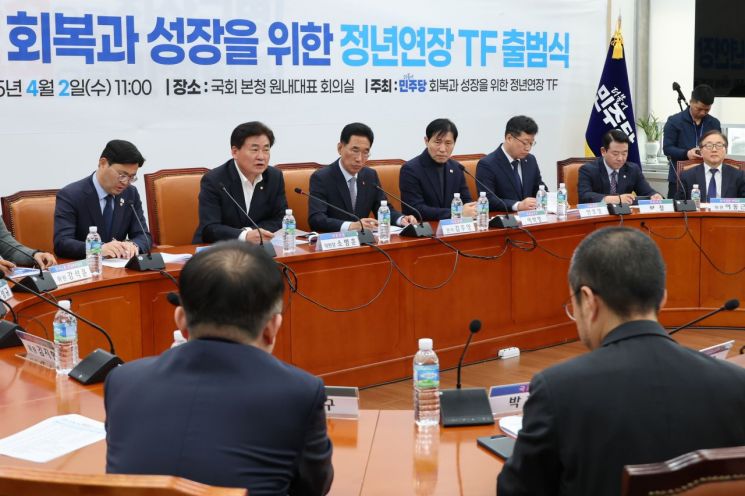
Meanwhile, the Democratic Party's Retirement Age Extension Task Force, which was launched in April, held a subcommittee meeting on this day to discuss ways to extend the retirement age. The meeting was attended by representatives from labor unions, business groups, youth, and experts. Based on the results of the Task Force's discussions, the Democratic Party plans to pursue legislation within this year.
© The Asia Business Daily(www.asiae.co.kr). All rights reserved.
![Clutching a Stolen Dior Bag, Saying "I Hate Being Poor but Real"... The Grotesque Con of a "Human Knockoff" [Slate]](https://cwcontent.asiae.co.kr/asiaresize/183/2026021902243444107_1771435474.jpg)















