A total of 35 billion won, including national funding, will be invested
Sampojigu area to be developed by 2028
Introducing a new model for hydrogen production
Yeongam County in South Jeolla Province has been selected as the final candidate for the Ministry of Land, Infrastructure and Transport's 2026 Fourth Hydrogen City Development Project.
The Hydrogen City Development Project is a government-led initiative to foster the hydrogen economy by building urban models that use hydrogen as a primary energy source, expanding hydrogen infrastructure, and applying it across all aspects of daily life.
This selection of Yeongam County as a hydrogen city marks the second achievement in the region, following Gwangyang City in the first round. South Jeolla Province is the first local government in the Honam region to have more than two cities selected. As a result, the province is expected to gain further momentum in fostering its hydrogen industry.
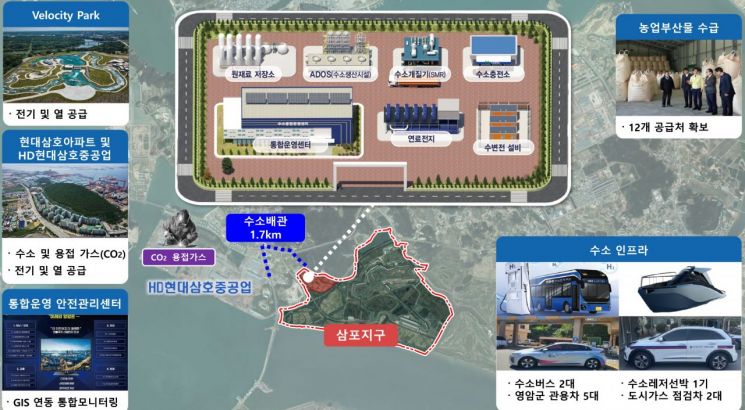
Yeongam Hydrogen City will be developed as an environmentally friendly and economically viable hydrogen city in the Sampojigu area by 2028, with a total investment of 35 billion won, including 11.5 billion won in national funding over three years. The project aims to produce and supply hydrogen from agricultural by-products.
Hydrogen production based on agricultural by-products is already a commercialized technology in more than 50 countries, including Europe and the United States. In Korea, Yeongam will be the first to pursue commercialization, presenting a new model for the clean hydrogen industry by utilizing South Jeolla's abundant agricultural by-products such as rice husks, rice straw, and fig stems.
Key projects include producing 730 tons of clean hydrogen annually using agricultural by-products such as rice husks and rice straw, constructing a 1.7-kilometer hydrogen pipeline, and installing fuel cell power generation facilities in nearby apartments and accommodations in the Sampojigu area.
Additionally, a hydrogen refueling station will be established in Sampojigu, and based on this, seven official vehicles will be converted to hydrogen cars, and two hydrogen buses will be introduced to expand hydrogen use in the transportation sector.
The project will also include a regionally specialized initiative to supply welding carbon dioxide to the Daebul National Industrial Complex, where the shipbuilding industry is concentrated, thereby simultaneously enhancing local industrial competitiveness and reducing carbon emissions.
Finally, a customized integrated safety system will be established to monitor the entire process of hydrogen production, transportation, and utilization in real time, strengthening accident response capabilities and creating a safety-first hydrogen city where residents can feel secure.
Going forward, South Jeolla Province plans to complete the comprehensive hydrogen city plan and detailed facility designs by March 2026, and finish the project by 2029 to firmly establish itself as a leading hydrogen city.
Jung Hyungu, Director of the Energy Industry Bureau of South Jeolla Province, stated, "By establishing a hydrogen city in the western region following the eastern region, in line with the new government's climate crisis response and sustainable energy transition policies, we expect South Jeolla to lead the future clean hydrogen industry. We will ensure seamless progress through meticulous master planning and thorough project management, continuously fostering the clean hydrogen industry in the western region."
© The Asia Business Daily(www.asiae.co.kr). All rights reserved.
![Clutching a Stolen Dior Bag, Saying "I Hate Being Poor but Real"... The Grotesque Con of a "Human Knockoff" [Slate]](https://cwcontent.asiae.co.kr/asiaresize/183/2026021902243444107_1771435474.jpg)















