Among the Increase in Current Labor Income and Future Pension Benefits,
the Latter Accounts for About 14%
The Closer to Pension Start, the Greater the Impact
Awareness of Future Pension Benefit Increases
Affects the Long-Term Effects of the Earned Income Tax Credit
"Working not only increases current labor income but also boosts future income through higher public pension benefits." The Bank of Korea has analyzed that raising awareness of this fact among low-income groups contributes to enhancing the long-term effects of the Earned Income Tax Credit (EITC). The Earned Income Tax Credit is a system that provides subsidies to low-income households with labor income. In addition to supplementing the income of working low-income individuals, it is expected to encourage labor market participation among those who were not previously working, enabling them to earn labor income.
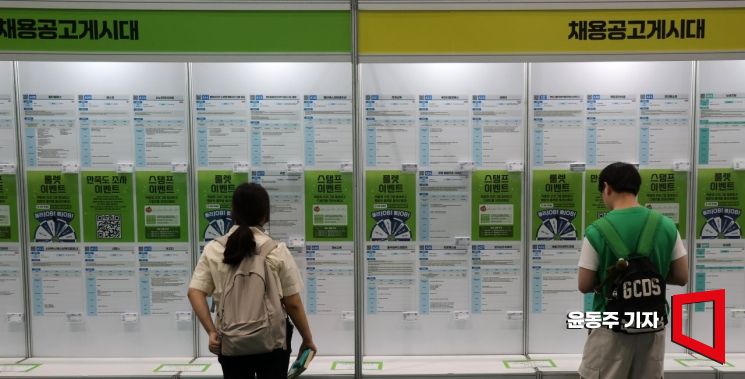 People visiting the Gangnam-gu Job Fair held at COEX in Gangnam-gu, Seoul, are checking the job posting board.
On September 30, the Bank of Korea stated this in its BOK Economic Research Report, "A Study on the Long-Term Effects of the Earned Income Tax Credit: An Analysis Using a Life-Cycle Model." Chun Dongmin, head of the Model Forecasting Team at the Economic Modeling Office, explained, "When low-income individuals who were not working enter the labor market due to the Earned Income Tax Credit, their future income in the form of public pension benefits can also increase." He pointed out, "This is because, under typical public pension systems, pension benefits rise according to the total amount of pension contributions made through labor market participation before retirement."
Considering this increase in future pension benefits (dynamic effect), the impact of the Earned Income Tax Credit on lifetime income could be greater than when only the current increase in labor income (static effect) is considered. The effect of the Earned Income Tax Credit on labor supply may also vary depending on the level of awareness and understanding of this dynamic effect among low-income groups.
Chun stated, "Through quantitative analysis using a life-cycle model, we found that the long-term effect of the Earned Income Tax Credit (on lifetime income and welfare level) becomes significantly larger due to the increase in pension benefits resulting from labor market participation."
Among the returns from labor market participation due to the Earned Income Tax Credit-namely, the increase in current labor income and future pension benefits-the latter accounted for about 14% over the entire life cycle. This proportion was 10% for ages 25-39, 13% for ages 40-49, and 19% for ages 50-65, indicating that the closer individuals are to the point of starting to receive pension benefits, the greater the impact.
Chun emphasized, "This is mainly because the response to the Earned Income Tax Credit is stronger when decision-making takes into account the increase in future pension benefits. These findings highlight the importance of awareness and understanding of future pension benefit increases in maximizing the long-term effects of the Earned Income Tax Credit."
He concluded, "Enhancing the awareness and understanding among low-income groups of the relationship between labor market participation and public pension benefits can be highly effective in increasing the long-term effects of the Earned Income Tax Credit. In the long run, the Earned Income Tax Credit can also help alleviate old-age poverty through the public pension pathway."
© The Asia Business Daily(www.asiae.co.kr). All rights reserved.
![Clutching a Stolen Dior Bag, Saying "I Hate Being Poor but Real"... The Grotesque Con of a "Human Knockoff" [Slate]](https://cwcontent.asiae.co.kr/asiaresize/183/2026021902243444107_1771435474.jpg)















