A PROTAC (PROteolysis TArgeting Chimera) nanomedicine that degrades immunometabolic proteins in refractory breast cancer and destroys cancer cells using light has been developed. PROTACs are small-molecule compounds that induce the degradation of disease-causing target proteins and are attracting attention as an innovative new drug development platform technology.
The National Research Foundation of Korea announced on September 30 that a research team led by Dr. Shim Mankyu at the Korea Institute of Science and Technology (KIST) and a team led by Professor Park Juho at Konkuk University’s Department of Biomedical Science have developed a new nanomedicine, 'NanoTAC (Nano-PROTAC; NanoTAC),' capable of treating triple-negative breast cancer.
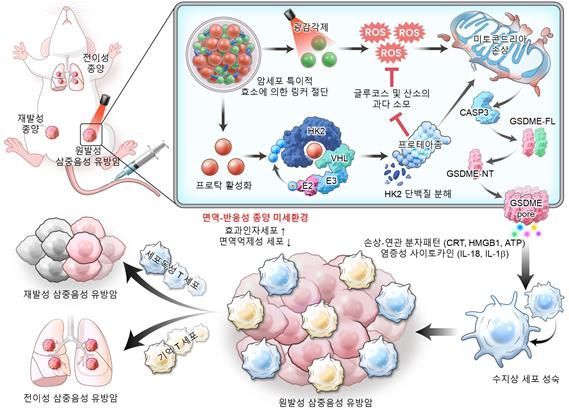
Triple-negative breast cancer is a type of breast cancer characterized by rapid progression and relatively high risks of metastasis and recurrence. The term 'NanoTAC' is a combination of nanomedicine and PROTAC, referring to the new therapeutic agent developed by the joint research team through this study.
Immunotherapeutic agents that enhance a patient’s immune response to treat disease have already been utilized in various cancer treatments, and related research is actively ongoing.
However, due to various mechanisms, the immunogenicity (the ability to elicit an immune response) within tumors has consistently weakened, leading to reduced therapeutic efficacy.
Photodynamic therapy-which involves injecting a photosensitive drug and then selectively destroying lesions such as cancer cells by irradiating them with a laser-has been known to enhance the immunogenicity of cancer cells. However, in solid tumors like triple-negative breast cancer, hypoxic environments and excessive glycolysis (the process where glucose is broken down in the cytoplasm to generate energy) have acted as factors that decrease the efficiency of treatment.
To overcome these limitations, the joint research team applied PROTACs, which have recently drawn attention in clinical settings, to anticancer immunotherapy and developed the nanomedicine 'NanoTAC,' which can be effectively delivered to tumor tissues.
NanoTAC was developed by combining PROTACs, which can continuously degrade key proteins involved in cellular immunometabolism, with a photosensitizer (a light-responsive drug used in photodynamic therapy) that can maximize immunogenicity within tumor tissues.
In experiments using animal models of triple-negative breast cancer, the joint research team confirmed that after NanoTAC was administered, it accumulated in the tumor and was cleaved by tumor-specific enzymes, releasing the PROTAC and photosensitizer separately.
During this process, the PROTAC degraded the target protein, suppressing glycolysis in cancer cells and improving hypoxic conditions. When light was applied, a strong immune response induced by photodynamic therapy effectively suppressed tumor growth, recurrence, and metastasis.
Dr. Shim stated, “NanoTAC is a nanomedicine technology that maximizes immunogenicity within cancer cells through the synergistic effects of PROTACs and photodynamic therapy. We expect that NanoTAC could become a new foundational technology for anticancer immunotherapy in the treatment of refractory cancers in the future.”
© The Asia Business Daily(www.asiae.co.kr). All rights reserved.
![Clutching a Stolen Dior Bag, Saying "I Hate Being Poor but Real"... The Grotesque Con of a "Human Knockoff" [Slate]](https://cwcontent.asiae.co.kr/asiaresize/183/2026021902243444107_1771435474.jpg)















