"Growing Interest in Musicals...
Promotion Act Expected to Pass Next Year"
Korean musicals, which began in 1966 with singer Patti Kim starring in "Saljjagi Obseoye," will celebrate their 60th anniversary next year. In May of this year, as the musical industry was busy preparing for anniversary projects, welcome news arrived: the original musical "Maybe Happy Ending" won six awards, including Best Musical, at the prestigious Tony Awards in the United States. Public interest in original musicals has grown, and there is now hope that musicals can establish themselves as a globally recognized genre within K-Culture. At the "Musical Forum 2025," hosted by the Korean Musical Association on September 2 at the Hongik University Daehakro Art Center, the 700-seat grand theater was filled to capacity as musical fans flocked to the event.
Recently, Lee Jongkyu, chairman of the Korean Musical Association, was interviewed at the association’s office to discuss strategies for the future development of Korean original musicals.
Chairman Lee stated, "These days, both the government and the National Assembly are showing great interest in musicals. I am especially grateful for their unprecedented proactive approach to providing legal and institutional support, always asking how they can help." Currently, the Musical Industry Promotion Act, sponsored by Assemblyman Kim Seungsoo of the People Power Party in June last year, is pending in the National Assembly. Lee expressed hope, saying, "I expect discussions and reviews on the bill to take place by the end of the year, and that it will be enacted sometime in the first half of next year."
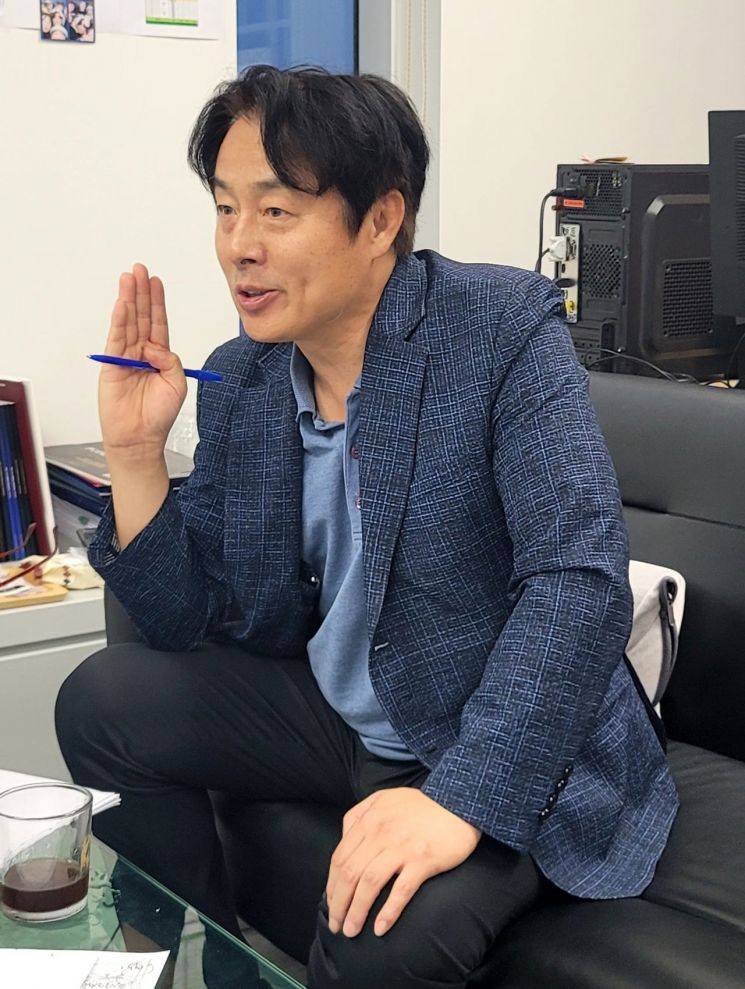 Lee Jongkyu, chairman of the Korean Musical Association, is explaining the necessity of enacting the Musical Promotion Act, which is currently pending in the National Assembly.
The musical industry expects that, just as the Film Promotion Act enacted in 1996 sparked explosive growth in the Korean film market, the Musical Promotion Act will serve as a catalyst for the growth of the musical industry.
The Promotion Act stipulates the designation of a dedicated organization for the advancement of the musical industry, as well as the establishment of the Musical Industry Promotion Committee to deliberate, decide, and advise on related matters.
Chairman Lee explained, "While it would be ideal to establish a new promotion agency, increasing the number of public institutions is a burden for the government, so the musical industry has agreed to designate an existing capable institution instead."
"Establishing Consistency in Musical Support Policies through Dedicated Organizations and Promotion Committees"
If the bill passes, it is highly likely that one of the existing organizations currently supporting various musical projects-such as the Korea Arts Council, Korea Creative Content Agency, or Arts Management Support Center-will be designated as the dedicated body. Until now, support for the musical industry has been spread across several institutions, leading to overlapping projects and making it difficult to concretely measure the impact of support.
Chairman Lee stated, "Problems such as fragmented budgeting, short-term support, and the difficulty of measuring policy effectiveness have been pointed out. If a dedicated organization is established, the currently divided musical support policies managed by three institutions will be consolidated, ensuring unity, consistency, and continuity from planning to execution."
Chairman Lee also emphasized the need for a theater dedicated to musicals. Currently, original musicals are mainly developed for small and medium-sized theaters, making it difficult to develop productions for large theaters. Large theaters primarily host licensed musicals. Even "Maybe Happy Ending" premiered in 2016 as a small-theater musical at the 300-seat DCF Daemyung Culture Factory.
Chairman Lee explained, "Producing large-theater musicals involves significant costs and risks, making it difficult for production companies to take the initiative. From the theater’s perspective, they need to rent out the venue to productions that have proven commercial appeal to ensure investment returns, so it is not easy to lease large theaters to unproven original works."
Therefore, Lee stressed the need for a dedicated public theater to foster original musicals suitable for large venues.
 Lee Jongkyu, chairman of the Korean Musical Association, is explaining the necessity of enacting the Musical Promotion Act, which is currently pending in the National Assembly.
Currently, the Sejong Center for the Performing Arts and the Seoul Arts Center are the main public theaters in operation. However, as these are complex cultural facilities, it is difficult to allocate their venues exclusively to musicals. In the case of the Sejong Center, the Seoul Metropolitan Musical Theatre is an affiliated organization, making it even harder for other groups to stage musicals there. Thus, a new theater dedicated to musicals is needed.
Lee explained, "The Promotion Act does not specifically stipulate the establishment of a theater for premiering original musicals. However, it does define the responsibility of the government and local authorities to promote the Korean musical industry."
"Musicals Contribute to the National Economy through Job Creation and IP Exports"
Chairman Lee remarked that it is encouraging that, despite challenging conditions, more than ten original musicals for large theaters-including "The Last Empress"-have been developed and achieved success. Over the years, original large-theater musicals such as "Hero," "Frankenstein," "Gwanghwamun Sonata," "The Days," "The Man Who Laughs," "Ben-Hur," and "Mata Hari" have been developed, and last year, "Swing Days: Codename A" and "Il Tenore" premiered. This coming December, a new original musical based on the novel "The Man in Hanbok," which tells the story of Joseon-era scientist Jang Yeong-sil, is set to premiere at the Chungmu Art Center Grand Theater.
Chairman Lee emphasized the need to develop the original musical market, while also stressing that licensed musicals, which dominate large-theater performances, should not be neglected.
"The actors, publicity, and marketing staff involved in licensed productions are all Koreans. Although original tour teams sometimes come, when performances are held in Korea, Korean actors and staff are often employed. This is a vital pillar of our musical ecosystem. Compared to other art genres, musicals have a high job creation effect."
Lee stressed, "The reason we must promote the musical industry is that it creates jobs, contributes to the national economy, and enhances the cultural welfare of the people." In addition to job creation, he highlighted the export potential of intellectual property (IP). "Just as successful works on Broadway and the West End continue to generate revenue for 40 to 50 years, we can also develop great works and export their IP. Already, more than 40 productions have been exported to countries such as China and Japan, so the revitalization of musicals benefits not only the musical industry but the entire nation," he emphasized.
© The Asia Business Daily(www.asiae.co.kr). All rights reserved.
![Clutching a Stolen Dior Bag, Saying "I Hate Being Poor but Real"... The Grotesque Con of a "Human Knockoff" [Slate]](https://cwcontent.asiae.co.kr/asiaresize/183/2026021902243444107_1771435474.jpg)
















