National Assembly Holds Discussion on Preventing Major Industrial Accidents Using AI and System Technologies
Artificial intelligence (AI) technology is emerging as a new solution for preventing major industrial accidents, but it appears that the pace of technological advancement is outstripping the ability of workplaces to keep up. Companies cite a lack of acceptance and trust, cost burdens, and rigid legal and regulatory frameworks as obstacles, and are calling for practical support such as national-level technology standardization and expanded tax credits.
On September 29, Assemblywoman Kim Sohee of the People Power Party, a member of the National Assembly Environment and Labor Committee, jointly hosted a "Discussion on Major Accident Prevention Using AI and System Technologies" at the National Assembly with the People Power Party's Policy Committee. The event brought together safety management officials from government ministries such as the Ministry of Employment and Labor, the Ministry of Science and ICT, and the Ministry of Trade, Industry and Energy, as well as major corporations and public institutions including DL E&C, GS Engineering & Construction, Hyundai Engineering, POSCO E&C, Hanwha Ocean, Hyundai Steel, SPC, Korail, and Korea Electric Power Corporation. During the discussion, representatives from companies and public institutions repeatedly raised the limitations they face in the field and the need for government support.
"National-Level Development and Standardization Needed"

Companies commonly expressed that there are significant limitations to developing and applying AI technology solely at the corporate level. A POSCO E&C representative said, "Common technologies such as robotics and automation require annual investments of more than 10 billion won (approximately 100 billion KRW), which is a heavy burden for companies to develop and operate alone. If the government actively participates in development at the national level, the speed of field adoption will increase." The representative continued, "Each company is developing and using its own interpretation applications for foreign workers, but there are limitations due to the specialized terminology of construction. The government should establish a standardized database so that even small and medium-sized enterprises can easily use it."
A DL E&C representative also stated, "It costs 11 billion won (approximately 110 billion KRW) per year just to develop and operate an AI control system. The construction industry, which is suffering from declining profitability, cannot bear all these costs alone." The representative suggested, "If investments in smart safety equipment were eligible for tax credits, adoption would accelerate."
A Hyundai Engineering representative commented, "The number of foreign workers on-site is increasing, but language barriers mean that even with AI translation systems, there are many limitations. The government should step in to standardize and legislate these aspects." The representative also emphasized, "We are developing unmanned exterior robots, but there are limits to what companies can do alone. Government intervention is necessary." A GS Engineering & Construction representative added, "Even large companies face significant difficulties due to the accuracy issues of AI translation, and small and medium-sized enterprises are even more vulnerable due to their lack of capacity. The government should provide policy funding to support SMEs."
There were also calls for the government to operate joint proof-of-concept (PoC) projects, as it is difficult to conduct demonstrations at the corporate level. A Hyundai Steel representative said, "There are too many new technologies, such as autonomous unmanned vehicles, smart CCTV, and digital twins, for companies to demonstrate individually. The government should run joint PoC projects by industry so that proven technologies can be immediately applied in the field."
"On-Site Acceptance a Major Obstacle"
Lack of on-site acceptance was also mentioned. Hanwha Ocean stated, "Many technologies cannot be applied due to issues with on-site acceptance. The government should revise laws and regulations to encourage adoption." HD Hyundai Samho said, "We installed radar sensors on forklifts, but the alarms go off excessively, so workers turn them off. Without AI technology to filter signals, safety devices like sensors become useless."
A Korea Electric Power Corporation representative noted, "There are 230,000 construction sites per year, more than 3,400 per day, and most of our subcontractors are small businesses with fewer than 50 employees. While AI could be a breakthrough, on-site acceptance is the biggest challenge." The representative also said, "Network integration reviews take a long time, and security guidelines are unclear. The government needs to establish clear and reasonable regulations."
A Korail representative likewise stated, "Railways have unique characteristics, but only uniform safety management tools are mandated, which do not fit. The government should recognize safety management systems tailored to the specific characteristics of each industry."
Education Alone Is Not Enough... Systemic Change Needed
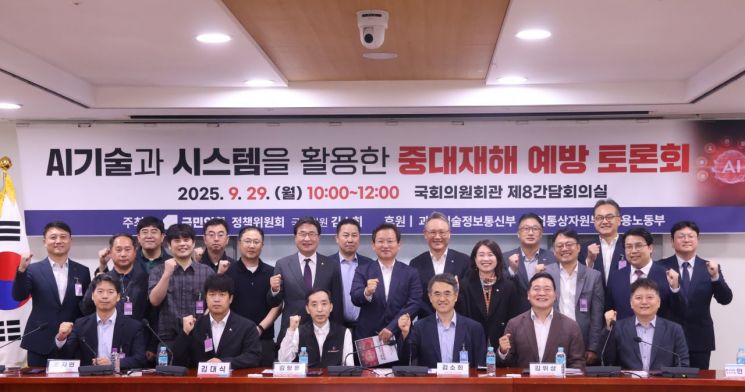 On the 29th, at the National Assembly, participants are taking a group photo at the "Discussion on Major Accident Prevention Using AI and System Technologies," jointly hosted by Kim Sohee, a member of the People Power Party's Policy Committee and the National Assembly Environment and Labor Committee. Photo by Kim Sohee's Office
The Serious Accident Punishment Act was enacted in 2021 as a result of a social consensus to reduce accidents, even through punishment if necessary. However, the annual number of workplace fatalities remains at around 800. In particular, the fatality rate in the construction industry is twice the average of the Organisation for Economic Co-operation and Development (OECD).
Chae Jonggil, a research fellow at the Seoul Institute who presented prior to the discussion, said, "The law has had a positive effect in raising the awareness of corporate management." However, he pointed out, "Since the law took effect, companies have increasingly turned to large law firms not only for case representation but also for extensive preemptive legal advice. Each consultation costs between 200 million and 300 million won (2 to 3 billion KRW), and this advice is focused on how to draft contracts to avoid management liability, rather than on safety measures." Chae emphasized, "As a result, companies are focusing more on compliance than on accident prevention. The key to preventing major accidents is to establish systems that prevent fatalities even when mistakes occur."
He also pointed out problems in the way accident causes are identified. Chae said, "Analysis of construction accident data shows that most causes are recorded as 'personal negligence.' This ultimately leads to repeated education as the main solution." He continued, "It is unrealistic to expect people to maintain concentration all day. In reality, people become desensitized when spending long periods in hazardous environments. There are limits to simply attributing mistakes to individual responsibility and trying to solve everything through education."
He cited the example of traffic accident reduction, stating, "Accidents and fatalities have decreased because of the combination of hardware (bumper design, front and rear sensors), software (traffic regulations), and human factors (seat belt use culture). We need to approach industrial accidents in the same way." Chae added, "Safety technologies such as AI and sensors have already been developed and are available on the market, but the problem is field application and cost burden. Budgets focused on education should be redirected toward the actual introduction of devices and equipment."
Assemblywoman Kim, who hosted the discussion, said, "Major accidents in industrial sites are not just simple incidents, but pain that affects our entire society. Since there are limits to what companies can do voluntarily, government policy support, institutional backing, and cooperation from society as a whole are all necessary."
© The Asia Business Daily(www.asiae.co.kr). All rights reserved.


















