The Constitutional Court has ruled that the supplementary provisions of the Special Act on Public Housing, which expand the scope of the obligation for priority sale conversion of public construction rental housing built by private rental operators and apply price control provisions retroactively when rental housing is sold to a third party, do not violate the Constitution.
On September 25, the Constitutional Court unanimously decided that the constitutional complaint (2021Hun-Ma728) filed by Company A, which argued that "the supplementary provision Article 6, Paragraph 1, Subparagraph (la) of Article 50-3, Paragraph 1, and related parts of the Special Act on Public Housing are unconstitutional," was without merit.
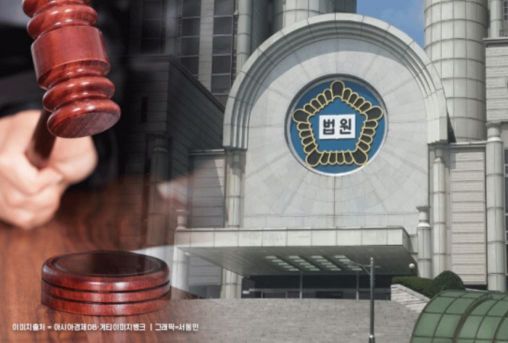 The Constitutional Court has ruled that the supplementary provisions of the Special Act on Public Housing, which expand the scope of the obligation for priority sale conversion of public construction rental housing built by private rental business operators and apply price control provisions retroactively when rental housing is sold to a third party, do not violate the Constitution. Photo by Asia Economy DB
[Provisions Under Review]
Supplementary provision Article 6 of the Special Act on Public Housing stipulates the application of priority sale conversion for public construction rental housing not operated by public housing operators. The provisions under review are Article 6, Paragraph 1, Subparagraph (la) of Article 50-3, Paragraph 1, and Article 50-3, Paragraph 4 of the supplementary provisions.
Article 6, Paragraph 1 of the supplementary provisions states, "Notwithstanding Article 6, Paragraph 2 of the Supplementary Provisions of Act No. 13499 (the Act on the Partial Amendment of the Act on Private Rental Housing), the amended provisions of Article 50-3, Article 57-3, and Article 60 shall also apply to housing regarded as public construction rental housing under Article 6, Paragraph 2 of the Supplementary Provisions of Act No. 13499, where the conversion to sale has not been completed."
[Case Overview]
Company A, which operates in housing construction and real estate leasing, received approval for its business plan in August 2015 to build public construction rental housing on land developed for public projects under Article 16 of the Housing Act, at the time of the enforcement of the Special Act on Private Rental Housing. The company also leased housing constructed after the enforcement of this law, using land supplied for public construction rental housing purposes. At the time of the constitutional complaint, each public construction rental housing unit was either still within the mandatory rental period or, even if the period had expired, the lease contract between the rental operator and the tenant remained in effect, meaning the conversion to sale had not been completed.
Because Company A is not a public housing operator under the Special Act on Public Housing, the supplementary provisions of the former Special Act on Private Rental Housing originally applied. However, under Article 6, Paragraph 1 of the supplementary provisions of the Special Act on Public Housing, the new provisions also became applicable to each public construction rental housing unit. In other words, instead of the former Article 21, Paragraph 1, Subparagraph 4 and Article 21, Paragraph 7 of the Rental Housing Act, Article 50-3, Paragraph 1, Subparagraph (la) and Article 50-3, Paragraph 4 of the Special Act on Public Housing now apply to each public construction rental housing unit.
Company A argued that "the amended provisions expand the scope of the obligation for priority sale conversion and impose price controls even when rental housing is sold to a third party, thereby infringing on the freedom of business and other rights of the petitioner," and filed a constitutional complaint.
[Constitutional Court's Judgment]
The Constitutional Court held that expanding the scope of the obligation for priority sale conversion aligns with the information previously disclosed by the rental operator, and that imposing price controls on the sale of rental housing to a third party removes the economic incentive for rental operators to narrowly interpret tenants' eligibility for priority sale conversion. Therefore, the provisions under review do not infringe on the freedom of business of rental operators.
The Court stated, "The provisions under review are intended to prevent disputes between rental operators and tenants regarding the priority sale conversion of public construction rental housing and to protect tenants, while also ensuring housing stability and the substantive guarantee of tenants' rights to priority sale conversion. Thus, the legitimacy of the legislative purpose and the appropriateness of the means are recognized."
The Court further explained, "With the revision of Act No. 17734, the part concerning Article 50-3, Paragraph 4 of the provisions under review requires that, regardless of whether the tenant had eligibility for priority sale conversion, any sale of the relevant public construction rental housing to a third party must be at or below the priority sale conversion price, rather than at a higher price, as was previously allowed under the former Special Act on Public Housing and the former Rental Housing Act. This aims to prevent disputes that could arise if rental operators, motivated by the prospect of selling at a higher price, narrowly interpret tenants' eligibility for priority sale conversion and notify tenants that they are ineligible."
The Court also noted, "The new requirements regarding 'homeless status' in the provisions under review are consistent with the information previously disclosed by the rental operator. Moreover, the profits that a rental operator could obtain by selling rental housing to a third party at an arbitrary price may fluctuate depending on the number of tenants eligible for priority sale conversion, so it is difficult to consider the operator's existing expectations as a value or necessity that requires special constitutional protection. Additionally, in the case of laws regulating economic activities such as housing rental business, it is common to impose new legal regulations according to social and economic circumstances, and the specific procedures for sale conversion of rental housing cannot be regarded as immutable."
Park Suyeon, Law Times Reporter
※This article is based on content supplied by Law Times.
© The Asia Business Daily(www.asiae.co.kr). All rights reserved.
![Clutching a Stolen Dior Bag, Saying "I Hate Being Poor but Real"... The Grotesque Con of a "Human Knockoff" [Slate]](https://cwcontent.asiae.co.kr/asiaresize/183/2026021902243444107_1771435474.jpg)
















