Hyundai Mobis Hosts Vehicle Semiconductor Forum on the 29th
"Fostering the Domestic Vehicle Semiconductor Ecosystem...A Pivotal Role"
Hyundai Motor: "10% of Semiconductors to Be Domestically Produced by 2030"
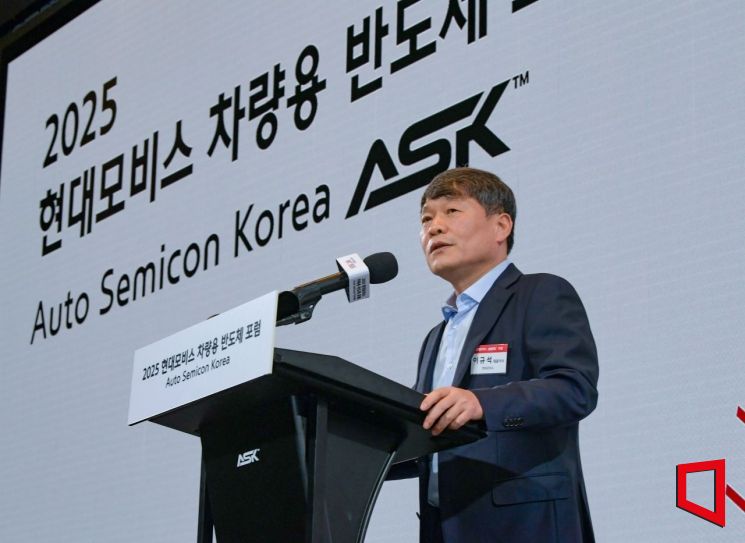
President Lee Kyuseok of Hyundai Mobis announced that next-generation vehicle semiconductors developed and produced domestically could be applied to mass production as early as next year. Hyundai Mobis emphasized that it will play a pivotal role in connecting the automaker and semiconductor industries to foster the domestic vehicle semiconductor ecosystem.
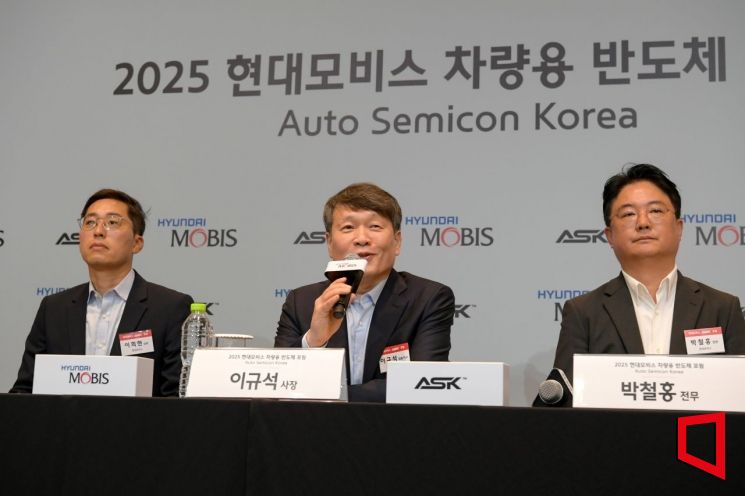 Kyu-Seok Lee, President of Hyundai Mobis (center), is speaking at a press conference held on the 29th at the DoubleTree by Hilton Seoul Pangyo Hotel in Seongnam, Gyeonggi Province, during the "1st Vehicle Semiconductor Forum." From left to right: Hee-Hyun Lee, Executive Director of Hyundai Mobis System Semiconductor Division; President Lee; and Cheol-Hong Park, Executive Vice President in charge of the Semiconductor Business. Hyundai Mobis
On the 29th, at the "1st Vehicle Semiconductor Forum (ASK)" held at the DoubleTree by Hilton Seoul Pangyo Hotel in Seongnam, Gyeonggi Province, President Lee stated, "We are currently co-developing more than 10 types of semiconductors with domestic semiconductor companies."
Currently, the dependence on foreign-made vehicle semiconductors, such as those from Europe and North America, is close to 95%. President Lee explained, "Witnessing the supply chain crisis for vehicle semiconductors from 2021 to 2023 due to the pandemic and geopolitical issues, I strongly felt that securing a domestic base is essential for stable procurement."
Hyundai Mobis has independently developed a total of 16 types of semiconductors, including integrated semiconductors for airbags, power semiconductors for eco-friendly vehicles, integrated semiconductors for motor control, and power semiconductors for AVN (audio, video, navigation) electronic components, and is mass-producing them through external foundry companies. The number of semiconductors expected to be mass-produced this year alone is projected to exceed 20 million units.
With this forum as a starting point, Hyundai Mobis plans to bring together more than 20 semiconductor companies and research institutes, including Samsung Electronics, LX Semicon, and SK Key Foundry, to foster the vehicle semiconductor sector. Currently, the company is conducting research and development on 11 types of next-generation semiconductors, such as battery management systems, communication semiconductors, and network system-on-chips (SoC), aiming to complete them within three years.
President Lee said, "Within the next two to three years, we will be able to achieve collaborative results with domestic companies on more than 10 types of vehicle semiconductors," adding, "Personally, I would like Hyundai Mobis to guide two or three new projects per fabless company."
He further explained, "Vehicle semiconductors have many demanding requirements, but the market size is small. Although many types of semiconductors are used, the purchase volume is limited. To overcome these limitations, we will increase demand volume through standardization and sharing of semiconductors, and expand the market by identifying existing semiconductors that can be used for vehicles."
With the advent of software-defined vehicles (SDVs), demand for vehicle semiconductors is expected to increase. Verified Market Research forecasts that the vehicle semiconductor market will grow from $54.9 billion in 2024 to $104.6 billion by 2032, with a compound annual growth rate of 9.64% from 2026 to 2032.
Within Hyundai Motor Group, Hyundai Motor and Kia will focus on high-performance semiconductors, while Hyundai Mobis will concentrate on system and power semiconductors.
In addition, Hyundai Mobis has expanded its collaboration with Samsung Electronics to include the vehicle semiconductor sector. President Lee stated, "We are currently collaborating with Samsung on batteries and vehicle displays, and semiconductors will also become a new area of cooperation." However, he added, "Although Samsung Electronics has a large foundry capacity in Korea, there are several foundry companies domestically. We will collaborate with multiple foundry companies on the items currently under development."
President Lee emphasized, "Hyundai Mobis is not only a core affiliate of Hyundai Motor Group but also an active player that directly designs and develops semiconductors. We will serve as a connector across the entire semiconductor value chain, linking automakers, fabless companies, design houses, and packaging companies."
Meanwhile, Hyundai Motor Group has announced plans to more than double the application rate of domestically produced vehicle semiconductors to 10% by 2030. The group aims to secure the domestic semiconductor value chain to proactively mitigate mid- to long-term supply chain risks.
Lee Hyukjun, Executive Director of Electronic Parts Purchasing at Hyundai Motor, stated at the forum, "The scale of vehicle semiconductor purchases will more than double from 8.3 trillion won in 2024 to 16 trillion won in 2033. To expand the application rate of domestic semiconductors by 2030, we will directly select major semiconductors and manage the entire value chain, establishing a collaborative system."
© The Asia Business Daily(www.asiae.co.kr). All rights reserved.
![Clutching a Stolen Dior Bag, Saying "I Hate Being Poor but Real"... The Grotesque Con of a "Human Knockoff" [Slate]](https://cwcontent.asiae.co.kr/asiaresize/183/2026021902243444107_1771435474.jpg)
















