On September 29, Hanwha Investment & Securities revised its forecast for the Bank of Korea Monetary Policy Committee’s base rate cut from October to November, predicting that the rate will remain unchanged next year.
Kim Seongsu, a researcher at Hanwha Investment & Securities, stated in a report titled "The Last Cut in November, No Cut in 2026" that "overall, the terminal rate will be 2.25%." He explained that the Bank of Korea has maintained its decision to hold the rate steady since lowering it to 2.50% at the Monetary Policy Committee meeting in May.
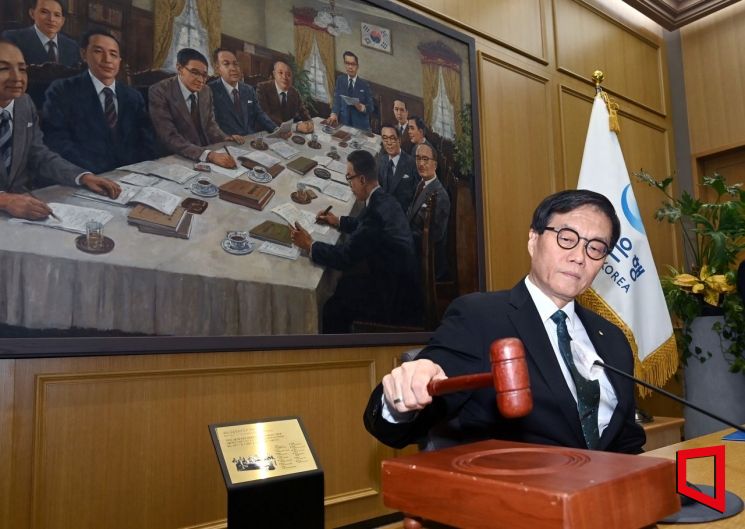 Lee Changyong, Governor of the Bank of Korea, is striking the gavel at the Monetary Policy Committee meeting held at the Bank of Korea in Jung-gu, Seoul, on the morning of August 28, 2025. Photo by Joint Press Corps
Kim noted, "So far, the Bank of Korea has assessed its monetary policy environment as 'improving, but with growth below potential' and has expected that government measures will help address issues related to real estate and household debt, though these need further observation." He added, "This assessment has shifted to 'Seoul housing prices are still rising and the foreign exchange market has become unstable again,' and 'growth is improving but remains below potential.'" He explained that "for now, it is natural to focus on financial stability for a longer period," and therefore revised the expected timing of the rate cut from October to November.
He also projected that the base rate would remain unchanged next year. Kim said, "If the timing of the base rate cut is delayed this year out of caution, there will be little reason to lower it next year, so it is highly likely that the 2.25% base rate will be maintained." He analyzed, "Inflation, financial stability, the economy, and the neutral rate will not strongly require additional policy adjustments in 2026."
He continued, "Even next year, it will be difficult to say that the real estate and household debt situations have stabilized, and the same goes for the exchange rate." He predicted, "Growth is expected to improve as the base effect from 2025 and risks related to tariffs gradually ease or are reflected."
Additionally, he pointed out that although the neutral rate is generally influenced by the potential growth rate, Bank of Korea Governor Lee Changyong has argued for over two years that 'the neutral rate considering financial stability will be higher than before.' Kim explained, "The current base rate is already below the midpoint of the neutral rate, and even if the neutral rate is revised downward, the base rate will continue to be below the midpoint if it is cut to 2.25%." He added, "A decline in the potential growth rate is offset by financial stability factors. Our terminal rate is 2.25%."
© The Asia Business Daily(www.asiae.co.kr). All rights reserved.
![Clutching a Stolen Dior Bag, Saying "I Hate Being Poor but Real"... The Grotesque Con of a "Human Knockoff" [Slate]](https://cwcontent.asiae.co.kr/asiaresize/183/2026021902243444107_1771435474.jpg)















