Concerns Over Anti-American Sentiment Triggered by Strong Rhetoric Toward the U.S.
Government: "Overcoming This Will Further Strengthen Korea-U.S. Relations"
On September 26 (local time), the government addressed concerns that South Korea's recent tough statements toward the United States regarding the stalled Korea-US tariff negotiations could fuel anti-American sentiment and negatively impact the talks, stating, "This is a challenge, but if we overcome it, the Korea-US relationship will be further strengthened."
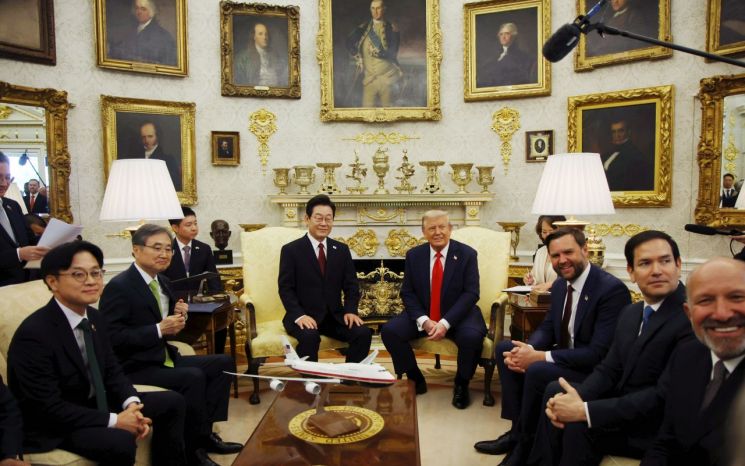
A senior government official met with the Korean press corps in New York that day and said, "Since the Korea-US tariff negotiations have not yet been concluded, we acknowledge that such factors present challenges to the bilateral relationship." However, the official added, "There have been several such challenges in the Korea-US relationship in the past, and each time, resolving them has only served to further strengthen our ties."
The official cited the 1997 foreign exchange crisis and the IMF package negotiations with the United States as an example, explaining, "There was criticism that the terms were harsh, but ultimately, we overcame the crisis and the Korea-US relationship improved." He continued, "During the 2008 global financial crisis, Korea was also able to avoid the worst of the crisis thanks to this experience and mutual trust."
At present, South Korea and the United States are locked in conflict, unable to narrow their differences in follow-up negotiations after reaching a trade agreement at the end of July. The United States agreed to lower reciprocal and automobile tariffs on Korean goods from 25% to 15%, while South Korea agreed to invest 350 billion US dollars (about 493 trillion won) in the United States in return. However, the United States is demanding a "Japanese-style agreement," which would increase the proportion of direct investment and allow the US to take 90% of the profits, while South Korea insists on an investment model focused on guarantees and loans. The South Korean government also believes that raising 350 billion US dollars in cash in a short period would inevitably cause a major shock to the foreign exchange market. As the two sides remain at an impasse, the United States has implemented a 15% tariff on Japanese and European automobiles, but continues to impose a 25% tariff on Korean cars.
In this context, President Lee Jaemyung publicly stated just before departing for New York to attend the United Nations General Assembly high-level session last week that fully accepting the US demands could lead to "a situation like the 1997 foreign exchange crisis and even the possibility of impeachment." The president's direct and tough remarks have heightened concerns that anti-American sentiment could be inflamed domestically and that the negotiations could become even more difficult. Subsequently, on September 24, President Lee met with US Treasury Secretary Scott Besant and emphasized the need for a Korea-US currency swap to facilitate a tariff agreement, but the US side did not respond. Instead, US President Donald Trump the next day described South Korea's 350 billion US dollar investment as "up front," repeatedly stressing that investment is a precondition for tariff reductions and adopting an even more uncompromising stance.
The senior government official's remarks appear to acknowledge that the current tariff negotiations could become a new test for the Korea-US relationship. At the same time, they are interpreted as emphasizing that overcoming this challenge could serve as an opportunity to further solidify the alliance.
© The Asia Business Daily(www.asiae.co.kr). All rights reserved.

















