The 13th Korea-OECD International Fiscal Forum Held
Discussions Centered on "The Role of AI and Fiscal Policy"
Estonia, France, and Others Share National Case Studies
Advice Offered on Data Integration and Sharing
"Korean Government Fo
"Artificial intelligence (AI) is a tool, so if it is not given data, its predictive ability is inferior to that of humans. However, once data is provided, it is clear that AI can replace many experts."
Yeonhee Lee, Director of the Fiscal and Economic Policy Intelligence Research Center at the Electronics and Telecommunications Research Institute (ETRI), made this statement at the 13th Korea-Organisation for Economic Co-operation and Development (OECD) International Fiscal Forum, held on September 26 at the JW Marriott Hotel Seoul in Seocho-gu, Seoul. Director Lee explained that fiscal efficiency and sustainability can be enhanced through physical AI, which executes fiscal tasks and seeks solutions to problems within a digital twin-a virtual model that closely resembles reality.
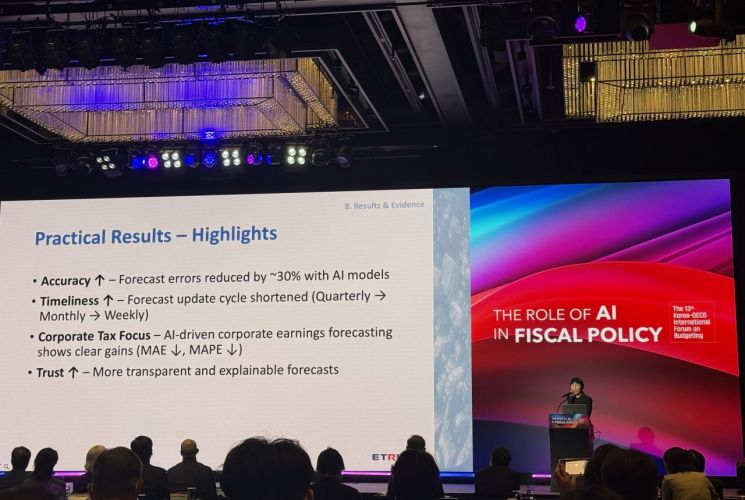 Yeonhee Lee, Director of the Fiscal and Economic Policy Intelligence Research Center at the Electronics and Telecommunications Research Institute (ETRI), is presenting at the 13th Korea-Organisation for Economic Co-operation and Development (OECD) International Fiscal Forum held on the 26th at the JW Marriott Hotel Seoul. Photo by Kim Pyeonghwa
The International Fiscal Forum is hosted by the Ministry of Economy and Finance and co-organized by the Korea Development Institute (KDI) and the OECD. Since 2009, it has alternated between Seoul and Paris, France. This year, experts in fiscal policy from major countries such as Korea, France, the United Kingdom, and Estonia, as well as the OECD, gathered to discuss the theme of "The Role of AI and Fiscal Policy."
Evolution from Perception AI to Physical AI: "Sustainable Fiscal Policy Possible"
As the presenter for Session 1, Director Lee stated, "Last year, we began real-time tax revenue estimation research with the Ministry of Economy and Finance and have been working together. Over the past three to four years, we have experienced errors amounting to tens of trillions of won in tax revenue estimation. Without accurate forecasts, it is difficult to establish reliable fiscal policy, so we are striving to improve our predictions." She added, "In particular, we are focusing on corporate tax," explaining that this is because corporate performance and the economic cycle are the main causes of errors in tax revenue estimation. She also mentioned plans to develop an AI model specialized in corporate tax prediction.
Director Lee noted, "The fiscal domain of tax revenue prediction itself has long cycles, which makes it difficult to discuss predictive accuracy." Nevertheless, she said, "We are continuously working to improve performance using various AI techniques." She went on to say, "(Going forward) we plan to utilize more timely data and high-frequency microdata." She emphasized, "Ultimately, having a pipeline system to acquire timely data is crucial for improving predictive performance."
In the process of enhancing fiscal policy efficiency, she explained that Perception AI, Generative AI, Agentic AI, and Physical AI can all be utilized. Director Lee stated, "Starting with Perception AI, which recognizes fiscal data and detects anomalies, we will move toward Physical AI, which implements real fiscal problems in a digital twin environment similar to reality to help solve real-world issues." She further explained, "By making predictions in environments similar to reality, planning and executing fiscal policy based on those predictions, and rapidly incorporating feedback, it will be possible to achieve swift and sustainable fiscal policy."
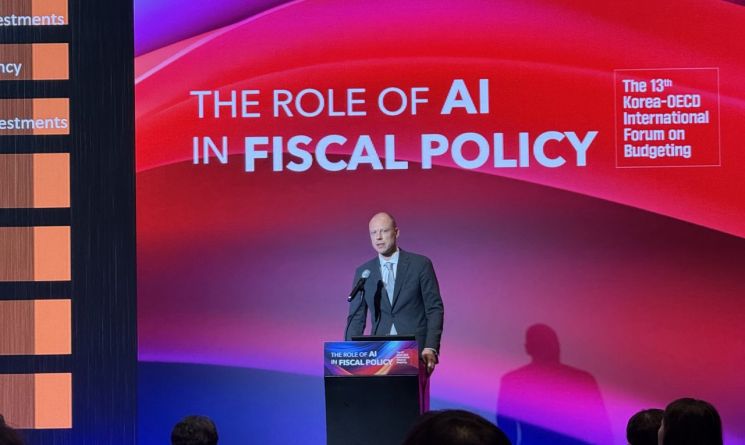 Sven Kirssipuu, Deputy Assistant Minister for Budget at the Estonian Ministry of Finance, is presenting at the 13th Korea-Organisation for Economic Co-operation and Development (OECD) International Fiscal Forum held at the JW Marriott Hotel Seoul on the 26th. Photo by Kim Pyeonghwa
Fiscal authorities from Estonia and France also shared their respective cases of AI utilization at the event. Sven Kirssipuu, Deputy Assistant Minister for Budget at the Estonian Ministry of Finance, said, "We are using AI in the budget formulation process." He explained, "By conducting meta-analysis to re-examine existing analyses and generate data, we were able to make proposals for budget efficiency and reduce the budget through the process of analyzing hundreds of pages of policy documents." He added that as the era of Artificial General Intelligence (AGI) approaches, "connecting data within government is important," stating, "This is the ultimate goal."
Victoire Daer, Head of the Digital Transformation Project at the French Ministry of Finance, said, "France is utilizing AI in various projects," and explained, "We were able to increase tax revenue by identifying undeclared property tax records." She also stated, "For next year's tax revenue forecasts, we were able to predict profits using AI," and "Thanks to AI, we have enjoyed increased tax revenue." She added, "AI also makes predictions related to tax payments," but explained, "We are deploying personnel in the process to ensure data accuracy."
During the discussion following Session 1, several challenges and pieces of advice were presented to fiscal authorities. Kim Junghoon, President of the Fiscal Policy Research Institute, emphasized, "All government data should be made available to the public after anonymization." He also remarked, "The International Monetary Fund (IMF) conducts fiscal monitoring annually, but unlike the 39 other member countries, Korea excludes local governments from the scope of central government." He continued, "The silo problem between government governance structures is difficult to overcome but is an important issue," and pointed out, "Fiscal data without local governments is meaningless."
Kwon Sungjun, Director of the Tax Revenue Estimation Center at the Korea Institute of Public Finance, said, "To improve fiscal efficiency and the accuracy of tax revenue forecasts, an integrated data repository that refines and consolidates various data is needed." He added, "For this purpose, not only cooperation among related agencies but also strong government commitment is required." He further noted, "Since data produced by various agencies is dispersed, preliminary work is needed for collection and integration," and emphasized, "Especially in tax revenue prediction, since tax data from the National Tax Service is crucial, forecasting agencies must be able to access it securely."
UK: "Active Promotion of AI as One of the Top 10 Policy Priorities"... Korea: "AI Investment as a Means to Restore Fiscal Soundness"
In Session 2, under the theme of "The Role of Investment and Fiscal Policy," presentations were given on the direction of public investment in AI, the creation of an AI industrial ecosystem, and the role of fiscal policy in securing technological sovereignty. Experts from the United States, the United Kingdom, and Korea discussed the government's role in AI investment for the development of advanced and national strategic industries and explored ways for global cooperation.
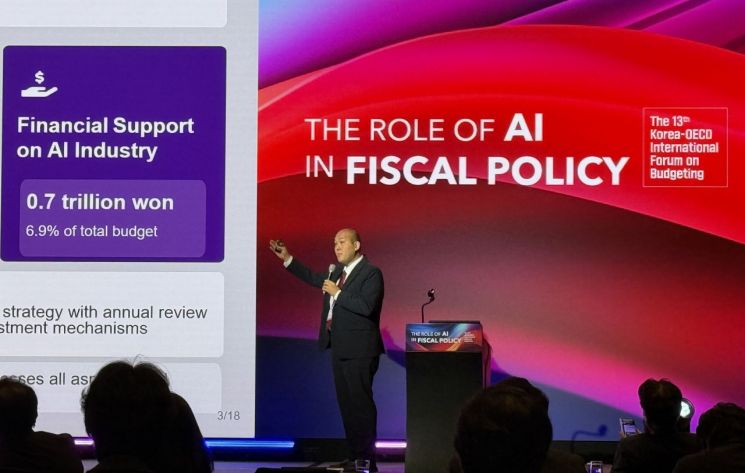 Kim Gunmin, Director of the Information and Communication Budget Division at the Ministry of Economy and Finance, is presenting at the 13th Korea-OECD International Fiscal Forum held on the 26th at JW Marriott Hotel Seoul. Photo by Kim Pyeonghwa
Stuart Glassborow, Director for Growth at the UK Treasury, said, "There is a government-level action plan, and various initiatives are being implemented in both the public and private sectors. The government is making significant investments and forming numerous partnerships." He continued, "The Treasury is examining how these efforts will affect the tax base, labor market, and financial services, respectively. I believe coordination is key." He emphasized that "AI is one of the top 10 policy priorities, with the Prime Minister and Deputy Prime Minister taking a personal interest."
Another presenter, Kim Gunmin, Director of the Information and Communication Budget Division at the Ministry of Economy and Finance, stated, "Going forward, the Korean government will focus on physical AI," and explained, "Korea's manufacturing sector is undergoing digitalization and is working to embrace AI." He added, "While Korea may not be able to lead the large language model or autonomous vehicle industries, it can take the lead in manufacturing AI." Kim emphasized, "Government spending on AI is a means to restore fiscal soundness; if we succeed, economic growth and fiscal soundness will follow, and that is our true goal."
© The Asia Business Daily(www.asiae.co.kr). All rights reserved.



















