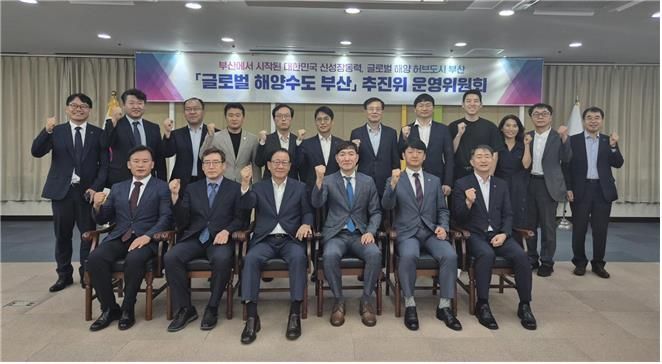
Busan City is accelerating the implementation of strategies to become a global maritime hub city. On the morning of the 25th, the city held the inaugural meeting of the "Global Maritime City Busan Steering Committee" at City Hall, where concrete action plans were discussed.
The Steering Committee operates under the "Global Maritime City Busan Promotion Committee," which was launched in August. It plays a key role in identifying policy tasks, reviewing and adjusting action plans, and driving strategic initiatives. Kim Kaya, Distinguished Professor at the Korea Maritime and Ocean University’s Institute of International Maritime Affairs, and Park Jaeyul, Co-Representative of the Maritime City Busan Development Council, serve as co-chairs. Around 20 experts from academia, industry, research institutes, and civil society are participating.
During the meeting, the city focused on detailed action plans for the three main strategies and twelve tasks aimed at advancing as a "global maritime hub city."
The first strategy, "Space Innovation (SX)," aims to restructure urban spaces around five major ports, positioning Busan as a key axis for economic growth in the southern region, a hub city for the Arctic shipping route, and a center for the global maritime service industry.
The second strategy, "Industrial Innovation (IX)," targets a renaissance in maritime manufacturing by nurturing marine-specialized power semiconductors and secondary battery industries, building an eco-friendly energy ecosystem for shipbuilding and marine industries, and transitioning to AI and data-driven industries. Additionally, the plan includes establishing a "K-Blue Food" hub and pursuing marine ecosystem restoration projects to promote sustainable maritime development.
The third strategy, "Talent Innovation (TX)," focuses on cultivating advanced talent to lead the era of the Arctic shipping route and digital innovation in marine and fisheries sectors. It aims to strengthen the talent supply base by building an ecosystem linking local universities, industries, and research institutes.
Based on the results of this discussion, the city plans to strengthen collaboration among industry, academia, research, civil society, and government, and finalize the action plan in December. The city also intends to further develop its policies by submitting proposals to the central government and securing national funding.
Co-chairs Professor Kim Kaya and Representative Park Jaeyul emphasized, "We will complete the future of Global Maritime City Busan by bringing together the opinions of citizens and experts."
The Promotion Committee, launched on August 28, consists of about 90 institutions and organizations representing the region’s industry, academia, research, civil society, and government.
Seong Heeyeop, Deputy Mayor for Future Innovation of Busan City, stated, "The Steering Committee will serve as a think tank, connecting the vision and strategies of the Promotion Committee to practical policies," adding, "Through the realization of a global maritime hub city, we will also contribute to creating new national growth engines."
© The Asia Business Daily(www.asiae.co.kr). All rights reserved.

















