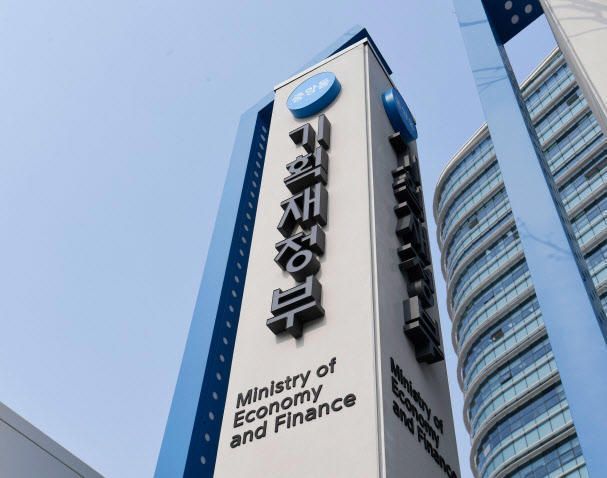
The Democratic Party of Korea, the government, and the presidential office have completely scrapped the previously promoted restructuring of financial authorities, raising concerns about a weakening of the status of the Ministry of Economy and Finance, which is set to launch next year. Initially, the government planned to split the current Ministry of Economy and Finance into the Ministry of Economy and Finance and the Ministry of Planning and Budget. The new Ministry of Economy and Finance was supposed to take over financial policy functions from the Financial Services Commission and serve as the 'economic control tower' overseeing all economic policies. However, with the financial authority restructuring removed from the plan, the new ministry is left with only the roles of overseeing economic policy and taxation.
On September 25, the Ministry of Economy and Finance stated that "the newly established ministry will continue to serve as the economic control tower as a deputy prime minister-level department," but internally, there is a growing sense of frustration, with some saying the ministry has been reduced to "half a department." Many within the ministry believe it has lost much of its capacity to function as the economic control tower.
In practice, the three core tools of economic policy are considered to be budget, taxation, and finance. The Ministry of Economy and Finance now only retains control over taxation. Typically, macroeconomic management is handled through fiscal policy (budget and taxation) and monetary policy (base interest rates, under the jurisdiction of the Bank of Korea), while microeconomic management is carried out through finance and various regulations. The original plan was for the new ministry to oversee both taxation and financial policy, thereby managing overall economic policy. With financial policy excluded, there are inevitable limitations on its ability to coordinate economic affairs.
Internal Frustration: "A Hollowed-Out Organization"
The internal shock within the ministry is significant. Immediately after the announcement, a mid-level official expressed outrage, saying, "How can a matter that already passed the National Assembly's Legislation and Judiciary Committee be overturned like this? Shouldn't we track down those responsible for this outcome? This is too much." Disappointment quickly turned into cynicism. Another official remarked sarcastically, "Should we stage a protest too?" This reaction stems from the belief that the protests and internal solidarity shown by the Financial Services Commission and the Financial Supervisory Service, including demonstrations in front of the National Assembly, influenced the recent decision by the government and ruling party.
There is also a strong undercurrent of resistance. On the ministry's internal bulletin board, "Empathy and Communication," posts criticizing senior officials have been posted in succession. One employee wrote, "Our executives have no sense of mission regarding the organization's role and capabilities, nor any concern for staff," adding, "This stands in stark contrast to the Financial Services Commission executives, who originated from the same ministry but have actively shaped public opinion both internally and externally."
There is also strong dissatisfaction with the ministry's official stance. While the ministry stated it would "strengthen its overall economic policy coordination function and communicate closely with fiscal and financial authorities," employees criticized this as "empty rhetoric with no basis or concrete measures," asking, "How can we strengthen economic policy coordination when both budget and finance have been taken away? The organization has become a hollow shell."
Complaints have also arisen about the lack of sufficient communication with staff during the restructuring process. Typical demands include, "At least hold a staff meeting to explain," and "The minister or vice minister, not just a first-grade official who has resigned, should come out and explain directly." Some pointed out that despite the high level of difficulty and heavy workload, the compensation system is not commensurate. One employee criticized, "Even if we draft the budget and set the direction of economic policy in line with the new government's agenda, we end up just working behind the scenes with no real benefits like organizational expansion or promotion. If budget and financial authority are gone, why would other ministries bother to call us?"
Concerns Over Coordination Between Budget and Financial Policy
Experts also pointed out that the practical influence of the Ministry of Economy and Finance will inevitably be limited. Kang Sungjin, professor of economics at Korea University, said, "The ministry has been a powerful department because it held budgetary authority, but now, with responsibility limited to tax policy, it will be reduced to just another ordinary ministry." He added, "Financial policy should have been consolidated under the ministry, but with this decision, it will be difficult to maintain balance and coordination with financial policy."
An official from an economic research institute predicted, "Going forward, economic stimulus will be handled by the Ministry of Planning and Budget, price stability by the financial and monetary authorities, and the Ministry of Economy and Finance will mainly be responsible for tax policy." A professor of economics, who requested anonymity, commented, "Isn't this decision actually what the administration intended? If financial functions were transferred to the ministry, its authority would become even stronger than when it only had budget control. Ultimately, this can be interpreted as a signal that the presidential office intends to oversee all sectors directly."
Some in political circles also analyzed that there was a desire to keep the ministry's power in check. A ruling party official said, "The ministry has long dominated as a 'super ministry' in charge of both budgeting and taxation. I believe this move serves as a check-and-balance mechanism." However, some cautioned against over-interpreting the decision. Lee Soyoung, a Democratic Party lawmaker on the National Assembly's Planning and Finance Committee, said in a phone interview, "The original direction of government reorganization was reflected in the national policy agenda, and there was a strong will to implement it. The failure to transfer the financial sector was not due to any particular intention."
© The Asia Business Daily(www.asiae.co.kr). All rights reserved.

















