50% Tariff on Kitchen and Bathroom Furniture,
30% on Sofas and Upholstered Items,
25% on Heavy Trucks
President Donald Trump of the United States announced on September 25 (local time) that tariffs will be imposed on pharmaceuticals, furniture, and heavy trucks starting October 1. Previously, Secretary of Commerce Howard Lutnick had promised most-favored-nation treatment for pharmaceuticals, but with the finalization of the Korea-U.S. trade agreement delayed, the tariff imposition deadline is now just five days away.
On this day, President Trump shared the news of the tariff measures through his social media platform, Truth Social.
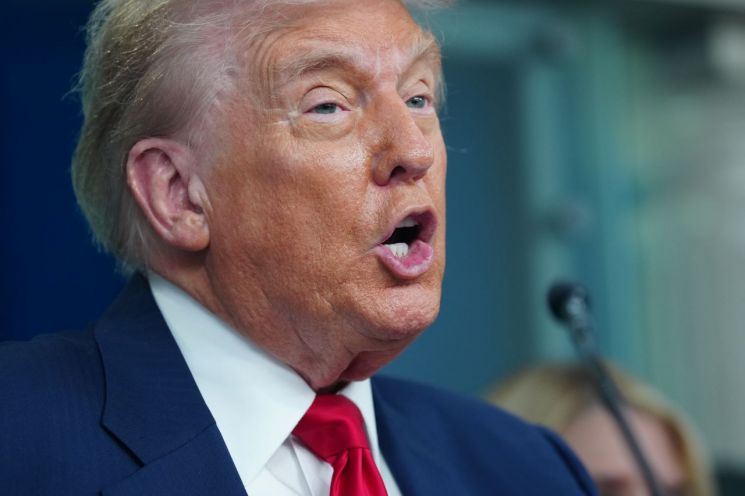
Regarding pharmaceuticals, President Trump stated, "Starting October 1, 2025, a 100% tariff will be imposed on all branded pharmaceuticals (products sold under specific brand names that are copies of original drugs whose patents have expired) or patented pharmaceuticals, except for companies that are building pharmaceutical factories in the United States."
He added, "'Building' is defined as 'breaking ground' and/or 'under construction.' Therefore, if construction has begun, those pharmaceuticals will not be subject to tariffs."
President Trump has repeatedly signaled the pharmaceutical tariffs, recently stating before his state visit to the United Kingdom that higher tariffs could be imposed on high-margin items such as automobiles, semiconductors, and pharmaceuticals, comparing the recently imposed tariffs on these products.
In response, major pharmaceutical companies are rushing to invest in the United States. British pharmaceutical company GSK announced a $30 billion investment over five years in research and development (R&D) and supply chain infrastructure in the United States. American pharmaceutical company Eli Lilly also revealed plans to invest $5 billion to build manufacturing facilities in Virginia. Johnson & Johnson will invest $55 billion in U.S. manufacturing, research, and technology over the next four years, and AstraZeneca plans to invest $50 billion in the United States by 2030.
Additionally, President Trump announced that tariffs will also be imposed on furniture and trucks starting on the 1st of next month. Kitchen cabinets, bathroom vanities, and related products will face a 50% tariff, while upholstered furniture such as sofas will be subject to a 30% tariff. Heavy trucks will be hit with a 25% tariff.
President Trump stated that these furniture products are "flooding" into the country in large quantities from overseas, calling it a highly unfair practice and emphasizing, "We must protect our manufacturing industry for reasons of national security and others."
Heavy trucks will also be subject to a 25% tariff. President Trump said, "Our great heavy truck manufacturers, including Peterbilt, Kenworth, Freightliner, Mack Trucks, and others, will be protected from the onslaught of external interference," adding, "For various reasons, it is necessary for our truck drivers to remain financially sound and robust, but above all, it is essential for national security."
In April, the U.S. Department of Commerce launched an investigation under Section 232 of the Trade Expansion Act to assess the impact of pharmaceutical and medium- and heavy-duty truck and parts imports on national security. In August, it also began an investigation into imported furniture.
Section 232 of the Trade Expansion Act allows the president to restrict imports, including by imposing tariffs, if imports of certain items are deemed to threaten national security. Previous tariffs on steel, aluminum, and automobiles were also imposed under this law.
With President Trump announcing that tariffs will be imposed in just five days, attention is focused on whether the United States will honor the most-favored-nation treatment promised to Korea. At the time of the Korea-U.S. trade agreement on July 30, Secretary Lutnick stated regarding semiconductor and pharmaceutical tariffs, "Korea will not be treated worse than any other country." However, with follow-up negotiations stalled and the finalization of the trade agreement delayed, it remains uncertain whether Secretary Lutnick's promise will be kept once the tariffs take effect.
Meanwhile, with the pharmaceutical investigation under Section 232 of the Trade Expansion Act concluded and tariffs now imposed, there are expectations that semiconductor tariffs may soon follow, as semiconductors were included in the investigation launched in April alongside pharmaceuticals.
© The Asia Business Daily(www.asiae.co.kr). All rights reserved.

















