Disagreement Over U.S. Investment Fund Method as Trump Stresses "Up Front" Payment
WSJ: "Lutnick Requests Increased Investment from South Korea... Negotiations on Shaky Ground"
On the 25th (local time), U.S. President Donald Trump referenced the $350 billion (approximately 493 trillion won) investment fund that South Korea has agreed to invest in the United States, emphasizing, "That is up front." This remark is interpreted as an attempt to pressure South Korea to agree to the terms preferred by the United States by suddenly insisting on an "up front" payment as a precondition for tariff reductions, at a time when negotiations have stalled due to differences between the two countries over how the investment should be implemented.
Amid this, local reports have emerged that the United States has demanded South Korea increase its investment amount, raising concerns that trade negotiations between the two countries may become even more difficult.
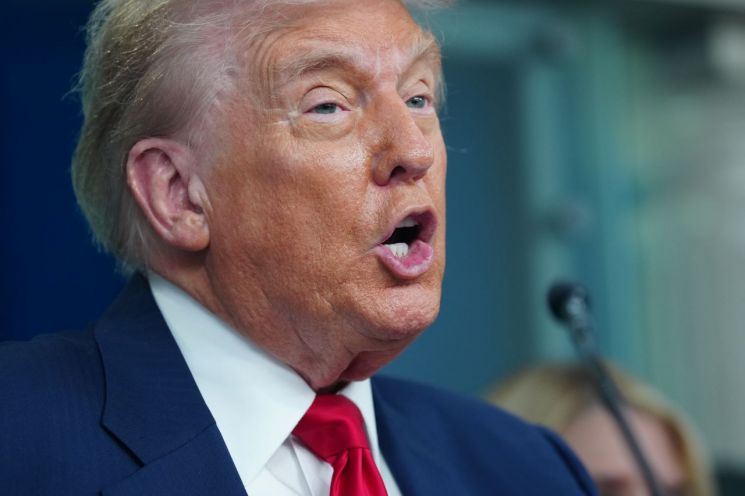
President Trump, after signing an executive order at the White House regarding the sale of the U.S. business rights of the Chinese video platform TikTok, told reporters, "During the past four years under the previous administration of Joe Biden, we were not treated properly by other countries, but now we are doing well. We have never done this well before."
He stated that trade negotiations with several countries, including China, are progressing smoothly, adding, "Tariff revenue is coming in, and new agreements are being signed." He emphasized, "In some cases, $950 billion is coming in."
He went on to mention South Korea and Japan, saying, "As you know, $550 billion is coming in from Japan and $350 billion from South Korea," and reiterated, "This is up front." He stressed, "We are earning enormous amounts of money from tariffs, and it is unprecedented in scale."
The $950 billion referenced by President Trump appears to point to the case of the European Union (EU). Howard Lutnick, the U.S. Secretary of Commerce who led trade agreements with South Korea and Japan, previously revealed plans to use foreign investment funds to establish the U.S. National Economic Security Fund and invest it in rebuilding domestic infrastructure.
President Trump's remarks came at a time when the two countries have failed to narrow their differences over the $350 billion investment fund, a key issue in recent U.S.-South Korea trade negotiations. In particular, his mention of "up front" is seen as a move to increase pressure on South Korea and induce an agreement on investment implementation in the manner desired by the United States.
Previously, at the end of July, the two countries agreed that the United States would lower reciprocal tariffs and automobile tariffs on South Korean imports to 15%, in exchange for South Korea investing $350 billion in the United States. However, regarding the investment method, the United States prefers direct investment, while South Korea favors a guarantee and loan-based investment, leading to conflict. As a result, the United States is still imposing a super-high tariff rate of 25% on South Korean automobiles. In contrast, for automobiles from Japan and the European Union, a 15% reduction in tariffs has been implemented in accordance with trade agreements.
The South Korean government has requested the conclusion of a currency swap agreement with the United States, arguing that a large-scale cash investment could cause shocks to the foreign exchange market. President Lee Jaemyung, who visited New York for the United Nations (UN) General Assembly High-Level Week, also met with U.S. Treasury Secretary Scott Besant the previous day to directly explain the need for a currency swap agreement. However, it is reported that the United States remains negative on the issue.
Meanwhile, The Wall Street Journal (WSJ) reported that Secretary Lutnick has asked South Korea to slightly increase its U.S. investment amount from the previously agreed $350 billion. The outlet highlighted the disagreement between the two countries, stating that "trade negotiations with South Korea are on shaky ground."
© The Asia Business Daily(www.asiae.co.kr). All rights reserved.

















