Presenting the Vision for RCEP 2.0
Emphasizing the Introduction of Clean Economy Norms
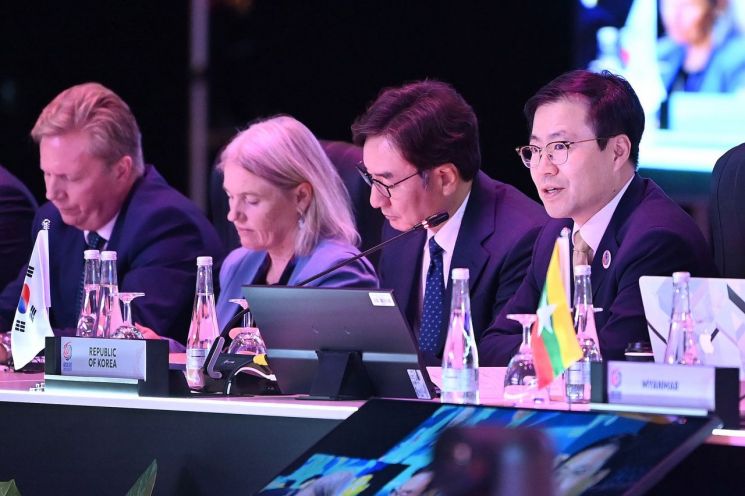
The Ministry of Trade, Industry and Energy announced on September 25 that Yeo Han-koo, the Trade Minister, attended the "Korea-ASEAN Economic Ministers' Meeting" and the "Regional Comprehensive Economic Partnership (RCEP) Ministers' Meeting" held in Kuala Lumpur, Malaysia, from September 24 to 25, where he discussed ways to expand cooperation with ASEAN, a key region for the New Southern Policy.
At the meeting, Minister Yeo outlined the new Korean administration's stance on the New Southern Policy and presented digitalization, supply chains, and climate change as the three main pillars of cooperation. He stated, "The new Korean government will place ASEAN at the center as it expands and develops the New Southern Policy, while also strengthening Korea-ASEAN cooperation for the future, focusing on the three key areas of digitalization, supply chains, and climate change."
Korea and ASEAN agreed to upgrade their Free Trade Agreement (FTA) to cover digitalization, supply chains, and carbon reduction. In particular, Minister Yeo emphasized, based on the results of a joint study, that if new digital norms are established, the scale of digital trade between the two sides could increase by at least 22 billion dollars. He stated, "Through the upgrade of the Korea-ASEAN FTA, we must build a 'digital highway' connecting Korea and ASEAN."
Minister Yeo also introduced five economic cooperation projects, including: ▲ strengthening the Korea-ASEAN think tank dialogue; ▲ the TASK project and standardization/startup cooperation for supply chain collaboration; and ▲ building renewable energy electrical safety infrastructure. As a new initiative, he proposed the "ASEAN Civil Servant Trade Academy," which attracted interest from several member states.
At the RCEP Ministers' Meeting, the participants reviewed the achievements of the agreement in its fourth year since coming into effect and presented the vision for "RCEP 2.0." Minister Yeo proposed the following implementation tasks: ▲ initiating accession procedures for new members such as Hong Kong, Sri Lanka, Chile, and Bangladesh; ▲ introducing digital and clean economy norms; and ▲ transitioning to a negative list approach for service commitments.
In addition, bilateral meetings were held with nine countries, including the United States, the European Union, Japan, Malaysia, Singapore, Australia, New Zealand, and Indonesia. With the United States, follow-up discussions were held on the Korea-US tariff negotiations; with the EU, ways to address export challenges such as the Carbon Border Adjustment Mechanism (CBAM) were explored. With Japan, discussions focused on expanding investment and trade; with Malaysia, the goal was to conclude the Korea-Malaysia FTA within the year and sign a film co-production agreement; and with Singapore, talks centered on improving the FTA with a focus on supply chains, the green economy, and trade facilitation.
© The Asia Business Daily(www.asiae.co.kr). All rights reserved.
![Clutching a Stolen Dior Bag, Saying "I Hate Being Poor but Real"... The Grotesque Con of a "Human Knockoff" [Slate]](https://cwcontent.asiae.co.kr/asiaresize/183/2026021902243444107_1771435474.jpg)















