Sungsoo Kim, CEO of HR Cap, Presents
"Georgia Incident Reveals Limits of Dispatch Practices"
Emphasizes Need for Expanding Localized HR Governance
Calls for Fundamental, Long-Term Solutions
Following the recent detention of Korean personnel in Georgia, United States, experts have advised that Korean companies must establish stable and sustainable human resources systems locally in the U.S. Recommendations include systematically building a visa management system for all employees and expanding a locally centered talent pipeline to enable local staff to take the lead in key work areas.
Sungsoo Kim, CEO of HR Cap, the largest Asian global HR consulting firm in North America and former head of HR for LG Group's Americas headquarters, stated at the "Localization Guide and Total HR Solutions Seminar for Companies Entering the U.S. Market" held on the 25th in the conference room of the Korea Chamber of Commerce and Industry, "Localization strategies are not a choice but a survival strategy, and in the long term, they will become a core pillar of corporate competitiveness."
This seminar was organized in response to the recent detention of Korean personnel in Georgia, United States. It was prepared to provide professional solutions so that Korean companies can establish stable and sustainable human resources systems locally, especially as it has become clear that relying solely on short-term assignments makes it difficult to respond to changes in the local environment. The event was attended by Iljun Park, Executive Vice Chairman of the Korea Chamber of Commerce and Industry, Jongwon Park, Assistant Minister of the Ministry of Trade, Industry and Energy, and over 100 labor and HR managers from various companies.
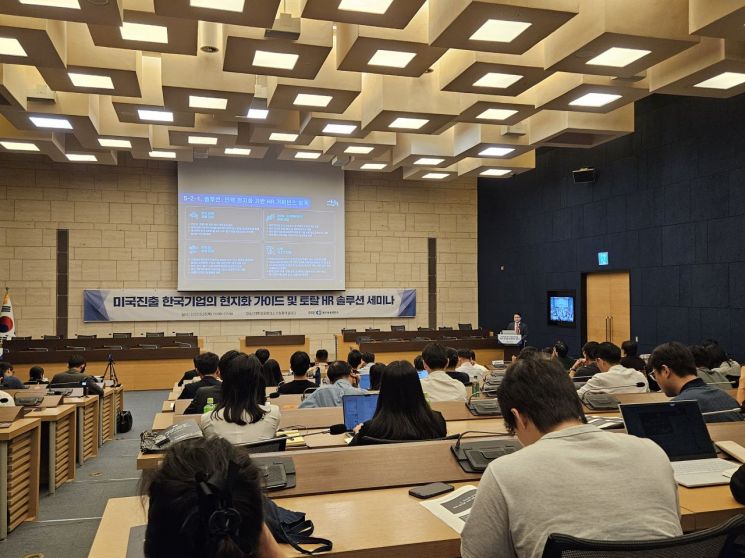 Sungsoo Kim, CEO of HR Cap, the largest Asian global HR consulting firm in North America and former head of HR for LG Group's Americas headquarters, is giving a presentation at the "Localization Guide and Total HR Solutions Seminar for Companies Entering the U.S. Market" held on the 25th at the Korea Chamber of Commerce and Industry's Members' Meeting Room. Photo by Park Joonyi.
Currently, Korean companies operating in the United States are being asked by the U.S. government to expand local employment. Due to the recent visa issues, Korean companies have been unable to hire on-site personnel, resulting in increased employment costs and construction delays.
CEO Kim pointed out, "This situation is not just a simple visa violation; it is a standard example of structural risk caused by a lack of a local talent base combined with a longstanding reliance on short-term staff assignments. The limitations of the dispatch practice have become evident, and with growing attention from local media, politicians, and labor organizations, it is now clear that a model centered on short-term assignments is no longer sustainable."
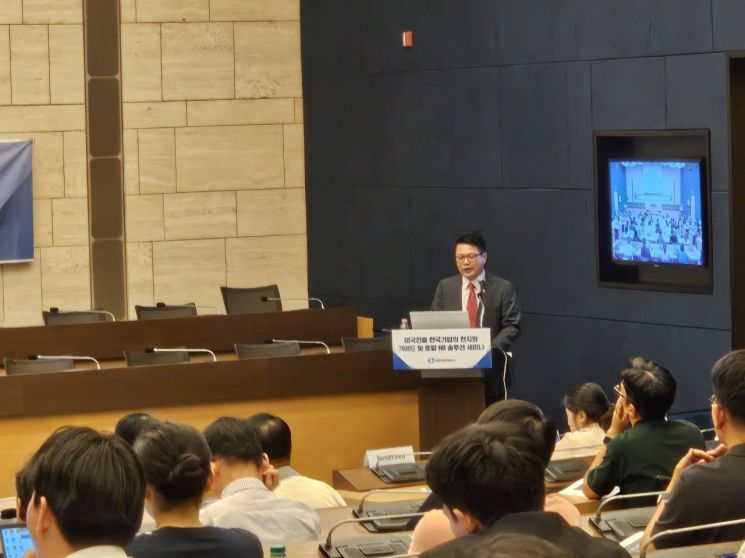 Sungsoo Kim, CEO of HR Cap, the largest Asian global HR consulting firm in North America and former head of HR for LG Group's Americas headquarters, is giving a presentation at the "Localization Guide and Total HR Solutions Seminar for Companies Entering the U.S. Market" held on the 25th in the conference room of the Korea Chamber of Commerce and Industry. Photo by Junyi Park.
To address the immediate problems, Korean companies are taking temporary measures. Both domestic and overseas Korean companies are only approving essential business trips, while the remaining staff are assigned to work online. They are also recommending that employees obtain visas appropriate for their purposes and are strengthening pre-departure training related to visas.
CEO Kim advised that more fundamental solutions are needed. He particularly emphasized the need for a local talent pipeline and a management system for crisis response. In the short term, stabilization through pre-departure visa training and interview management is necessary, while in the long term, companies should transition to 'localized HR governance' by fostering local hires and establishing dedicated teams for key work areas.
He stated, "Seventy to ninety percent of companies fail in overseas expansion due to a lack of preparation for localization. Twenty percent fail within the first year, and less than fifty percent last beyond five years. Many companies end up returning home after failing within five years."
He also stressed the importance of securing independent operational capabilities based on local resources. Specifically, he suggested: ▲ establishing a systematic visa management system ▲ securing HR governance based on localization ▲ setting up risk management and response systems.
Compliance management, including visa management and adherence to labor laws and regulations, was highlighted as an urgent task. In practice, various visas such as E-2 (investor), L-1 (intra-company transferee), H-1B (specialty occupation), and B1/ESTA (short-term visit) are used depending on the employee’s role and length of stay. Since requirements and approval procedures differ, risks can accumulate without systematic management.
He advised that, first, companies should use data management to verify employee identities during recruitment to preemptively block risks. He also recommended diversifying visa acquisition channels to disperse risk, and at the contract stage with partners, clarifying the division of legal responsibilities and compliance obligations to minimize risks borne by the main contractor. Specifically, he emphasized the need to build an HR management dashboard and visa tracking system that manages the visa status, stay details, and project schedules of all employees, including those from partner companies, in real time.
To establish a local hiring system, he suggested that, initially, headquarters expatriates should be responsible for technology transfer, while operations, legal compliance, and external relations should transition to local leadership-a "dual leadership model." He also explained that companies should develop a localization operations manual covering recruitment, evaluation, compensation, and labor risk response. In the first six months, the focus should be on stabilization; from six to twenty-four months, companies should expand the proportion of local staff, collaborate with educational institutions to foster key local talent, and internalize data-driven HR systems.
© The Asia Business Daily(www.asiae.co.kr). All rights reserved.
![Clutching a Stolen Dior Bag, Saying "I Hate Being Poor but Real"... The Grotesque Con of a "Human Knockoff" [Slate]](https://cwcontent.asiae.co.kr/asiaresize/183/2026021902243444107_1771435474.jpg)
















