Record R&D Budget for SMEs and Startups Next Year
Shift Toward Sales and Investment-Driven Results
Enhanced Full-Cycle Support from Startup to Global Expansion
The Ministry of SMEs and Startups is restructuring its support system for SME research and development (R&D) based on "profitable R&D." The ministry is shifting its policies away from focusing on papers and patents, instead prioritizing marketability and business potential, with a strategy to enhance global competitiveness through full-cycle support.
On September 25, the Ministry held a "SME & Startup R&D Innovation Plan Meeting" at Endorobotics in Jongno-gu, Seoul, where it shared its R&D project plans for next year.
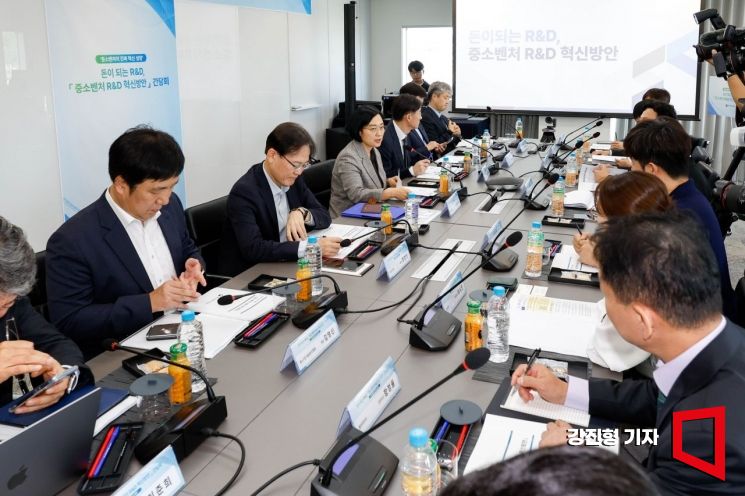 Sung Sook Han, Minister of SMEs and Startups, is delivering opening remarks at the 'SME & Startup R&D Innovation Plan Announcement and Meeting' held on the 25th at Endorobotics in Jongno-gu, Seoul. Photo by Jin Hyung Kang
The R&D budget for SMEs and startups next year has been set at a record-high 2.2 trillion won. The vision is to foster "SMEs that can respond quickly to the market" by strengthening tailored support at each stage, from early startup to scaling up and global expansion.
Minister Sung Sook Han emphasized, "SME and startup R&D will be restructured to focus on marketability and business potential," adding, "We will drive innovation not with papers and patents, but by centering on technologies that sell well in the market and are attractive to investors."
At the event, various suggestions were raised by companies and related organizations. Jungyul Ham, Executive Director at Ultra V, said, "For medical devices, there are cases where public certification cannot be completed within the required period due to institutional circumstances. Currently, the extension is limited to three months, but we hope this can be made more flexible."
Dong Eun Seo, CEO of Repla, stated, "The simplification of the application submission process is very positive," and added, "There are often redundant items in the documents we submit, so we hope further streamlining will be considered."
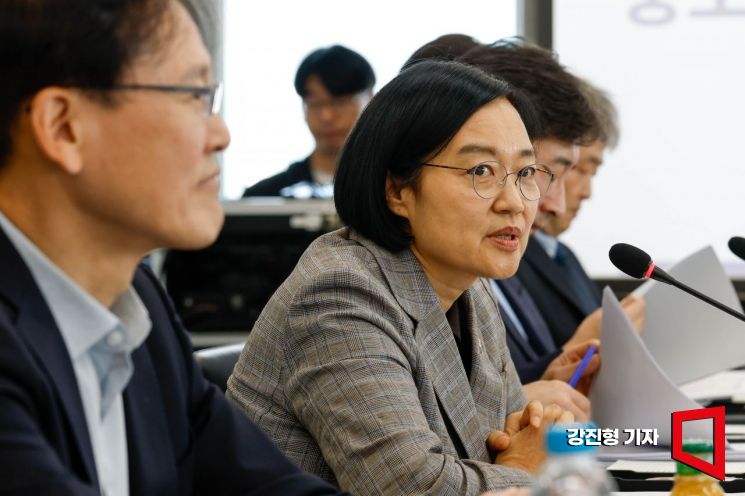 Hansung Sook, Minister of SMEs and Startups, is delivering opening remarks at the "SME and Startup R&D Innovation Plan Presentation and Meeting" held on the 25th at Endorobotics in Jongno-gu, Seoul. Photo by Kang Jinhyung
Sang Woo Han, Chairperson of the Korea Startup Forum, pointed out, "The biggest concern for entrepreneurs hesitant to participate in R&D support programs is the risk of technology leakage," and emphasized, "Protection measures are needed, considering that companies' core assets may be exposed during the evaluation process."
Of next year's 2.2 trillion won R&D budget, the ministry has allocated 1.1064 trillion won to the TIPS (Tech Incubator Program for Startup) R&D program. A notable feature is the expansion from a focus on startup support to full-cycle growth support, including scaling up and global expansion.
The ministry will also introduce a "Korean-style STTR" program to connect public technologies from universities and government-funded research institutes with SME revenue generation. A three-stage support system will be established: first, technology and marketability will be verified; second, R&D projects with outstanding results will receive tailored follow-up support such as investment, financing, exports, and marketing; and third, commercialization will be promoted.
Industries that are strategically important to the nation, such as regional key industries, artificial intelligence (AI), bio, and carbon neutrality, will have separate support tracks. Specifically, 96.9 billion won will be allocated to regional key industry development, 45 billion won to the adoption and expansion of AI by SMEs, and 11.8 billion won to collaborative joint R&D between bio-AI ventures and pharmaceutical companies.
The ministry has also reduced the burden on companies by minimizing document submission at the application stage and switching to a system where information is verified afterward through the administrative information network.
Minister Han stated, "It is important to create a virtuous cycle where the technological capabilities of outstanding companies are valued in the market and these achievements are reinvested in R&D," adding, "We will actively reflect feedback from the field in our policies to build an ecosystem of 'profitable R&D.'"
© The Asia Business Daily(www.asiae.co.kr). All rights reserved.
![Clutching a Stolen Dior Bag, Saying "I Hate Being Poor but Real"... The Grotesque Con of a "Human Knockoff" [Slate]](https://cwcontent.asiae.co.kr/asiaresize/183/2026021902243444107_1771435474.jpg)
















