One-Year Average Return of 12% Across 25 Didim Funds
Stable Returns Aligned with Medium-Risk, Medium-Return Strategy
Limited Sales Channels and Lack of Differentiation Remain Challenges
As Didim Fund marks its first anniversary, it is being evaluated as having successfully established itself in the market, thanks to stable returns and a steady increase in assets under management. However, the limited number of sales channels and the lack of differentiation compared to Target Date Funds (TDFs) have been cited as areas needing improvement.
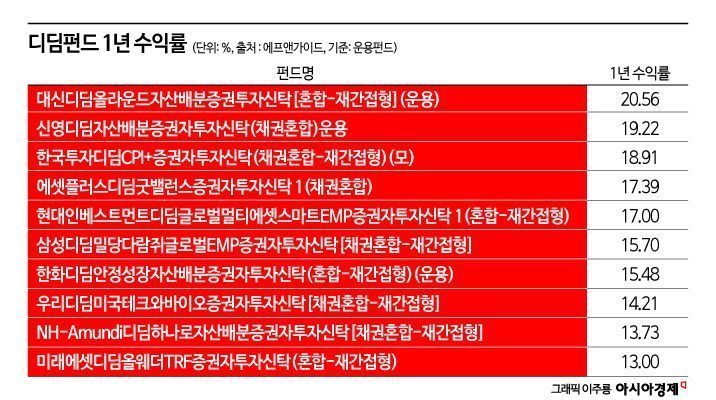
According to FnGuide on September 26, as of September 24, the one-year return for 25 Didim Funds (based on managed funds) was 12.46%. Among individual funds, Daishin Asset Management’s Daishin Didim All Round posted the highest return at 20.56%. This was followed by Shinyoung Asset Management’s Shinyoung Didim Asset Allocation at 19.22%, and Korea Investment Management’s Korea Investment Didim CPI+ at 18.91%. Additionally, Asset Plus Asset Management’s Asset Plus Didim Good Balance and Hyundai Investment Asset Management’s Hyundai Investment Didim Global Multi-Asset Smart EMP recorded returns of 17.39% and 17.00%, respectively.
While these returns are lower than the over 40% rise in the KOSPI this year, they are still considered favorable given the purpose of Didim Fund. Didim Fund is designed to invest in a diversified portfolio of assets such as stocks and bonds to ensure stability while aiming for higher returns than savings and installment deposits-pursuing a “medium-risk, medium-return” profile. It is a type of balanced fund (BF) focused on asset allocation. By maintaining the proportion of risk assets within a certain range, it can adjust asset allocation according to market conditions and changes in asset value.
Assets under management have also steadily increased, with the total amount reaching 226.3 billion won. Since the beginning of the year, assets have grown by 86.8 billion won, and over the past year, by 146.9 billion won. The fund with the largest increase in assets was Shinhan Asset Management’s Shinhan Didim Global EMP, which grew by 35.2 billion won over the past year to reach 39.5 billion won. This was followed by Samsung Didim Mildang Squirrel (28.2 billion won), Heungkuk Asset Management’s Heungkuk Didim Pension Plus (22.3 billion won), and Hyundai Investment Didim (21.3 billion won). On the other hand, some funds had assets under management of less than 1 billion won, including Midas Asset Management (260 million won), Asset Plus Asset Management (230 million won), Hana Asset Management (130 million won), and IBK Asset Management (110 million won).
The financial investment industry has positively evaluated Didim Fund for providing investors with a wider range of choices. An official from an asset management firm stated, “With the participation of many management companies, customers now have more sound options for asset allocation investments. As these funds are mainly operated with retirement pension funds, the focus has been on avoiding losses, which has resulted in solid performance.”
Another official explained, “At the association level, we created funds that use common keywords. The emergence of a sort of league of risk-neutral asset allocation funds has drawn attention, which is a positive development.”
However, there are still areas that need improvement. The first is the expansion of sales channels. Since its launch, Didim Fund has faced criticism for its limited sales outlets. Even after a year, aside from a few management firms affiliated with banks, most sales are still conducted through securities firms. Additionally, the lack of significant differentiation from existing retirement pension products is seen as a drawback. Another asset management official commented, “It is unfortunate that awareness remains low and that the default option and sales channel lineup are insufficient. Apart from the tax benefits for pension accounts, there are no additional advantages, and there is no clear distinction from TDFs or other asset allocation funds.”
Despite these remaining areas for improvement, the industry expects the growth of Didim Fund to continue. The official added, “Didim Fund has the advantage of being flexibly managed within a 50% risk asset limit according to market conditions. If it builds a solid track record and is gradually selected for defined benefit (DB) plans or as a default option, it could become well established in the pension market.”
© The Asia Business Daily(www.asiae.co.kr). All rights reserved.
![Clutching a Stolen Dior Bag, Saying "I Hate Being Poor but Real"... The Grotesque Con of a "Human Knockoff" [Slate]](https://cwcontent.asiae.co.kr/asiaresize/183/2026021902243444107_1771435474.jpg)
















